
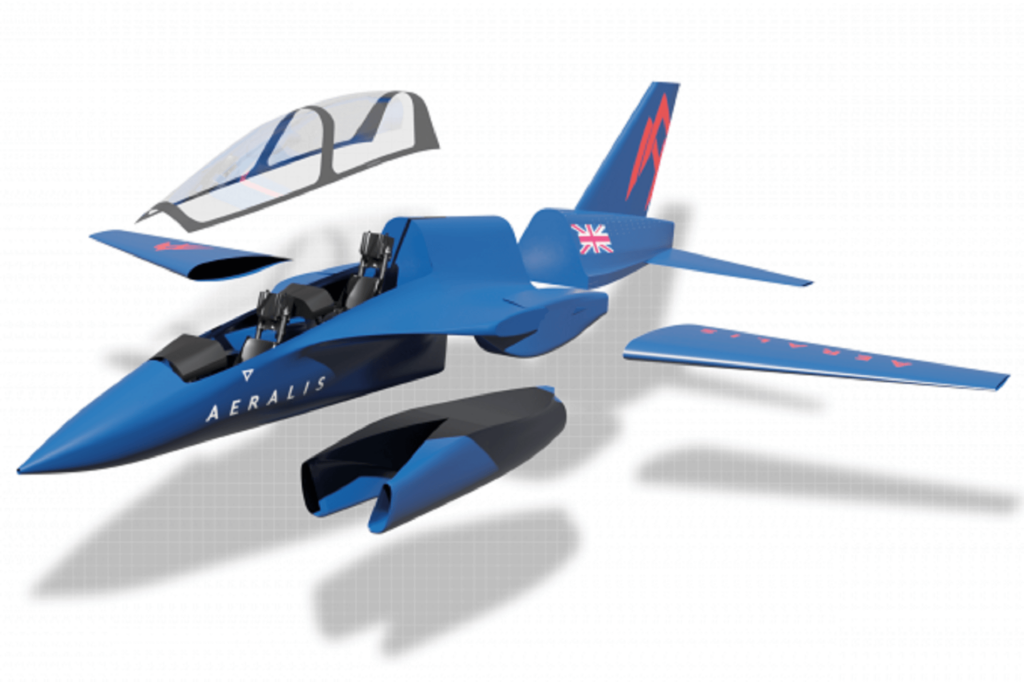
Aeralis, a British startup developing a modular advanced jet trainer, entered administration on May 14, 2026, as its main financial backer withdrew funding and the UK government’s long-delayed defense spending plan continued to stall. Around 30 jobs have been lost.
David Buchler and Joanne Milner of Buchler Phillips were appointed joint administrators. In a statement, they attributed the collapse to “a sustained period of pressure” on the company’s cash flow, caused by “continued delays to the UK Defence Investment Plan, combined with geopolitical factors affecting sources of funding”.
Qatari backer pulls out
Those geopolitical factors centered on Barzan Holdings, the strategic investment and procurement arm of Qatar’s Ministry of Defence, which had been Aeralis’ primary backer since 2021, when it injected £10.5 million into the company. Barzan subsequently advanced a £5 million convertible loan in 2023 and, as recently as early May 2026, converted part of that debt into equity, raising its stake in Aeralis from 17.4% to 24.9%.
An early sign of trouble came around the same time, when Omar Fahad Alqadi, Barzan’s chief commercial officer and an Aeralis board director since September 2025, resigned from the company’s board, according to UK Companies House filings. Administration followed just over two weeks later.
According to BBC News, Barzan withdrew support amid the broader financial strain on Gulf states caused by Operation Epic Fury and disruption to Strait of Hormuz traffic.
Aeralis chairman Robin Southwell said that the board had taken the decision “after careful consideration of the company’s position and the funding challenges it has faced over recent months”.
Modular concept, ambitions in the UK and France
Founded in London, Aeralis had been developing the Dart, an Advanced Jet Trainer concept built around a common fuselage that could be reconfigured into basic and advanced training variants by swapping wings and engines.
The company claimed that keeping 85% of components common across variants could reduce fleet ownership costs by 30%. However, the aircraft exists only as digital designs and has not yet flown.
Aeralis had positioned itself as the only British firm capable of supplying an advanced jet trainer designed and built in the UK, targeting the RAF’s requirement to replace its aging Hawk fleet, including the Hawk T1 aircraft operated by the Red Arrows aerobatic display team.

The company had also established a French subsidiary in 2025, with ambitions to offer the Dart as a replacement for the French Air and Space Force Alpha Jet and to pitch a carrier-capable variant to the French Navy.
The RAF first provided Aeralis with a £200,000 grant through its Rapid Capabilities Office in 2021, an early public endorsement that never translated into a formal contract.
The UK’s Defence Investment Plan, intended to translate the June 2025 Strategic Defence Review into funded program commitments, had been promised for “Autumn” 2025, but has yet to be published. Its absence has left multiple procurement decisions, including the advanced jet trainer competition, formally unresolved.
Competitors and next steps
The RAF trainer requirement has attracted several established alternatives. BAE Systems, Boeing, and Saab are jointly proposing a UK-assembled variant of the T-7 Red Hawk, while Leonardo’s M-346 has also been cited as a candidate.
The UK Ministry of Defence declared that the fast jet trainer procurement process remains ongoing and that no final decisions have been made.
Administrators have said that they will work with management and stakeholders to assess strategic options, “including opportunities to secure investment, preserve value and support the continuation of the Aeralis program in an alternative structure”. The company’s digital engineering work and intellectual property may be of interest to third parties.