
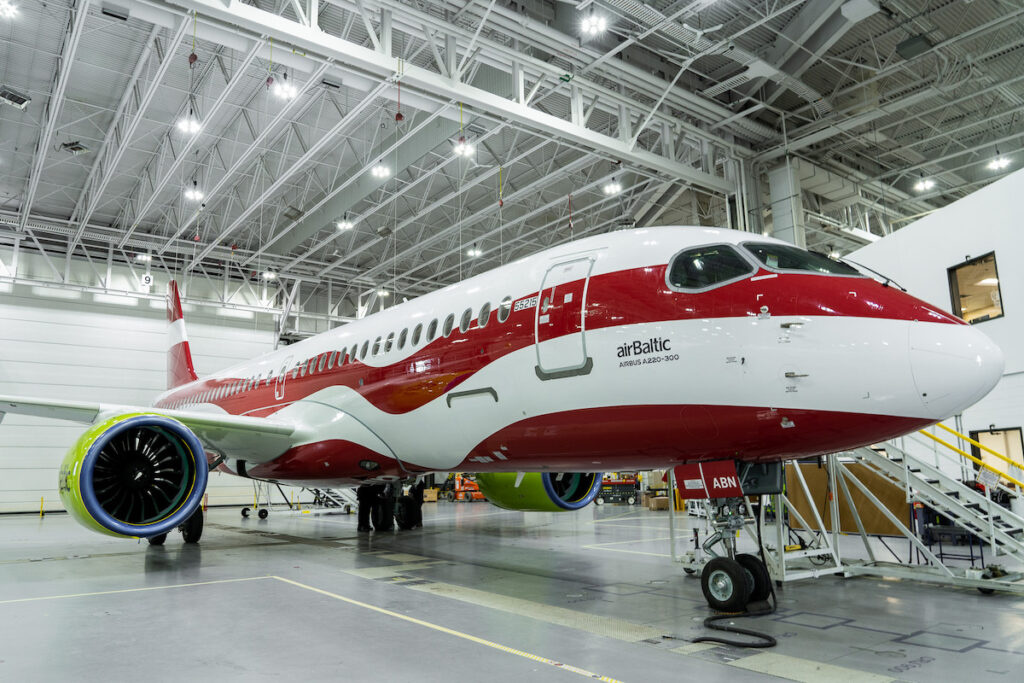
airBaltic has set a new course prioritizing “financial stability first, growth second” in a bid to secure its long-term future and competitiveness.
On August 11, 2026, airBaltic confirmed that the Supervisory Working Group had approved its business plan that will see the airline cut its fleet size and seek $259 million (€225 million) of interim financing.
The Supervisory Working Group was established by Lativia’s Ministry of Finance on December 16, 2025, following airBaltic’s financial results, on November 20, 2025.
The Lavian flag carrier was required to develop a completely new strategy and business plan to ensure its sustainability without regular state financial involvement.
airBaltic cuts fleet to 36 aircraft
The new plan includes a more focused network centered around Riga, a reduced all-Airbus A220-300 fleet, stronger year-round ACMI partnerships, and improved operational efficiency.
“Rather than pursuing broad expansion, airBaltic will focus on deepening its presence in existing markets by increasing depth and frequency where demand and profitability are strongest,” the airline said in a statement.
By the end of 2026, airBaltic expects to reduce its fleet of 54 Airbus A220-300s down to 36, with a plan to gradually increase this to around 40 aircraft by 2031.

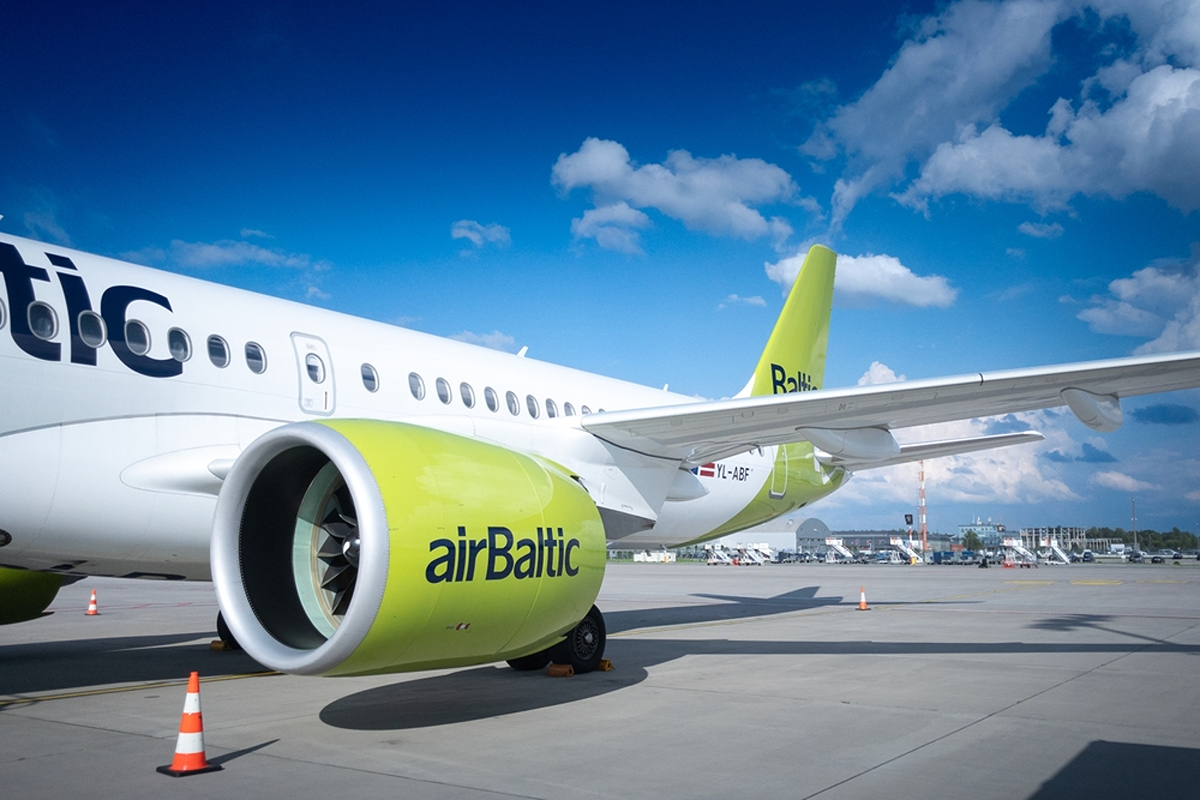
“Despite the smaller fleet, scheduled capacity is expected to remain broadly stable through improved aircraft utilization,” the airline added. “Moreover, enhanced commercial partnerships with ACMI partners will enable more efficient year-round aircraft deployment while reducing seasonal volatility across the business.”
The previous strategy airBaltic followed was developed in preparation for the planned initial public offering (IPO) with growth central to the plan as well as a larger fleet of 100 aircraft.
Why airBaltic needed a new strategy
The revised business plan responds to a difficult operating environment where the carrier suffered from developments in Ukraine and the Middle East and Pratt & Whitney engine availability constraints.


“Every successful airline must continuously adapt to a changing market,” Erno Hildén, CEO of airBaltic said. “Thus, this business plan is about making disciplined choices that strengthen airBaltic’s long-term competitiveness while preserving what matters most – reliable connectivity and operations, together with financial sustainability. It provides a stronger foundation for the company’s future and positions us to create long-term value for our customers, partners and Latvia.”
airBaltic seeks €225 million in interim financing
To bridge the company to a permanent solution airBaltic is also seeking $259 million (€225 million) of interim financing and $115 million (€100 million) of new equity capital.
“The proposed recapitalization also contemplates partial equitization of the 2029 Senior Secured Notes, with the remaining portion replaced by new, reduced debt of up to EUR 125 million, as well as partial equitization of selected other balance-sheet obligations,” airBaltic explained.
Essentially, airBaltic is proposing to turn some of its debt into ownership of the company, while reducing the rest of its debt to as much as $144 million (€125 million).
Some parts of the proposed recapitalization remain subject to the required approvals.
“Under the revised business plan, airBaltic expects revenue to reach approximately EUR 0.8 billion in 2027, increasing to EUR 0.9 billion in 2029 and EUR 1.0 billion by 2031,” airBaltic added.
Holders of airBaltic’s 2029 Senior Secured Notes are encouraged to take part in votes on the proposed recapitalization and new business plan.
The first is on August 17, 2026, with further voting rounds expected to follow.