
Airbus reported lower commercial aircraft deliveries and sharply reduced profit for the first quarter of 2026 on April 28, 2026, with engine supply constraints continuing to weigh on the A320 family ramp-up, while a near-doubling of defense orders supported group-level results.
Airbus delivered 114 commercial aircraft between January and March 2026, down from 136 in the same period of 2025. The mix included 19 A220s, 81 A320 family aircraft, three A330s and 11 A350s.
Group revenues fell 7% year-on-year to €12.7 billion, while EBIT adjusted dropped 52% to €300 million. Reported EBIT came in at €224 million and earnings per share at €0.74, against €1.01 a year earlier.
Airbus attributed the swing to lower delivery volume, on top of an inventory buildup tied to the production ramp-up across its programs. The group’s net cash position fell to €9.8 billion at the end of March 2026, from €12.2 billion at the end of December 2025.
Despite the soft start, Airbus reaffirmed its full-year 2026 guidance of around 870 commercial aircraft deliveries, EBIT Adjusted of around €7.5 billion, and free cash flow before customer financing of around €4.5 billion. The trajectory mirrors the pattern seen in 2025, when first-quarter deliveries totaled 136 aircraft, and the company ultimately delivered 793 aircraft for the year.
CEO Guillaume Faury said the operating environment remained “dynamic and complex” and acknowledged that the company was watching developments in the Middle East. He pointed to the ongoing shortage of Pratt & Whitney engines as the main constraint on commercial output, while highlighting solid momentum at the Defence and Space division.
Engine shortage continues to pace the A320 ramp-up
Pratt & Whitney’s inability to meet engine deliveries for the A320neo family powered by geared turbofans remains the dominant industrial issue for Airbus. The manufacturer still expects to reach a monthly production rate of between 70 and 75 A320 family aircraft by the end of 2027, stabilizing at a rate of 75 thereafter, the same trajectory it had outlined alongside its full-year 2025 results in February 2026.
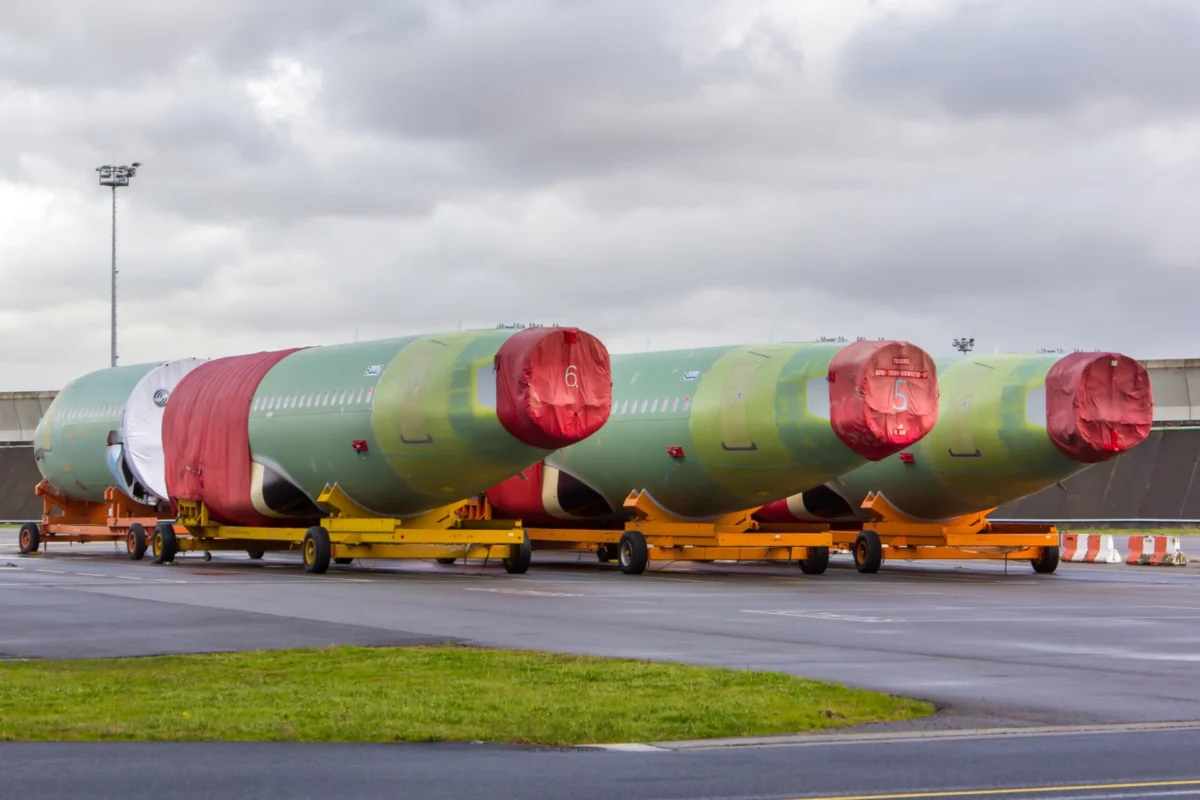
The constraint has been a recurring feature of Airbus’ commercial reporting throughout 2024 and 2025, with parked, engineless airframes accumulating outside final assembly lines and pushing deliveries into the back end of each year.
EBIT adjusted from commercial aircraft activities collapsed to €81 million from €494 million in the first quarter of 2025, hit by the weaker delivery volume and an unfavorable hedge rate as the US dollar weakened against the euro. The dollar dynamic also drove a €42 million negative adjustment between EBIT (reported) and EBIT Adjusted, reflecting the working capital and balance sheet revaluation tied to the timing gap between transaction and delivery dates.
Other ramp-up targets were left unchanged. Airbus continues to aim for a monthly rate of 13 A220s in 2028, 12 A350s in 2028, and five A330s in 2029. The A220 program is still paced by the integration of Spirit AeroSystems work packages, with Airbus having completed its takeover of Spirit’s A220 and A350 industrial assets in December 2025. The integration drove an additional €32 million negative adjustment in the first-quarter accounts.
Defence and Space division pulls weight as orders nearly double
The defense side of the business provided the clearest bright spot in the quarter. Airbus Defence and Space booked €5.0 billion of net order intake by value, almost double the €2.6 billion recorded in the first quarter of 2025. The company attributed the increase mainly to its Air Power business unit, which covers fighter aircraft, military transports, mission aircraft, and unmanned systems.
Divisional revenues rose 7% year-on-year to €2.8 billion, and EBIT Adjusted reached €130 million, up from €77 million in the same period of 2025, with Airbus citing better profitability across all of the division’s business units.
Faury said the focus on the defense side remained on serving global demand and ramping up production across the portfolio.
Airbus Helicopters delivered 56 rotorcraft in the quarter, up from 51 a year earlier, and registered 79 net orders against 100 in the first quarter of 2025. Revenues at the rotorcraft division held flat at €1.6 billion, while EBIT Adjusted slipped to €65 million from €78 million on a less favorable delivery mix and higher research and development spending.
Backlog stays at record highs
Gross commercial aircraft orders reached 408 in the quarter, with 398 net orders after cancellations. The backlog stood at 9,037 aircraft at the end of March 2026, up from 8,726 a year earlier and slightly above the 8,754 figure that closed 2025. Airbus Helicopters’ backlog rose to 1,060 units from 942 a year earlier.
Self-financed research and development spending edged up 8% year-on-year to €730 million, reflecting continued investment across commercial, defense, and helicopter programs. Group headcount stood at 166,876 at the end of March 2026, up about 1,500 from year-end 2025, partly driven by the absorption of former Spirit AeroSystems employees onto Airbus payroll.
Airbus said its 2026 guidance assumes no further disruption to global trade, the world economy, air traffic, the supply chain, or its internal operations, and includes the impact of currently applicable tariffs. M&A activity is excluded from the outlook. The company will host its analyst conference call later on April 28, 2026.