
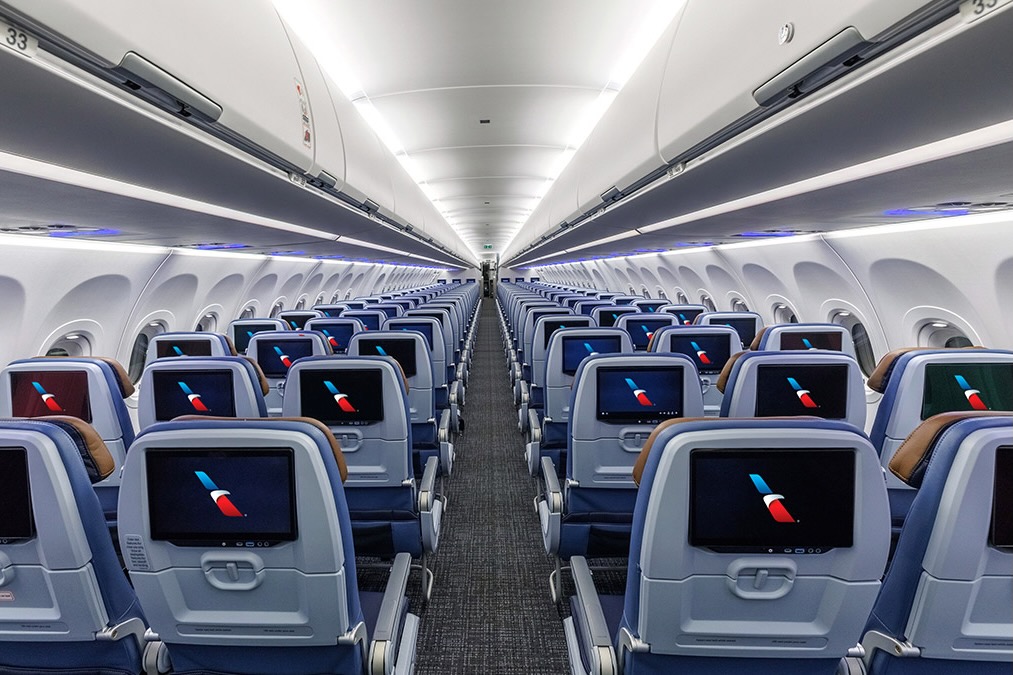
American Airlines is reversing a nearly decade-old strategy of relying on passengers’ personal devices for inflight entertainment, announcing plans to install seatback screens throughout its narrowbody fleet as it works to close the gap with Delta Air Lines and United Airlines.
The airline said on August 18, 2026, that it will install screens at every seat on more than 800 narrowbody aircraft. New Airbus and Boeing aircraft will begin arriving with the screens in 2028, when American will also start retrofitting aircraft already in its fleet. The work is expected to continue into the early 2030s.
The move represents a significant change in direction for American. In 2017, the airline decided against installing seatback screens on its incoming Boeing 737 MAX aircraft, reasoning that most passengers were already bringing smartphones, tablets and laptops onboard. American instead invested in streaming entertainment and faster inflight internet that allowed passengers to watch content on their own devices.
At the time, American said more than 90% of its passengers brought their own screens when they flew and predicted that installed monitors could quickly become obsolete. The approach also avoided the cost and weight associated with installing entertainment systems.
Delta took a different approach and continued investing in seatback entertainment, while United has increasingly added screens as part of upgrades to its narrowbody cabins.
American now says customer preferences have changed. The airline pointed in particular to younger travelers who increasingly use multiple screens at the same time and said advances in technology have made the latest entertainment systems lighter and more capable.
The new systems will include 4K displays with Bluetooth connectivity, USB-C fast charging and interactive flight maps. Premium seats will receive larger displays.
American is also moving ahead with Starlink high-speed Wi-Fi, giving passengers the option of using their own connected devices even after seatback screens return.
The cabin overhaul comes as American faces pressure to improve its financial performance relative to Delta and United. American expects to finish 2026 around break-even, while its two largest US rivals are forecasting solid profits. American CEO Robert Isom has acknowledged the performance gap as the airline works to improve profitability.
American also plans to substantially increase the number of premium seats on its narrowbody aircraft. Premium seating will grow from about 25% to roughly 40% of narrowbody capacity over the next several years, including additional First Class and Main Cabin Extra seats.
Premium passengers accounted for nearly half of American’s ticket revenue during the second quarter, according to Reuters, making higher-paying travelers an increasingly important part of the airline’s strategy.
American did not disclose how much the cabin overhaul will cost. The airline already offers seatback entertainment on its long-haul aircraft.