
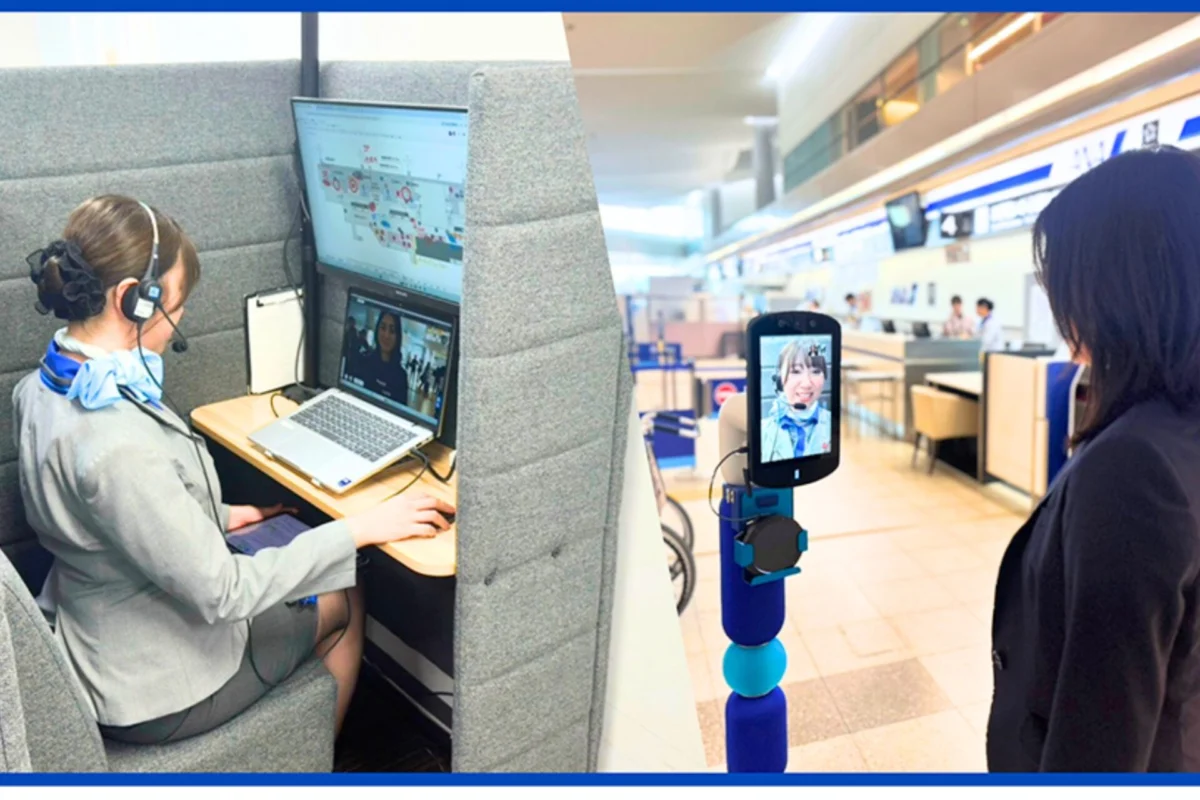
All Nippon Airways (ANA) announced that it will begin rolling out remote passenger support across multiple regional airports in Japan starting August 21, 2026, in partnership with avatarin, a Tokyo-based AI and robotics startup.
The service will use what the airline calls “newme” robots operated centrally from Kansai International Airport (KIX), making ANA the first Japanese airline to launch this kind of inter-airport remote support system.
Under the new setup, staff based at Kansai International Airport will assist travelers at regional airports through the “newme” robots, rather than requiring on-site personnel at every location.
ANA said the approach builds on extensive testing conducted at Haneda Airport (HND), where researchers analyzed more than 25,000 customer interactions and found that the vast majority of passenger questions, 98.4%, could be resolved remotely with the same quality as in-person service.
Behind the move: data, efficiency, and shorter wait times
ANA said the initiative is part of its broader mid-term strategy to blend human hospitality with digital technology.
By centralizing remote support, the airline will be able to collect and analyze passenger inquiry patterns at regional airports for the first time, data it says will help drive ongoing improvements to its customer support.
The system is designed to reduce wait times for travelers, particularly during off-peak hours or when on-site staffing is limited between flights, by giving passengers access to immediate assistance through the robots regardless of how busy a particular airport is at any given moment.
ANA said it will evaluate the program’s effect on customer satisfaction and operational performance before deciding whether to expand the service to additional airports.
Japan leans on robots as its workforce shrinks
ANA’s move reflects a broader shift happening across Japan, where robotics and artificial intelligence are increasingly being used to offset a shrinking workforce.
According to a June 2026 analysis published by the Observer Research Foundation, roughly 30% of Japan’s population is now 65 or older, and the country has one of the lowest fertility rates in the world, a demographic reality that has sharply reduced the working-age population and strained industries reliant on labor.
In response, Japan has leaned heavily on automation, with companies like Fanuc and SoftBank Robotics integrating AI-driven systems into manufacturing, services, and increasingly, caregiving.
The same report noted that Japan’s approach emphasizes augmentation, using AI and robotics to extend human productivity rather than replace it entirely, an approach reflected in ANA’s own framing of its robot rollout as a way to combine “cutting-edge technology with human expertise” rather than eliminate staff altogether.