
Amir Lezer is Chief Security Officer at Avia Solutions Group, with three decades of experience in aviation security, intelligence, investigations, and enterprise risk management. His career includes service as an air marshal and aviation security manager in government service, and senior security leadership roles in multinational organizations.
The views and opinions expressed in this column are solely those of the author and do not necessarily reflect the official policy or position of Avia Solutions Group or AeroTime.
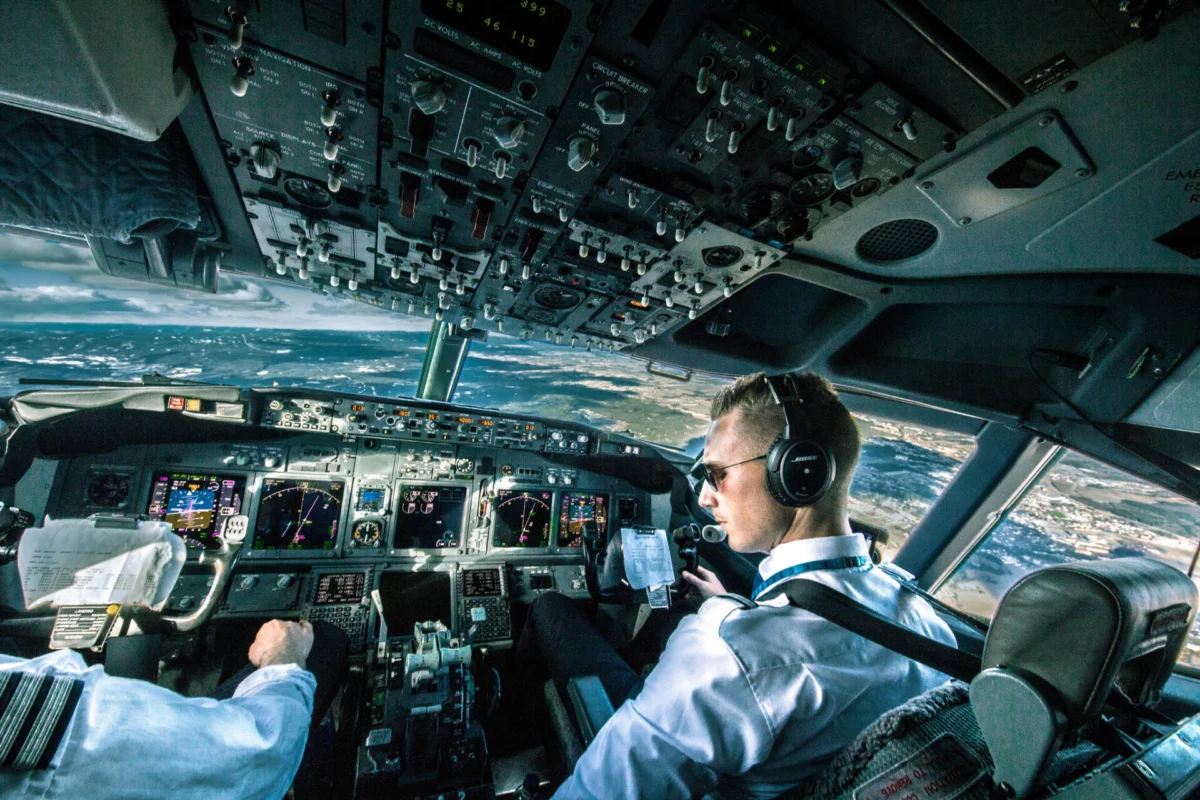
On September 30, 2026, a passenger flight from Dubai to Tel Aviv diverted to Saudi Arabia after a violent struggle on the flight deck. According to the UAE attorney general, the co-pilot had begun carrying out a planned terrorist attack: to take control of the aircraft and fly it into the passenger terminal at Ben Gurion Airport. The aircraft lost thousands of feet before the captain, wounded in the attack, managed in an act of real courage to open the cockpit door. Passengers forced their way in, restrained the co-pilot and helped stabilize the aircraft, which then landed safely.
The alleged attacker did not slip past a screening checkpoint. He was a licensed pilot, sitting in the cockpit with every right to be there. After three decades in aviation security, including years as an air marshal, I believe this is the question our industry must now answer:
For 25 years we have worked to keep threats out of the cockpit. Are we prepared for one that is already inside it?
How fast 9/11 changed everything
Until 2001, aviation security was built around a familiar scenario: hijackers seized aircraft and made demands. Crews were taught to accommodate them and get the aircraft safely on the ground. As the 9/11 Commission found, the protocols in place that morning assumed a traditional hijacking, not a suicide hijacking designed to turn the aircraft into a guided missile.
The response was almost immediate. On September 11, 2001, the US Federal Air Marshal Service had just 33 officers in service; within months, it had thousands. Ten weeks after the attacks, Congress created the Transportation Security Administration. By November 2003, the International Civil Aviation Organization (ICAO) required reinforced cockpit doors on larger passenger aircraft worldwide.
I remember that day vividly. Like many in my profession, I understood within hours that aviation security would never be the same. In the months that followed, the experience of countries that already ran in-flight security programs became something the rest of the world wanted to learn from.
The scale of the change matched the scale of the disaster. That is how our industry tends to move: decisively, but after the event. A security system can become highly effective against the threat it was designed for, while staying blind to one that challenges its basic assumptions. That is why a threat assessment is never a finished document.
The insider threat is not new
The September attack is not the first warning. In 2016, surveillance footage released by Somali authorities appeared to show airport workers handing a laptop bomb to a passenger who had already cleared security; it blew a hole in a Daallo Airlines aircraft after takeoff from Mogadishu. In 2015, a Germanwings co-pilot locked the captain out of the cockpit and deliberately crashed into the French Alps, killing all 150 people on board. The motive was not terrorism, but the vulnerability was the same: the reinforced door built to keep attackers out kept the captain out instead.
The September attack combined a terrorist motive, a trusted insider and, according to the attorney general, inspiration drawn from the 2001 attacks. It was stopped on board, by a wounded captain and by passengers who stormed the cockpit, not by any system that flagged it in advance.
Trust is not a one-time check
According to the attorney general, the suspect’s drift toward extremism began in 2017, while he was studying abroad. He flew for two other airlines before joining the operator in January 2026. At recruitment he met every professional and security requirement, and none of the procedures revealed his views or intentions.
This is not a story about one airline. The recruitment met the required standards, and that is the real problem: the limits exposed here belong to a model the whole industry shares, built on point-in-time checks. The rules exist. ICAO published guidance on managing insider risks in 2022, and European Union (EU) rules require crew of EU carriers to pass an enhanced background check repeated at least every five years. But years can pass between checks, long enough for a person’s risk profile to change completely.
In my experience, personnel security tends to slide into compliance: the check done, the access granted, the renewal scheduled. Airlines regularly assess professional competence and medical fitness. Security reliability is too often checked at the door and then assumed.
A layered model: reduce the risk, don’t pretend to remove it

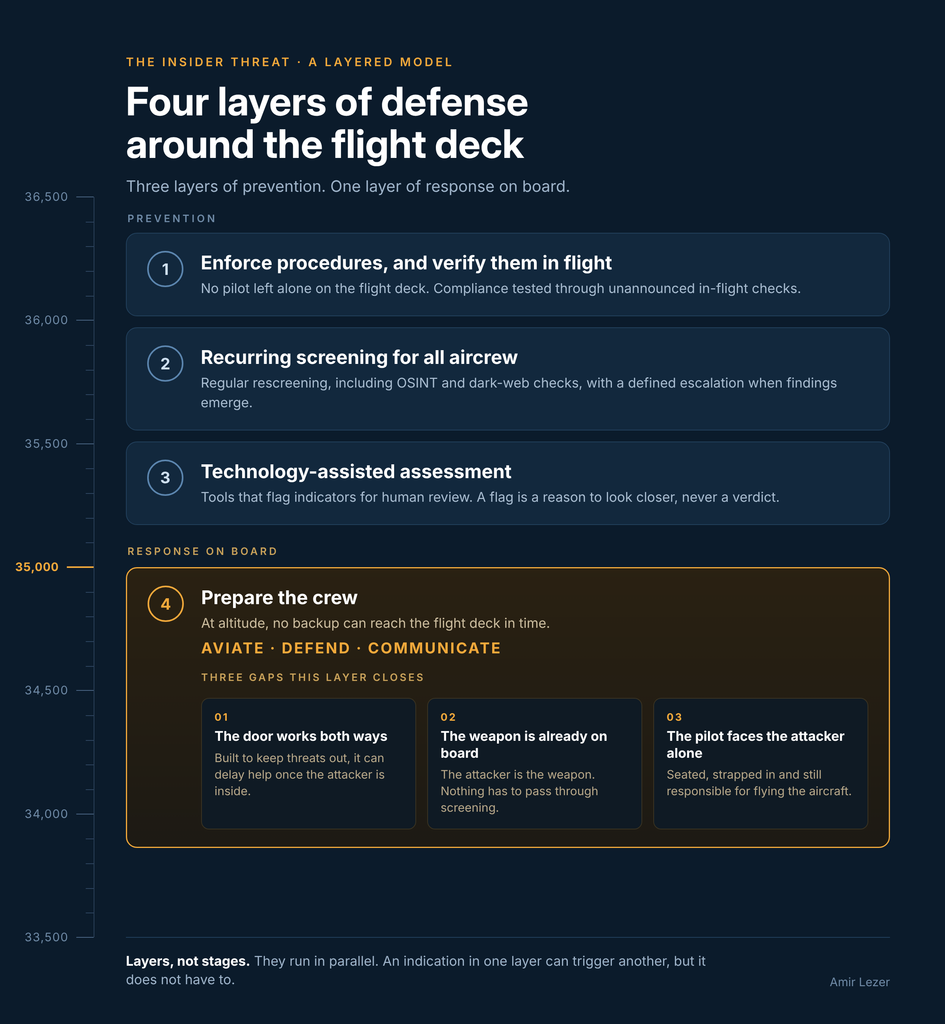
In security, there is no 100%. The insider threat cannot be eliminated, but it can be reduced substantially. Based on my experience, I would build the defense around aircrew on four layers: three of prevention and one of response on board.
1. Enforce procedures and verify them in flight
After Germanwings, many airlines required two people in the cockpit at all times. In 2016, the European Union Aviation Safety Agency (EASA) moved to a risk-based approach, and several European carriers dropped the practice. My view is that no pilot should be left alone on the flight deck. Whatever the procedure, compliance should be tested, including through unannounced in-flight checks.
2. Recurring screening for all aircrew
A background check at hiring is a snapshot. Aircrew should be rescreened regularly (I would suggest annually), including open-source intelligence (OSINT) and dark-web checks. Most results will be clean. Where findings emerge, they should trigger a defined escalation, from a closer review to an interview or a change in duties. We cannot know whether recurring checks would have caught the signs that appeared in 2017. We do know that a single check at hiring had little chance.
3. Technology-assisted assessment
I am not proposing a polygraph every two years. New tools, from eye-movement analysis to artificial intelligence (AI)-based risk screening, aim to flag indicators of concealed information or hostile intent faster and less intrusively. Their accuracy is still debated, and their use is restricted by law in several jurisdictions, so they should serve as a trigger for human review and never decide anything about a person on their own.
4. The last line of defense: prepare the crew
At altitude, no backup can reach the flight deck in time. I recently designed a self-defense program for aircrew, mainly pilots, built on a principle every pilot already lives by and adapted to a hostile situation: Aviate · Defend · Communicate. Keep the aircraft flying, defend yourself and the flight deck with simple, proven techniques, and communicate with the crew and the ground. The aim is not to turn pilots into fighters, but to make sure a moment of surprise does not become a moment of paralysis.

A living, breathing model
Security has two sides: the attacker and the defender. On the defending side, we never truly know whether we did well or whether they simply did not come today. That is why these are layers, not stages. Everyone with operational access goes through enforcement and recurring background checks. Technology-assisted assessment is used periodically, with its depth set by the findings and the overall picture. An indication in one layer can trigger another, but it does not have to. And every crew member, pilots above all, should go through the fourth layer: even with air marshals on board, there is no way to know whether they will be neutralized first.
All of this must be lawful, proportionate and based on evidence, never on nationality, religion or background. It also depends on sharing relevant concerns when crew move between operators and countries, and on a culture in which colleagues can report concerns without fear.
Adapt before the next incident
After 9/11, the industry changed fast because it had no choice. With the insider threat, we still have one.
The question is not whether aviation security will need to adapt, but whether we will make the changes before the next incident forces us to.