
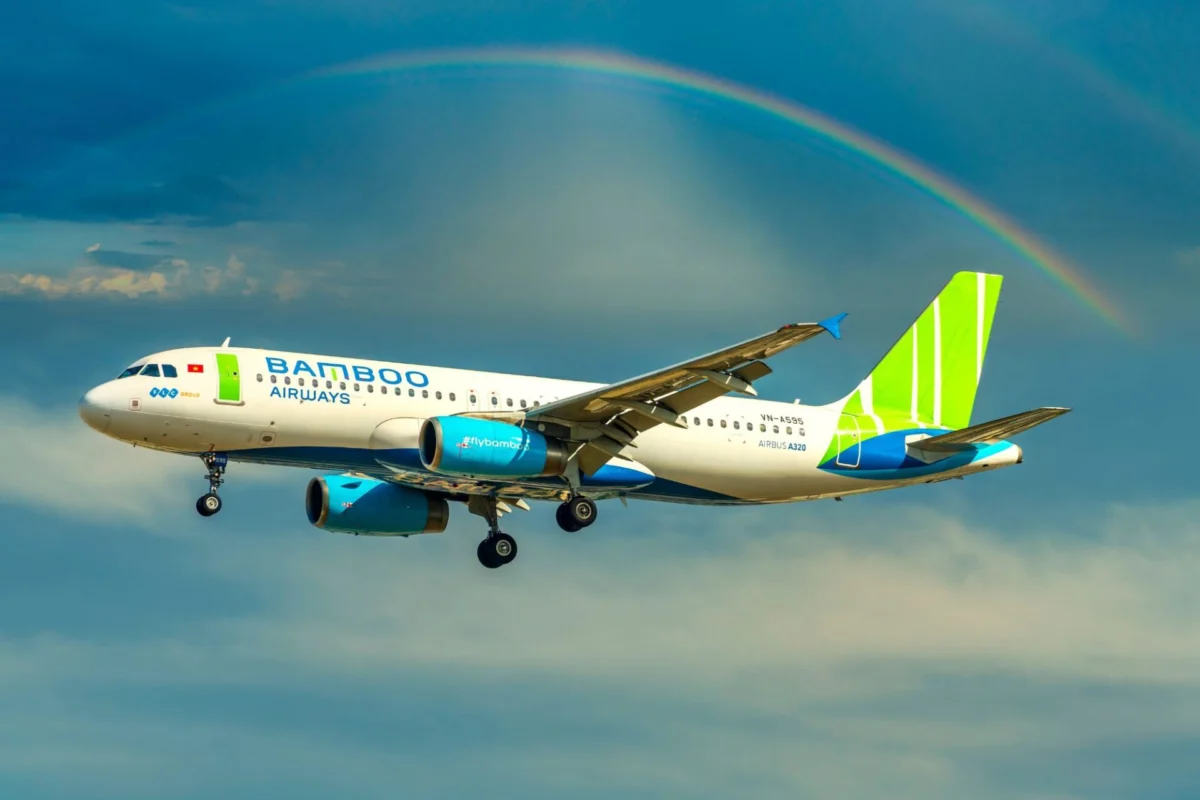
Vietnam’s Bamboo Airways has effectively stopped selling tickets for individual domestic flights, with its website showing “no flights found” on major routes such as Ho Chi Minh City-Hanoi, Hanoi-Da Nang, and Ho Chi Minh City-Da Nang since August 1, 2026.
The airline’s fleet, which once numbered 44 aircraft, has shrunk to just three, and according to Airways Magazine, only one of those three is currently in active use.
That remaining aircraft, an Airbus A321-200 registered VN-A227, is largely being used to operate a handful of charter flights rather than scheduled commercial service. Among them is a charter route between Da Nang International Airport (DAD) and Macau International Airport (MFM), operated under contract with a travel company that rents the entire aircraft for group travel.
Flight QH9588 departed Da Nang for Macau at 12:30 local time. on August 1, 2026 with another round-trip charter scheduled for August 20, 2026, followed by the aircraft’s final rotation on the route, a Da Nang-to-Hanoi flight, before charter operations on that route are set to stop entirely on August 22, 2026.
Beyond that date, the airline has not announced an operating schedule.
Financial strain and mounting complaints
Bamboo Airways has acknowledged the disruption publicly, apologizing to affected passengers and confirming that ticket refunds will be issued, though the airline says its customer service center is processing requests in the order received and that wait times may be longer than usual due to a surge in demand.
Under the airline’s current refund policy, tickets bought directly through its website, app, or ticket offices may be refunded as an eVoucher within 7 to 14 business days, while cash refund requests submitted by email could take up to 90 business days once all required documents are received.
Passengers who booked through third-party agents have been told to contact those agents directly. Several ticket agents have reported holding tens of billions of Vietnamese dong in deposits with Bamboo Airways without clear guidance on how those funds will be handled, and have also had difficulty reaching the airline in recent days.
Passengers have separately reported long wait times or an inability to reach Bamboo’s customer service hotline, along with delayed refunds and unclear flight schedules, according to social media complaints.
The airline’s operational struggles were already visible before this disruption. According to the Civil Aviation Authority of Vietnam, Bamboo operated 725 flights in June 2026, of which 241, or roughly 33%, were delayed, placing it among the worst-performing domestic carriers for on-time performance that month.
A rapid rise, then a steep decline
Bamboo Airways was founded in 2017 and launched its first commercial flight on January 16, 2019, operating from bases at Noi Bai International Airport (HAN) in Hanoi, Tan Son Nhat International Airport (SGN) in Ho Chi Minh City, and Quy Nhon Phu Cat Airport (UIH).
The airline positioned itself as a hybrid carrier, combining low-cost pricing with service comforts typically associated with legacy airlines.
At its peak, Bamboo operated a fleet of 44 aircraft, including Airbus A319, A320, and A321 jets alongside Boeing 787-9 Dreamliners, serving 20 domestic and 18 international destinations.
Its international network at one point extended as far as Melbourne Airport (MEL), Sydney Kingsford Smith Airport (SYD), Frankfurt Airport (FRA), London Gatwick Airport (LGW), and London Heathrow Airport (LHR), along with a range of other Asian routes. All of those international routes have since been terminated as the airline scaled back its operations.
The airline’s difficulties trace back to the 2022 collapse of parent company FLC Group and the imprisonment of Bamboo’s founder, businessman Trinh Van Quyet, on fraud charges.
By July 2025, auditors had identified roughly $350 million in unpaid debts, prompting lessors to repossess aircraft while tax authorities pursued an additional $16.8 million owed by the airline. Bamboo separated from FLC Group in 2023 before returning under FLC’s management in September 2025.
Bamboo’s troubles come as Vietnam’s aviation sector expands rapidly elsewhere.
The country’s airlines carried 45.49 million passengers in the first half of 2026, up 9.8% year-on-year, according to the Civil Aviation Authority of Vietnam.
Vietjet Air leads the market with 107 aircraft, followed by Vietnam Airlines with 97, while newer entrants like Sun PhuQuoc Airways are expanding quickly. Industry observers say the sector is returning to pre-pandemic growth rates, supported by an expected 24 million international visitors in 2026.