
Aviation journalist Andreas Spaeth talks to Johannes Lampela, Director of Industrial Design at BMW Designworks’ Los Angeles studio. He and his team created the entire interior design for the fleet of STARLUX Airlines and has worked repeatedly on the premium products of other world class carriers.
Johannes Lampela hails from Finland and studied in Lahti and Milan, starting his designer career working for furniture manufacturers. In 2005, Lampela joined Designworks at the Los Angeles studio, becoming Director of Industrial Design in 2015. He leads a multidisciplinary team of designers and creative directors focused on transportation. One of his first projects was for Singapore Airlines in 2010, when his team conceived First Class suites for their Boeing 777-300ER. Lampela and his team also realized all interiors for Starlux Airlines from Taiwan and did projects for Delta Air Lines and EVA Air. Besides, his team has worked for BMW Group brands, Bay Area Rapid Transit and Hyperloop.


Andreas Spaeth: Before venturing into aviation, did you work in the automotive industry as a designer?
Johannes Lampela: No, I’m actually a furniture designer, which might be deemed typical for a Finn. When I came to Los Angeles and found Designworks, I realized that as a furniture designer, I actually had a lot to give to transportation design. More of the spaces in transport are transformed now into living spaces. It’s not just a technical, mechanical, or performance design, although performance is always a part of it.
But it’s also about the psychological aspects of design, how do you make somebody feel at ease in the space. Those parts come more from my Finnish background as a furniture designer, merging them with very progressive BMW automotive design. It’s kind of a symbiosis.
Spaeth: Can you name some airline interior projects Designworks has been involved with?
Lampela: We have had the opportunity to work with many different airlines. STARLUX is our most recent public airline achievement, for which we have designed the interiors for all aircraft – the A321, the A330 and the A350. As they started from scratch, we basically created their product DNA from scratch as well.
We strive to work with the best. Quality airline brands really respect design and they understand the advantage design can give them. They want their own thing, listen to their customer feedback and they are also an active participant. It’s not that they just give us a brief and then just sit back and let us do everything. It’s very collaborative. Which is what we want from a client, that interaction, that feedback. You are designing and developing the mechanisms at the same time as the seat manufacturer works on the hardware, it’s all developed in symbiosis.

Spaeth: You have already worked on high-end airline products 15 years ago. How much has an airline brief changed for you as a designer over time?
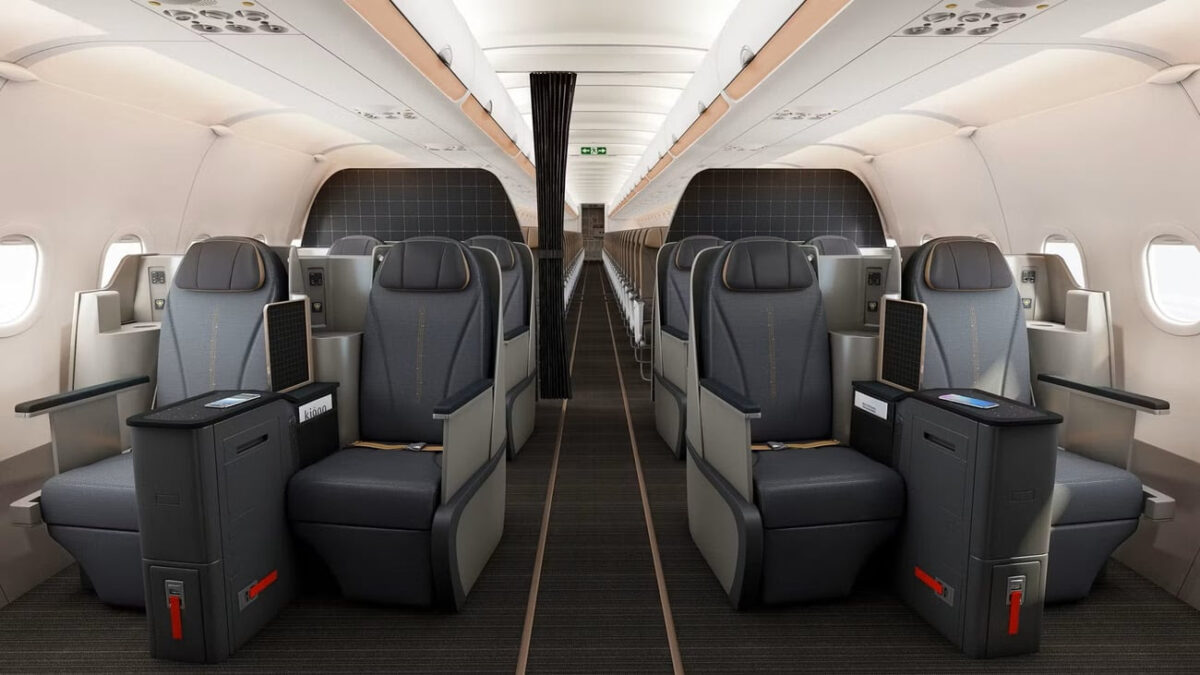
Lampela: It’s more about integration of technology and individual passenger needs these days; you count in more of the things passengers bring on board today, many more PEDs [Personal Electronic Devices – ed. note] and personal items. There is a greater need for charging, for horizontal surfaces – we do so much nowadays; we want to be productive in everything we do. Even when it’s relaxing, you want to have a feeling that you get most out of that relaxation. So, in a way, it’s much more performance-designed for all types of users.
There is also much more data available about the users, so the briefs are more specific to user feedback and user needs. There is less guessing and more direct problem-solving. The advancements in technology, manufacturing, and composites have also brought a lot of progress over time.
Spaeth: Before, the airlines provided the in-flight entertainment system, but now most people bring their own devices. Do you basically have to create interfaces?
Lampela: Correct. But we also observe that it’s all multi-tasking. Many younger passengers that bring their own PEDs still want to use the in-seat IFE as well. You might do two different things at the same time; you might have entertainment and gaming or chats and communications at the same time. Or [you might] even [be] working and [wanting to access] entertainment at the same time. It’s all very fluid. We build mock-ups very early and go through the sequence of what one might do. You have certain devices. Where do you put them? Can they stay there for takeoff and landing? You start to work on your laptop placed on the meal table, then the meal arrives. Where does the laptop go? Now I need to use the restroom. Can I still exit the seat with the meal and laptop being there? All these relations of activities where there can be friction are studied through mock-ups. Because on a computer screen you don’t necessarily realize them.
Physical mock-ups have almost become more important today because we bring more stuff on board, and we do more activities. We all want to pursue our individualized activities and feel that the space is created for us.
Spaeth: It’s surprisingly rare that an airline provides good laptop storage even in premium class seating…
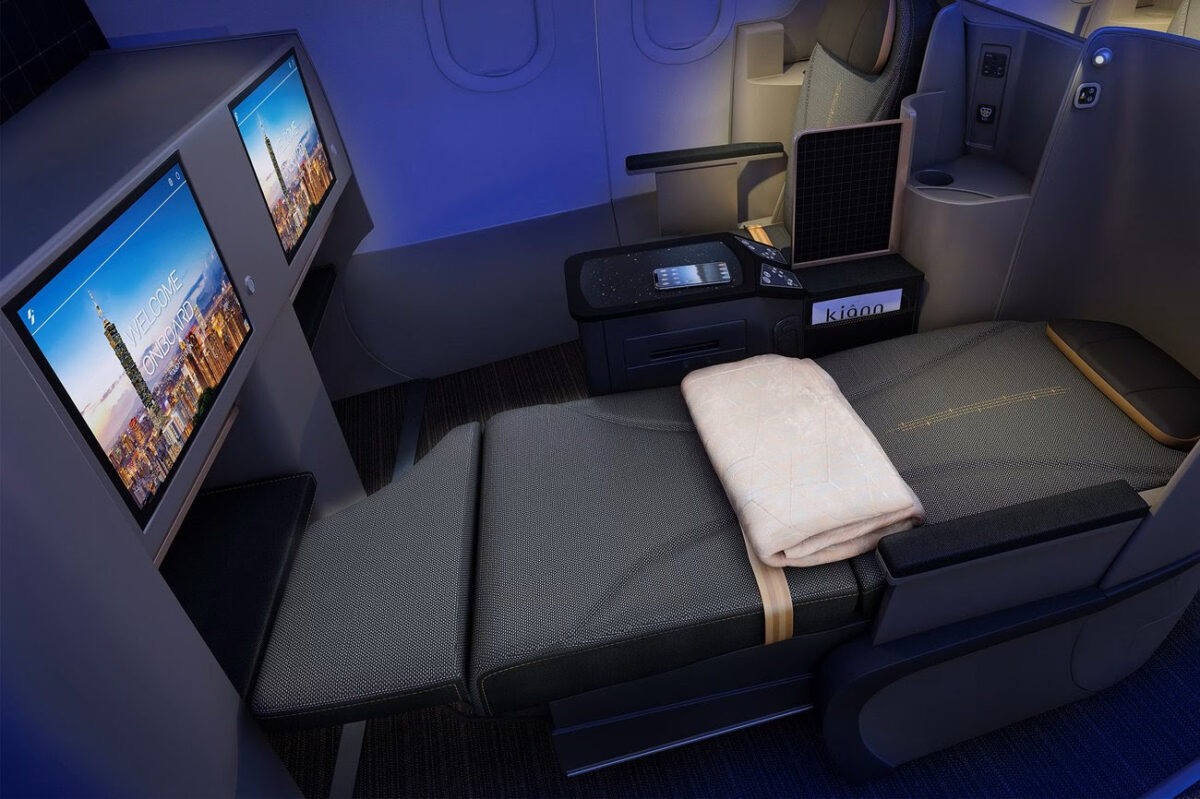
Lampela: Yes, and another factor that is often overlooked is horizontal surfaces. You really appreciate those as a passenger because you want to lay things out. It’s also the hierarchy of those horizontal spaces. We were very deliberate in ensuring you have enough space to put a laptop or personal items on the side console. But then having a second layer, where you can put your phone and drinks, for example.
And still, we have another area in the front where the flight attendant can serve and does not need to interfere with all the stuff that you have in your personal area. Also, in terms of the stowage compartments, there is a clear hierarchy: the side compartment is for water bottles, headphones are in the airline area, and the front is more for you and your personal valuables.
Spaeth: Are doors in long-haul business class now a must?
Lampela: Private spaces with sliding doors are part of the isolation culture today, to connect through media rather than physically. Wanting to be in your own cocoon. That mentality has influenced the perceived need for doors. The number one thing that passengers want besides comfort is privacy, so a lot of them value the door. Many people fly business class because they want better sleep, so you really need to prioritize the quality of the sleep, and that’s where the door has a huge impact. That ease and comfort, that no matter which position you are in, you are not exposed. It gives you that sense of security and homeliness.
Spaeth: Cabin designers always have to deal with a very restricted stage, as the fuselage diameter is limited. Isn’t that somehow boring, as you can’t really think out of the box?
Lampela: I wouldn’t say it’s boring; it’s a great challenge to work more on the smaller differences, trying to find that extra inch or extra delight that makes the difference for the passenger. Of course, it is nice to have a blank canvas, which we sometimes get on private jets or vision projects. We are also working with seating suppliers trying to create new seat platforms. The core of industrial design is to improve people’s lives and experiences. Working for aviation is wonderful because so many people will use it – and it will be actually produced, which is not always a given when we work on vision projects.
Spaeth: How do you imagine seat and cabin design will change within the next 15 years?
Lampela: The idea of having a new space frame, a different cabin size and configuration would be something to look forward to, which also could happen due to different regulations that would enable better accessibility.
I’m also excited to see where electrification in commercial and business aviation will lead, and when we will see different kinds of aircraft [than those we see today]. We might need to create an ultralightweight seat, defining priorities differently. That might be an interesting shift to an era when less might be more acceptable.