
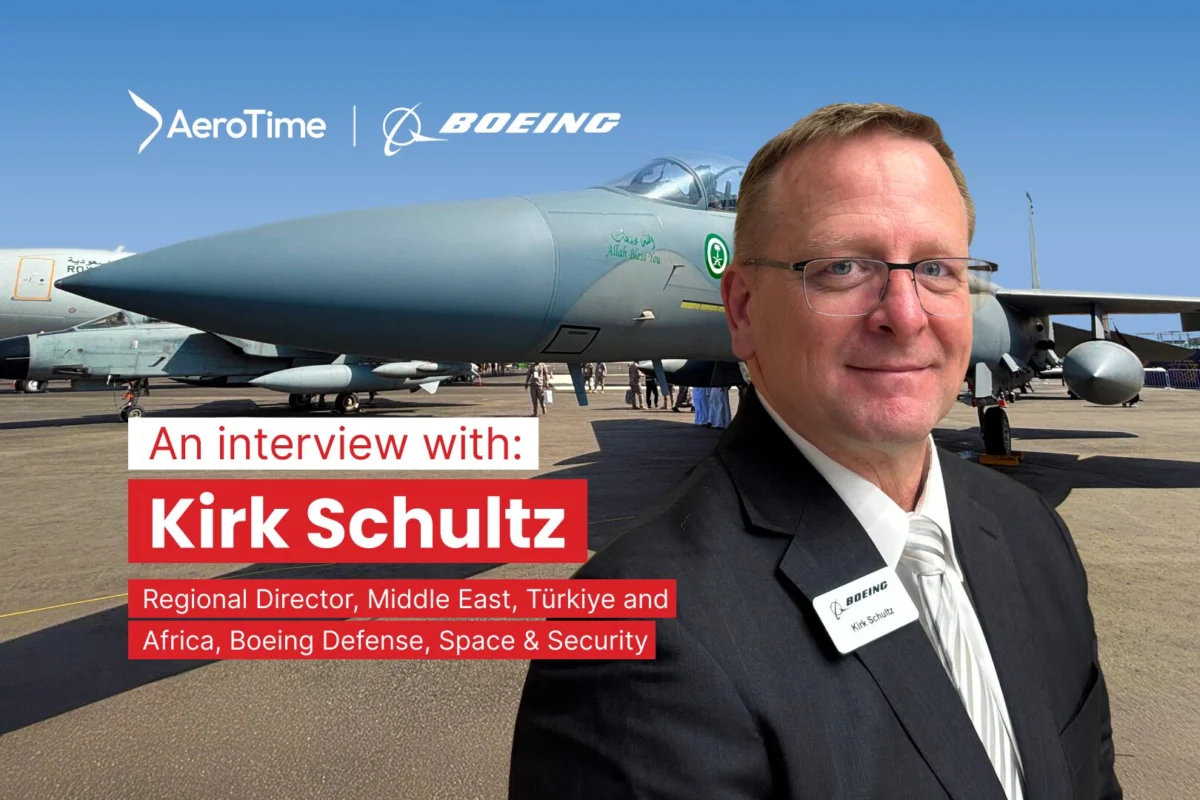
Boeing was among the most prominent exhibitors at the World Defense Show (WDS) 2026, held in Riyadh, Saudi Arabia, from February 8-12, 2026.
The US manufacturer demonstrated its strong presence within a market in which it maintains a significant footprint across both civilian and military sectors. Saudi Arabia is one of the few countries in the world to host a dedicated Boeing office, a fact that underscores the strategic importance that Boeing gives to its relationship with the Middle Eastern Kingdom.
To learn more about Boeing’s regional footprint and its plans for the Middle East in the field of defense and space, AeroTime spoke with Kirk Schultz, Regional Director for International Business Development at Boeing Defense, Space and Security, during WDS.
Schultz began by emphasizing the importance of WDS as a platform to showcase the company’s broad portfolio of solutions.
“If you had the chance to go out on the ramp, you could see some of our fantastic flagship products—the AH-64, the CH-47, F-15s, and a KC-46 – on display,” he noted.
A Saudi-operated F-15 also participated in the show’s flying display. In fact, Saudi Arabia operates nearly 400 military aircraft made by Boeing, making it one of the largest operators of the firm’s defense systems outside the United States.
“We’re just really happy to be here at WDS,” Schultz said. “First of all, this is a tremendous show. This is the third iteration of WDS, and we continue to increase our presence. It’s just a fantastic opportunity to meet with not only the Saudi Arabian military, but also key players around the region and across the world.”
Schultz then went on to underline the importance of Saudi Arabia and the broader Middle East region for Boeing.
“We have had a very long-standing relationship with Saudi Arabia,” he said. “It’s our largest user internationally of both [the] F-15 and [the] AH-64 Apache.”
“Our relationship with Saudi Arabia in defense goes back to the 1980s with both the F-15 and the Boeing 707 AWACS platform, as well as Boeing 707 tankers. We have then expanded that into vertical lifts with the AH-64, the CH-47 and the AH-6s that fly with royal Saudi land forces air component, as well as with the Ministry of the National Guard and the Royal Saudi Air Force (RSAF).”
Pitching the F-15EX to Saudi Arabia
But if there is one platform that stands out, it’s the F-15 fighter jet, due to its capabilities and the sheer number in Saudi service.
“I would say the focal point for Boeing’s relationship with the Saudi Ministry of Defence is the F-15 program,” Schultz said. “They have C’s, D’s, SA’s [the different F-15 versions operated by Saudi Arabia – ed. note]. The Saudis have continued to buy and upgrade their aircraft over the years and have over 220 F 15s right now.”

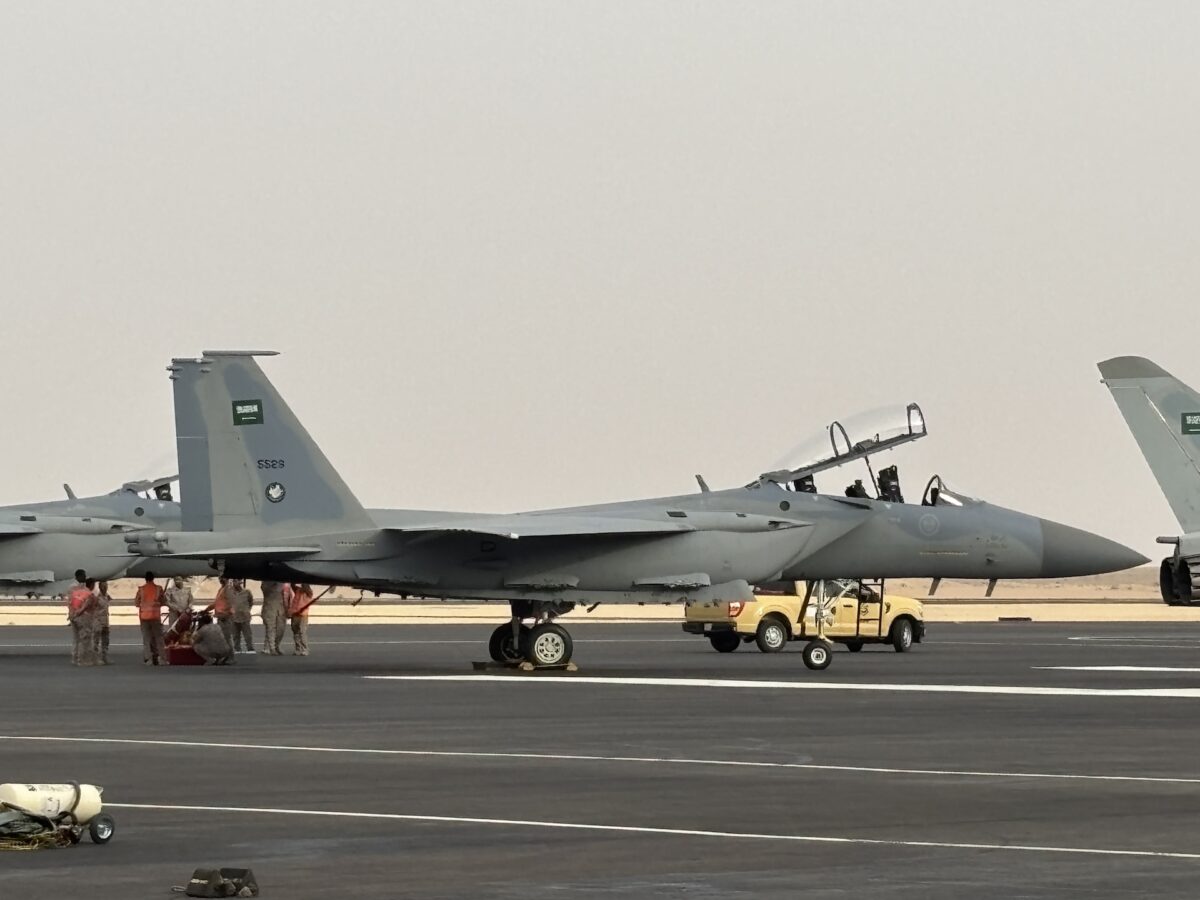
It is no secret that Saudi Arabia is interested in acquiring the F-15s latest incarnation, the F-15EX Eagle II. During the previous edition of WDS held in 2024, Saudi officials were reported to be in talks with Boeing to place an order for at least 46 aircraft of this type.
One of the highlights of Boeing’s booth at the WDS 2026 edition was a F-15EX simulator.
“The F-15EX, we believe will be an excellent complement to the Royal Saudi Air Force,” Schultz explained. “It would be an upgrade to the current fleet, and it will again bring them back to a level comparable to the US Air Force. Since the US Air Force is procuring the F-15EX, having Saudi Arabia with [the] F-15EX would be a very important program for us.”
Saudi authorities are also reported to be in conversation with Boeing’s competitor Lockheed Martin to buy F-35 jets. The acquisition of this advanced fighter was greenlighted by US President Donald Trump in November 2025.
While Schulz declined to comment on this matter, he stated: “From our perspective, if they are buying another US platform, it will be complementary. Look at the US Air Force, it has both F-15s and F-35s. They complement each other with different capabilities and missions.”
So, what other latest generation platforms are gathering interest from governments in the region?
“We have a lot of interest in things like the MQ-28 [Ghost Bat],” Schultz explained. “It’s an unmanned collaborative combat aircraft, a joint venture between the Boeing Company and the Royal Australian Air Force (RAAF) which traces its roots back to the ‘Loyal Wingman’ program.”
“It’s an AI-controlled, autonomous wingman which will complement manned fighters,” he added. “It can also be used with existing platforms.”
Going local in Saudi Arabia
Localization, or the handling of an increasing share of aerospace work by local companies, is one of the central themes of the aerospace chapter of Saudi Arabia’s Vision 2030. This is an approach that Boeing has fully embraced, Schultz explained, referring to the company’s decades-long presence in the kingdom.
“Saudi Arabia has a 60% localization requirement, and we continue to provide appropriate content within the country to maximize both their national defense and their local industry needs,” he said.
But what does this mean in practice?
“It would mean that we are making some components here, maintaining them here, and assembling some stuff here. Those are concepts that are either being explored or implemented,” Schultz explained, adding that this concept of localization is not new to Boeing, even if the amount of work being conducted locally is likely to keep increasing.
“We’ve been doing localization for years with Saudi Arabia and across the region, and we look to do more work together in the future,” he said. “It’s becoming a bigger part of any contract. Many of Boeing’s initial projects in Saudi have become the foundation for some of the Saudi aerospace industry.”
This also applies to space technology, an area in which Saudi Arabia also has ambitions.
“Boeing has the WGS-11 and 12 constellations for military satellite communications (SATCOM). These have recently been made available for export by the US government. So, we are having discussions across the region on additional capabilities,” Schultz said. “Saudi has multiple organizations that have significant interest in acquiring space-based capabilities.”
And what about Boeing’s work with other countries in the Middle East?
“We have many projects going on across the region, and we continue to have open discussions with them. The United Arab Emirates, for example, has significant Boeing vertical lift assets, AH-64 and CH-47s. Qatar has the newest F-15QA, which were the baseline program that later became the F-15EX of the US Air Force,” he explained. “So, there’s growth around the region and continuous interest in Boeing defense platforms and systems.”
The Middle East remains a fragile region from the point of view of security, with multiple geopolitical fault lines running through it. The last couple of years have seen conflicts flaring at several hotspots, from Yemen to Iran. Has this sparked renewed interest in investing in new defense platforms?
“There are always flash points and there’s always interest in Boeing platforms. This has been continuous,” Schultz said. “I think the region sees the value that Boeing defense brings in, and I am not just referring to the sale of a given platform, but to the partnerships necessary to support and sustain those platforms over the long term to ensure the national security of each of our partners.”