
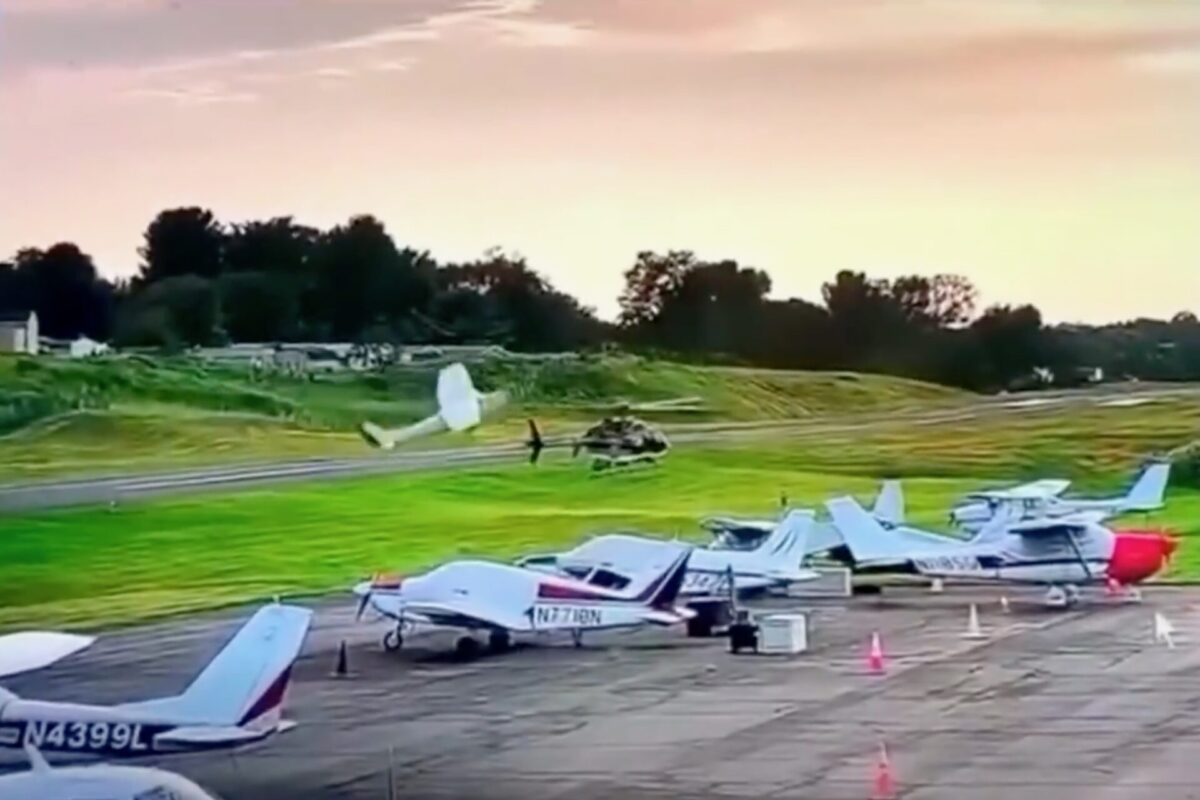
A Cessna 150 pilot was killed when his airplane collided with a hovering Pennsylvania State Police helicopter while the Cessna was attempting to land at Carlisle Airport in Pennsylvania.
Video posted on X shows the Cessna approaching the runway at low altitude as the Bell 407 hovers several feet above a grassy area beside it. The airplane then veers sharply to the right and strikes the helicopter from behind, sending both aircraft to the ground in a cloud of debris.
The crash occurred at about 18:52 local time on August 19, 2026, according to the Pennsylvania State Police and Federal Aviation Administration (FAA).
The Cumberland County Coroner’s Office identified the Cessna pilot as 57-year-old Paul Sokoloski of Hershey. He was the only person aboard the airplane.
Sokoloski was an emergency medicine physician affiliated with Penn State Health. He worked in emergency departments at Penn State Health Hampden Medical Center, Holy Spirit Medical Center and Lancaster Medical Center, according to his profile on the health system’s website.
The helicopter was conducting a routine training exercise when the collision occurred. Its two pilots, Corporal Bryce Corman and Trooper Jason Mills, are members of the Pennsylvania State Police aviation unit.
The impact tore away the helicopter’s rotor blades and tail boom. The aircraft rolled onto its side and partially onto its roof, trapping both troopers inside.
Corman pushed out a window and helped Mills to escape. Both were taken to Penn State Health Milton S. Hershey Medical Center, where hospital officials said they were in stable condition with minor injuries.
“When I say it was a very violent crash, that plane was cut into a lot of pieces,” Pennsylvania State Police Acting Commissioner George Bivens said during a news conference.
According to Bivens, the Cessna approached from behind the helicopter while lined up with Runway 28 before veering right at the last moment.
“The pilots would not have been able to even see that airplane approaching them,” he said.
Carlisle Airport is an uncontrolled field that does not have an air traffic control tower.
Rotor wash from the hovering helicopter is one possible factor that investigators may consider. The video shows the Cessna’s right wing dropping shortly before impact, but it does not establish why the airplane veered sharply.
FAA guidance warns that helicopters hovering close to the ground can produce high-velocity outwash vortices extending approximately three rotor diameters. The agency advises pilots of small airplanes to remain outside of this area. The same guidance notes that helicopter wake turbulence can drift toward a nearby runway.
Other factors, including visibility, aircraft spacing, radio communications and a possible last-second avoidance maneuver, have yet to be ruled in or out.
The National Transportation Safety Board (NTSB) is leading the investigation, with assistance from the FAA and Pennsylvania State Police. No cause has been determined.