
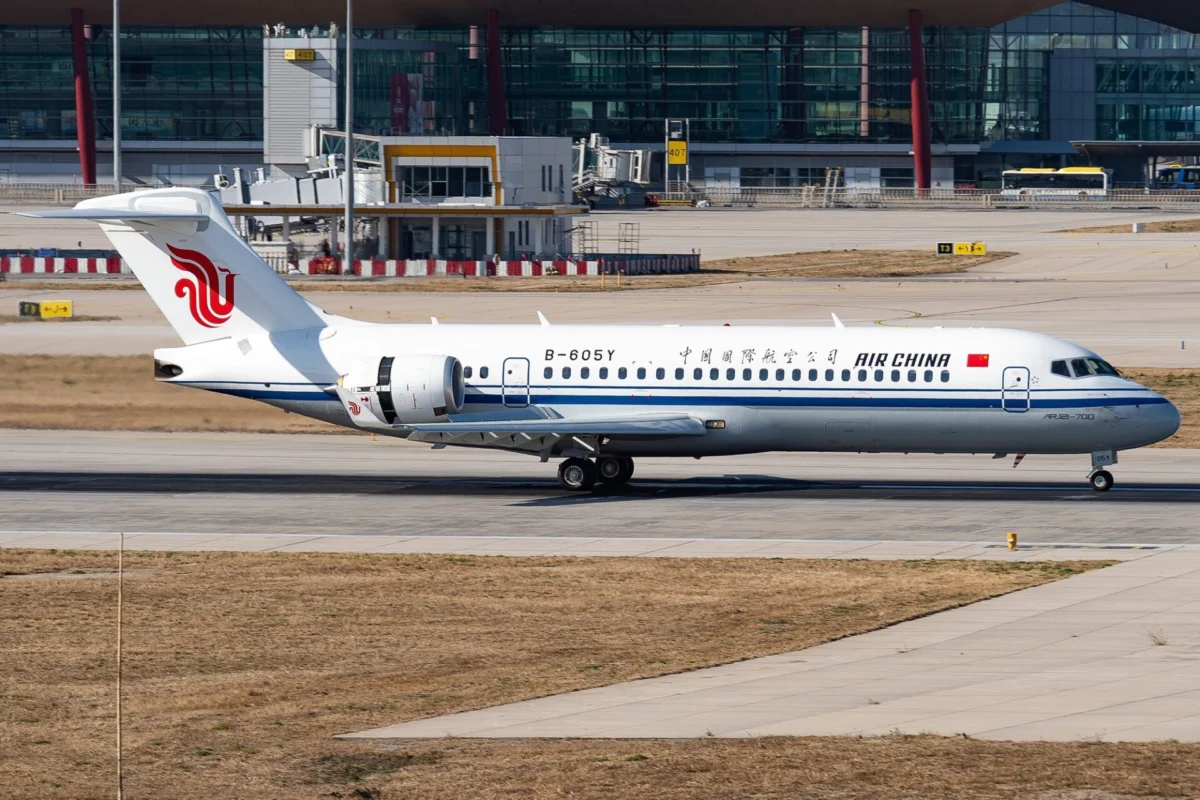
China’s Commercial Aircraft Corporation (COMAC) marked the 10th anniversary of the C909 regional jet entering commercial service on June 28, highlighting the aircraft’s growing role in the country’s domestic aviation market.
According to COMAC, 186 C909 aircraft have been delivered to more than 10 customers since the aircraft type entered commercial operations on June 28, 2016. The manufacturer said the C909 fleet now accounts for approximately 70% of China’s regional aircraft market, having carried more than 37 million passengers across over 860 routes serving more than 180 cities.
COMAC added that the C909 currently operates an average of more than 500 flights per day, making it the dominant aircraft type in China’s regional aviation sector.
The manufacturer said that around 70 C909 aircraft are currently deployed in China’s Xinjiang, Inner Mongolia, and Heilongjiang regions, where they have collectively transported more than 10 million passengers on over 200 000 flights.
Beyond the domestic market, the C909 has gradually expanded internationally. According to COMAC, the aircraft is now in service in Indonesia, Laos, and Vietnam, operating 25 international routes connecting 28 cities and carrying more than one million passengers.
In the meantime, in China, the C909 is operated by carriers including Chengdu Airlines, Air China, China Eastern Airlines, China Southern Airlines, Jiangxi Air, Genghis Khan Airlines, China Express Airlines, Colorful Guizhou Airlines, and Urumqi Air, while overseas operators include Indonesia’s TransNusa, Lao Airlines, and Vietnam’s VietJet.
Originally developed as the ARJ21 before being rebranded as the C909 in late 2024, the aircraft is designed to seat up to 90 passengers on short- and medium-haul regional routes. It complements COMAC’s larger C919 narrowbody as part of the manufacturer’s strategy to expand China’s domestically produced commercial aircraft portfolio.
COMAC is also currently developing additional C909 variants for specialized missions. According to the manufacturer, business jet, freighter, emergency command, and medical transport versions have already entered service, broadening the aircraft’s operational capabilities beyond passenger transport.