
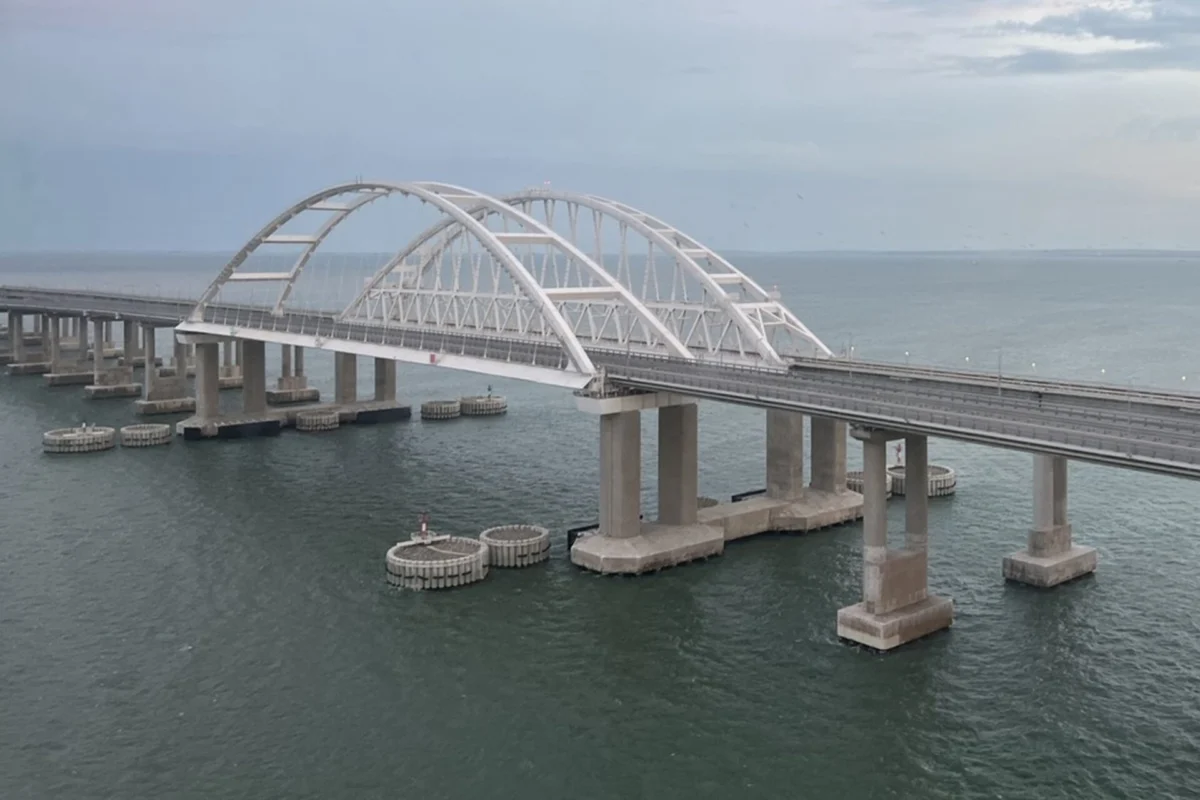
Russia suspended road and rail traffic across the Crimean Bridge on November 17, 2026, following a second overnight attack in as many days, as footage emerged appearing to show the road bridge’s main arch had collapsed into the Kerch Strait.
In a statement published at 08:51 Moscow time, Russia’s Ministry of Transport attributed the disruption to another drone attack. It said specialists were assessing the damage and reported no casualties on the bridge, according to preliminary information.
Motorists were advised not to travel toward the crossing. The ministry did not describe the extent of the damage or provide a timeline for reopening.
Sergei Aksyonov, the Russian-installed head of occupied Crimea, had reported the attack at 01:35 Moscow time. He later said two people had been killed in a drone attack in the peninsula’s Leninsky district, without establishing whether the deaths were directly connected to the bridge strike.
Footage suggests Crimean Bridge road arch has collapsed
Video and photographs published on November 17, 2026, appear to show the steel arch over the road bridge’s navigation span missing, with part of the roadway in the Kerch Strait. The parallel railway arch appears to remain standing. Russian authorities have not confirmed a collapse.
❗️🌉Footage showing the destruction of the road arch and span of the Crimean Bridge across the Kerch Strait. Unlike an ordinary bridge span, the massive steel arch cannot be easily replaced. Road traffic across the bridge has been completely severed, leaving the occupied land corridor as the only remaining overland route. Furthermore, the collapse also threatens Russian maritime traffic between the Black Sea and the Sea of Azov. The navigable channel beneath the bridge is only 120 meters wide and 8.3 meters deep, meaning the submerged steel structure could prevent large vessels from passing until the debris is removed.
— Special Kherson Cat 🐈🇺🇦 (@bayraktar_1love) November 17, 2026
The road arch had reportedly been damaged during the first attack on November 16, 2026. Russia’s Ministry of Transport initially suspended road traffic while trains continued running, before reopening the road to alternating one-way traffic that evening. At the time, Kremlin spokesperson Dmitry Peskov described the damage as minor.
Russia’s Investigative Committee has now confirmed that the attacks on November 16 and 17 had caused structural damage to the bridge. It also opened a criminal investigation under Russia’s terrorism laws.
The Crimean Bridge, which spans 19 kilometers (approximately 12 miles) across the Kerch Strait, is a strategic road and rail connection between mainland Russia and occupied Crimea. It has served as a major logistics route for Russian forces.
The crossing was previously damaged by a truck bomb in October 2022, naval drones in July 2023 and an SBU underwater explosive operation in June 2025.
Was the Crimean Bridge struck by Flamingo cruise missiles?

Although Russian officials attributed both attacks to drones, claims have emerged that Ukrainian-made FP-5 Flamingo cruise missiles were involved.
Denys Shtilierman, co-owner of Ukrainian missile manufacturer Fire Point, reposted a message from former Ukrainian interior ministry adviser Anton Herashchenko identifying the weapon as a Flamingo cruise missile.
Ukrainian news agency UNIAN reported that Shtilierman had confirmed the use of Flamingo missiles. An unverified video shows the view from a missile’s onboard camera immediately before impact.
A Ukrainian FP-5 Flamingo cruise missile seconds before striking the Kerch Bridge. Glory to Ukraine! https://t.co/E7g5ZerzQA
— Anton Gerashchenko (@Gerashchenko_en) November 17, 2026
Ukraine’s General Staff and Security Service (SBU) had not formally claimed responsibility for the latest bridge attack as of the morning of November 17, 2026.
The Flamingo was first reported in combat against a Russian Federal Security Service base in Crimea in August 2025. Fire Point claims the missile has a range of 3,000 kilometers (approximately 1,860 miles) and carries a 1,150-kilogram (approximately 2,535-pound) warhead. French newspaper Le Monde subsequently reported that the missile uses a guidance system supplied by Safran.
Russian strikes also damage two bridges in Kyiv
The attack on the Crimean Bridge came as Russia carried out missile and drone strikes across Ukraine, including against two major bridges in Kyiv.
Kyiv Mayor Vitali Klitschko reported that Russian missiles had struck the Northern and Southern bridges over the Dnipro River late on November 16, 2026. The Kyiv City State Administration subsequently confirmed damage to both crossings, which were closed to traffic. The strikes also damaged metro infrastructure, suspending services on part of the Green Line, and disrupted water and heating supplies in parts of the capital.
Kyiv’s Northern and Southern bridges remain closed in both directions following Russian ballistic missile strikes, city authorities report. Engineers are inspecting both crossings to assess structural damage. Mayor Vitali Klitschko says traffic will resume only after safety assessments. #Ukraine
— NOELREPORTS 🇪🇺 🇺🇦 (@NOELreports) November 17, 2026
Russian forces had repeatedly targeted Kyiv’s bridges in October and early November 2026, causing damage and temporary closures.