
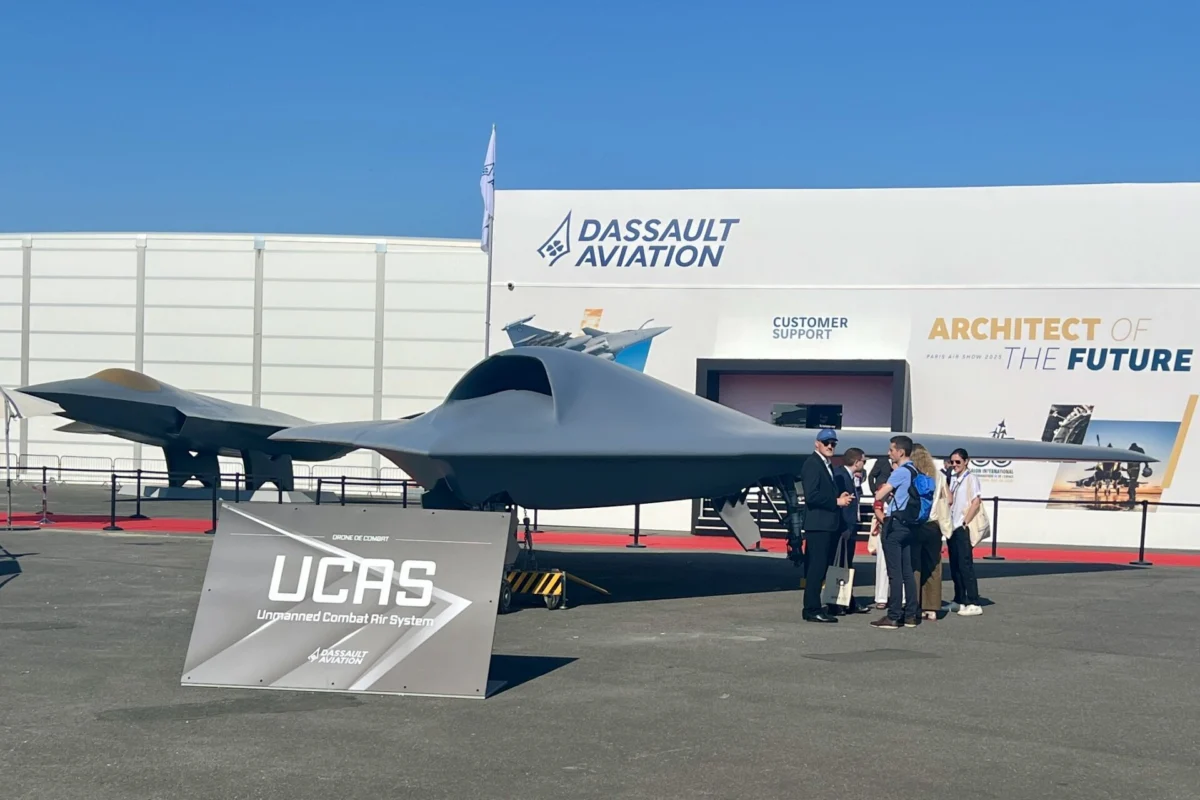
Dassault Aviation CEO Eric Trappier used the company’s 2025 annual results briefing to reject allegations that Dassault is failing to meet its contractual commitments on the Future Combat Air System (FCAS), arguing instead that the program’s deadlock is fundamentally about governance and leadership of the New Generation Fighter (NGF) pillar.
Speaking as Dassault Aviation reported higher 2025 sales and operating profit and forecast further growth in 2026, Trappier said the accusations aimed at Dassault are “fake” and framed the dispute as an attempt to dilute the industrial leadership that partner governments have already assigned.
Dispute on governance, not workshare
Trappier said FCAS was built on the understanding that France would lead the program and that Dassault would lead the NGF work, before Spain joined via Airbus Defence and Space. He said Dassault accepted a shift to a one-third share of the work when Spain entered, but that the core question has since become how decisions are made and who ultimately has authority over the fighter’s design tradeoffs, interfaces, and timelines.
In his opinion, FCAS cannot be managed through what he derided as a “co-co-co” guidance model, a reference to a structure in which multiple industrial partners effectively co-lead decisions, slowing execution and blurring accountability. Trappier once again argued that a program of FCAS’s scale requires a “real leader,” and said that not only France, but also Germany and Spain, have designated Dassault as leader of the NGF pillar.
Trappier went further, accusing Airbus of not respecting the initial agreement, and said that if Airbus “does not want to work with us,” the project would be effectively dead.
According to Trappier, FCAS risks reproducing a governance model that yields compromised aircraft, slower decisions, and ultimately reduced confidence in European autonomy.
Asked whether Dassault feared falling into irrelevancy, the CEO pointed out:
“Of the four countries that developed the Eurofighter, three bought the F-35. That’s what decline looks like.”
Paris insists operational requirements are aligned
Trappier’s remarks were made amid revived public debate in Germany over whether FCAS should split into separate national or semi-national fighter programs, in part because Berlin’s political leadership has argued that French and German operational requirements differ too much to sustain a single aircraft.
Trappier refused to assess how likely a “two jets” outcome is, but said German political claims about divergent requirements do not match the French position that the requirements remain the same.
German Chancellor Friedrich Merz has publicly questioned whether Germany needs the same fighter profile as France, describing the issue as one of differing requirement profiles. French President Emmanuel Macron, by contrast, has defended a single common fighter approach and argued the partners had already converged on the core concept.
“If we need new partners, we will find them”
In 2025, Airbus has signaled it is preparing for multiple scenarios. Airbus CEO Guillaume Faury said the company would be ready for outcomes including two separate French and German-led programs, while still expressing hope that Europe can continue to co-develop a single next-generation fighter.
Trappier also suggested Dassault could work with different partners if FCAS stalls, while emphasizing that any decision to add countries would be political, not industrial.
“It’s not my choice,” he said, stressing that French authorities would decide whether to bring additional nations and their companies into an alternative program.
Trappier broadened his critique into what he called “France-bashing” in aerospace, arguing France remains among the few countries still able to design and build a high-end combat aircraft end-to-end.
He pointed to Rafale’s multi-role positioning, including its nuclear mission certification and carrier compatibility, as evidence of Dassault’s competence and of the strategic value of retaining national design authority.