
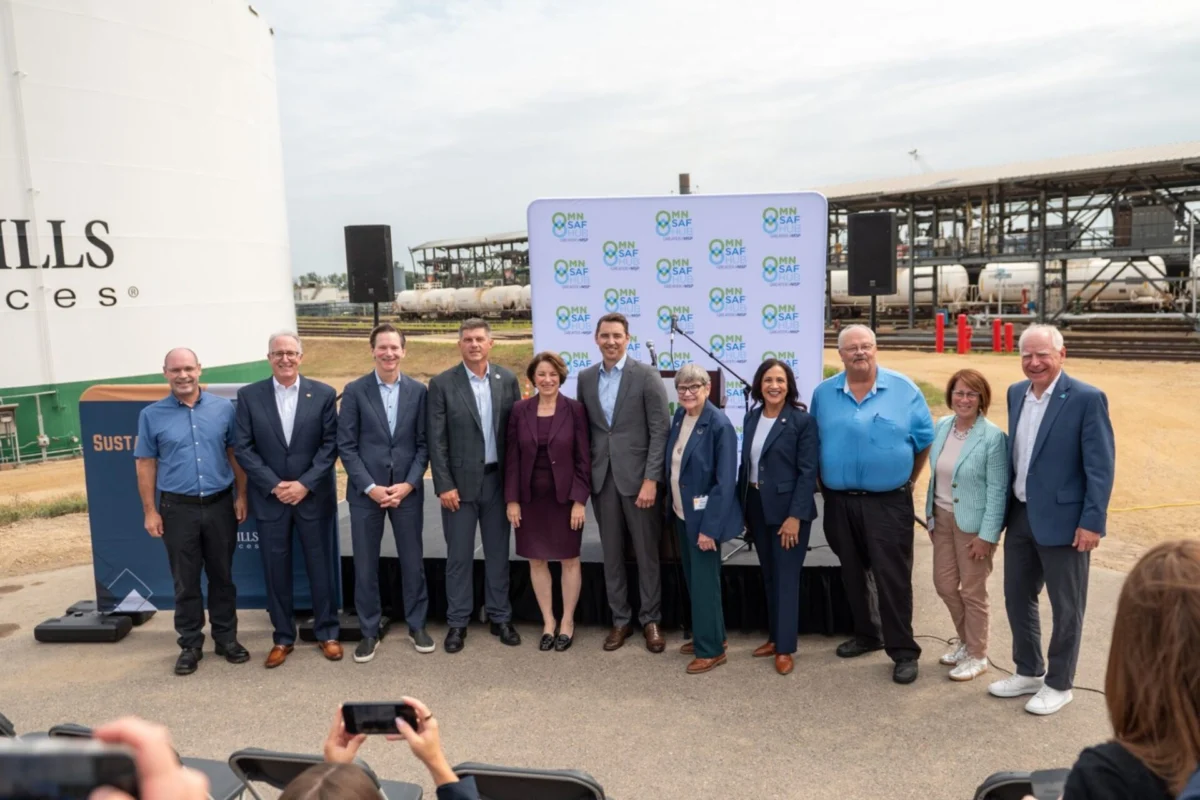
Delta Air Lines gathered with Minnesota officials on July 27, 2026, to mark the completion of a new fuel blending facility at Flint Hills Resources’ Pine Bend Refinery.
The project is meant to bring more sustainable aviation fuel to Minneapolis-St. Paul International Airport (MSP), Delta’s second-largest hub.
Sustainable aviation fuel (SAF) is made from renewable feedstocks and can cut lifecycle carbon emissions significantly compared to regular jet fuel.
The new facility lets SAF be blended with standard jet fuel right at the refinery, then delivered to MSP through pipelines that are already in place. Delta burns through roughly 250 million gallons of jet fuel a year at that airport alone, and once running at full capacity, the facility is expected to blend up to 30 million gallons of pure SAF annually.
Years in the making
Delta and Flint Hills Resources first announced the plan back in September 2024.
It’s one of four milestones tied to the Minnesota SAF Hub, a coalition Delta helped launch in 2023 alongside the Greater MSP Partnership, Bank of America, Ecolab, and Xcel Energy to help grow a regional SAF supply.
The opening brought out a mix of business and political figures, including Delta President Peter Carter, Flint Hills President and CEO Francis Murphy, Ecolab’s Nick Alfano, Greater MSP’s Peter Frosch, US Senator Amy Klobuchar, Governor Tim Walz, Congressman Brad Finstad, Speaker Lisa Demuth, and Senator Ann Rest.
Carter called the facility the result of years of work toward a shared goal.
“This facility is the culmination of a shared vision for Minnesota to become a leader in sustainable aviation fuel,” Carter said. “By expanding the infrastructure needed to support broader SAF adoption, it represents an important step toward turning that potential into reality.”
He said Delta is glad to have played a part and is optimistic about what Minnesota can contribute to SAF going forward.
SAF Production is still small relative to demand
SAF works in today’s aircraft engines without any modifications, and it can move through much of the same pipeline and storage systems airports already use. The real limitation has been supply. Production is still small relative to demand, which is why facilities like this one, built specifically to blend and move SAF at scale, matter for getting more of it into the system.
The Pine Bend facility adds to a growing list of steps Delta has taken on this front, including a five-year deal with Shell Aviation to expand SAF access across several major US airports through 2030, MSP among them. Jet fuel accounts for around 90% of Delta’s carbon emissions, and the airline has set a goal of running on 10% SAF by 2030 as part of its longer-term push toward net zero emissions by 2050.