
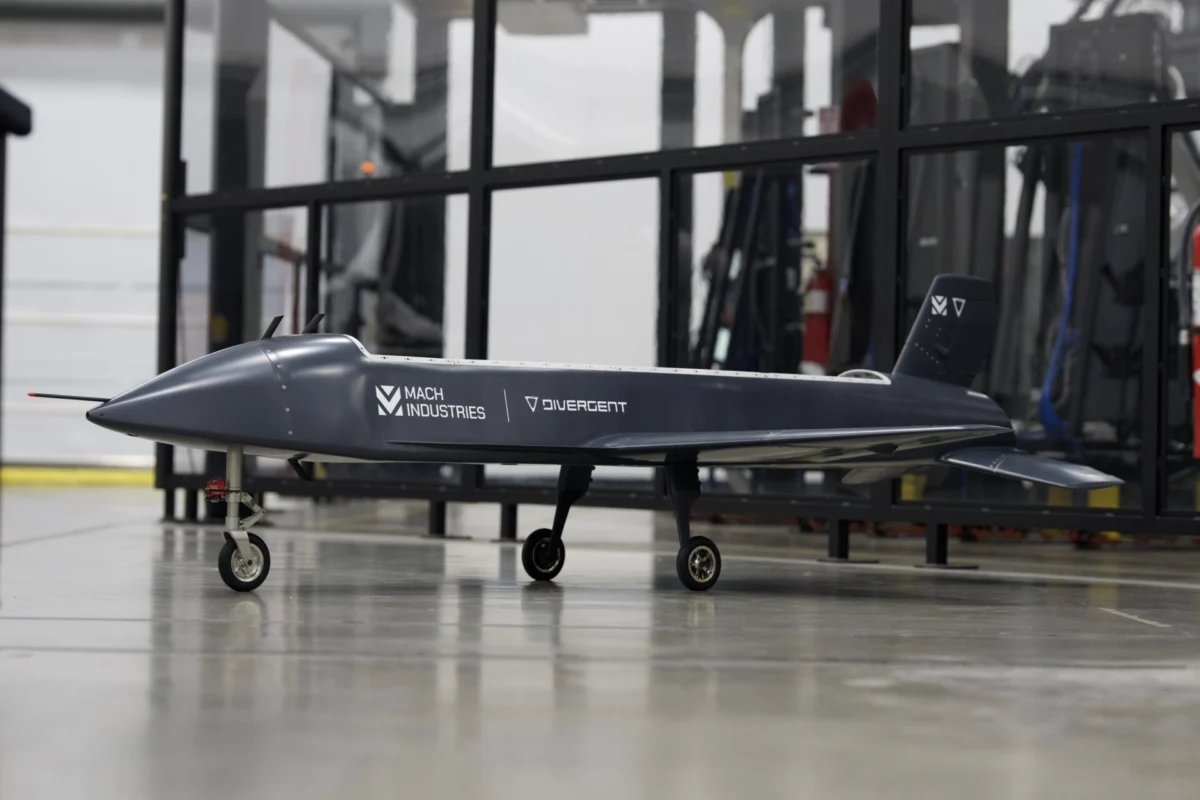
Two California defense startups designed, built, and flew a new rapid-build autonomous strike aircraft in just 71 days, a timeline that illustrates how quickly Pentagon-backed drone programs are evolving.
Divergent Technologies and Mach Industries announced the first flight of Venom, a prototype unmanned aircraft developed using a fully digital design and additive manufacturing process. The companies say the project moved from concept to first flight in just over two months.
Photos released following the announcement show US Secretary of Defense Pete Hegseth with company executives, a sign that the program has visibility at senior levels inside the Department of Defense.
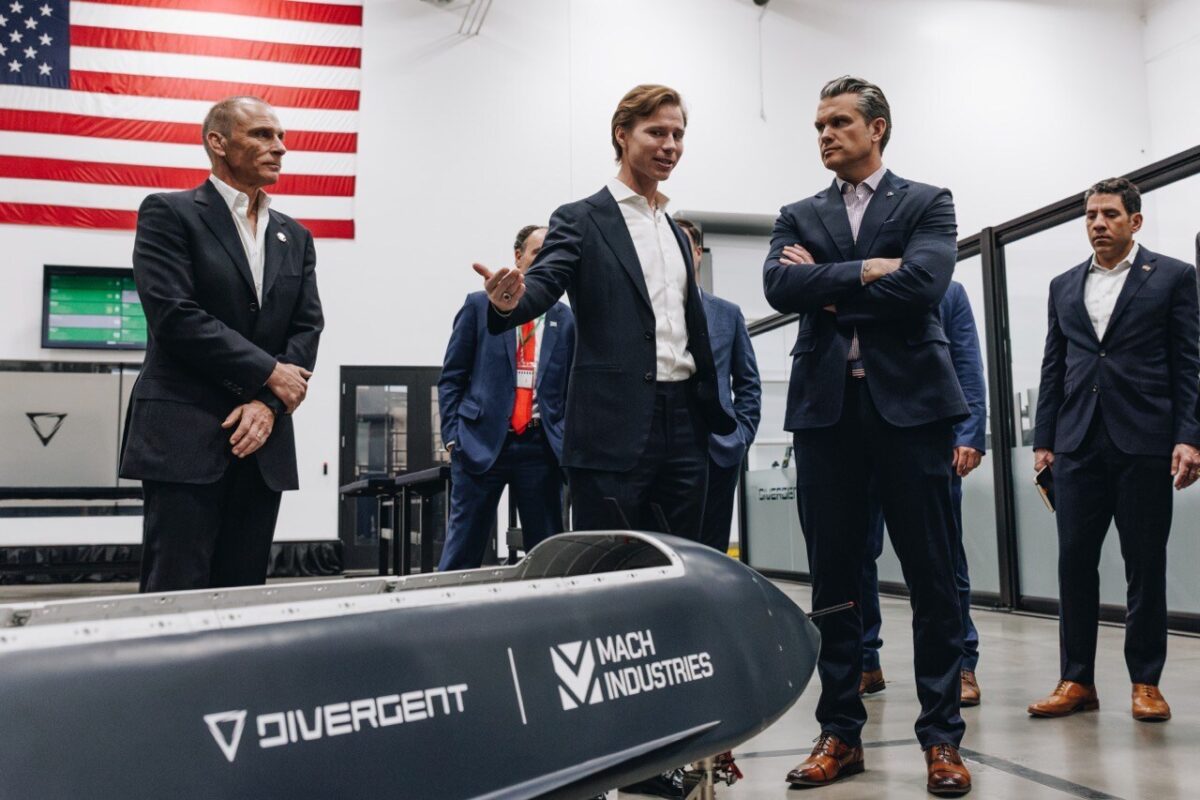
Mach Industries, founded in 2023 and based in Huntington Beach, California, led system architecture and integration. Divergent Technologies, headquartered in Torrance, California, and founded in 2014, designed and 3-D printed the aircraft’s structure using its Divergent Adaptive Production System.
Rather than build the airframe from hundreds of individual parts, Divergent printed large monolithic assemblies, including wings, fuselage sections and control surfaces. The approach reduces part count and eliminates traditional tooling, which can slow aerospace production.
The companies did not release detailed performance specifications for Venom. They described it as an autonomous strike aircraft and positioned it within the Pentagon’s push for “affordable mass,” a term used to describe large numbers of relatively low-cost unmanned systems that can be fielded quickly.
That shift reflects lessons from Ukraine and other recent conflicts, where inexpensive drones have forced militaries to rethink how they defend against low-cost unmanned aircraft.
Mach says it has taken four products from concept to flight test in the past 18 months and recently secured a production contract, though it did not specify the customer or dollar value. The company said it focuses on vertically integrating propulsion, weapons, and manufacturing to shorten development cycles.
Divergent, which previously worked in automotive manufacturing before expanding into aerospace and defense, has raised significant capital to scale its digital production platform. The company said it plans to produce thousands of airframes annually using its additive manufacturing system.
The companies say the program demonstrates how software-driven development can shorten production timelines while avoiding the need to create legacy manufacturing infrastructure.
Whether Venom becomes a fielded system will depend on details the companies have not shared, including range, payload, autonomy and unit cost. For now, the 71-day timeline is noteworthy, and it appears to fit with the Pentagon’s desire for rapid production of simple, lower-cost weapons systems.