
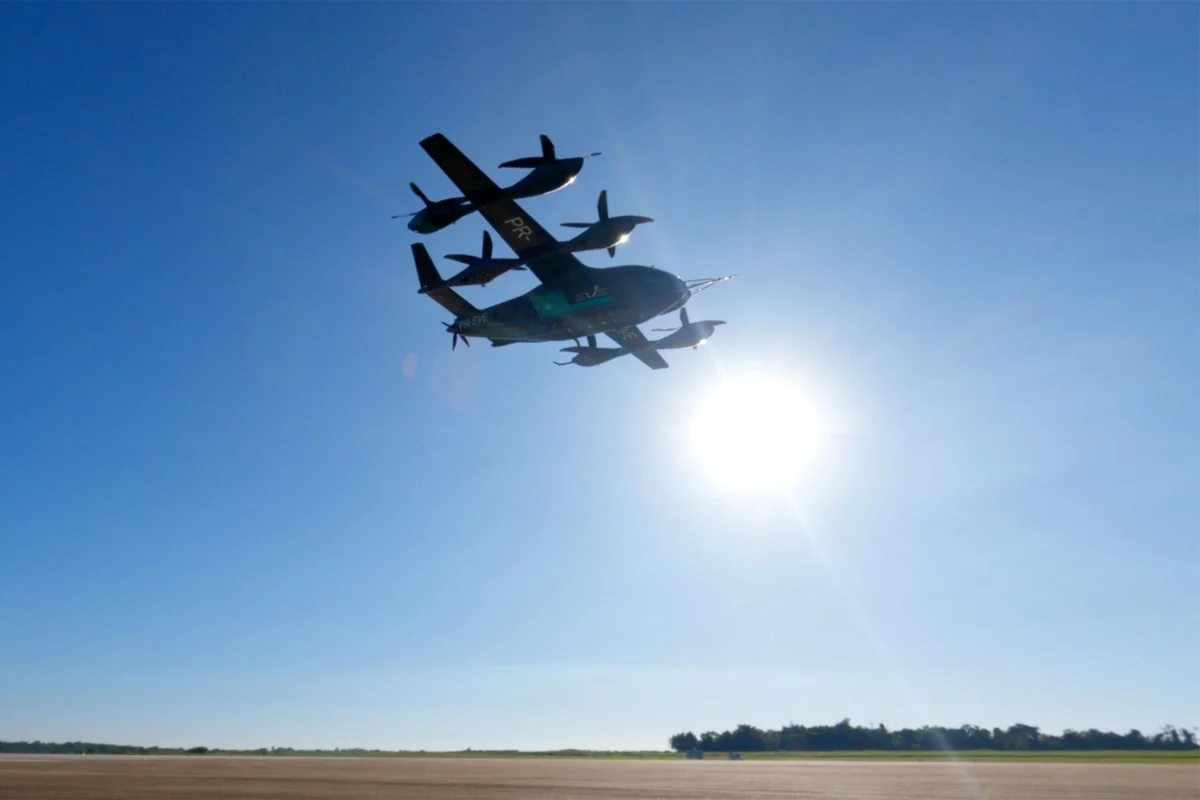
Eve Air Mobility, the advanced air mobility subsidiary of Embraer, announced on May 21, 2026 that it had closed out the hover and low-speed flights block of its full-scale engineering prototype, clearing the way for ground tests and a transition flight campaign expected to begin in July or August 2026.
Across 59 flights and two hours, 27 minutes, and 33 seconds of accumulated airtime, the eVTOL completed more than 100 flight test points, the company said. The prototype reached 215 feet above ground level on its highest flight and stayed airborne for 3 minutes and 48 seconds on its longest sortie.
Eve has pursued an incremental flight envelope expansion since the prototype’s maiden flight in December 2025 at Embraer’s Gavião Peixoto facility in São Paulo.
Prototype expands early flight envelope
The first phase of the recently completed block validated control laws, downwash effects, thermal behavior, and the propulsion model below 15 knots. The campaign then expanded to approximately 20 knots of ground speed, including simultaneous four-axis maneuvers intended to validate aerodynamic and load models ahead of a broader envelope expansion.
“Closing this phase validates the discipline behind our flight test strategy,” Johann Bordais, CEO of Eve, said in the company’s statement. He added that the team had confirmed stable hover performance and predictable control behavior while deepening its understanding of loads, aerodynamics, propulsion, and energy management.

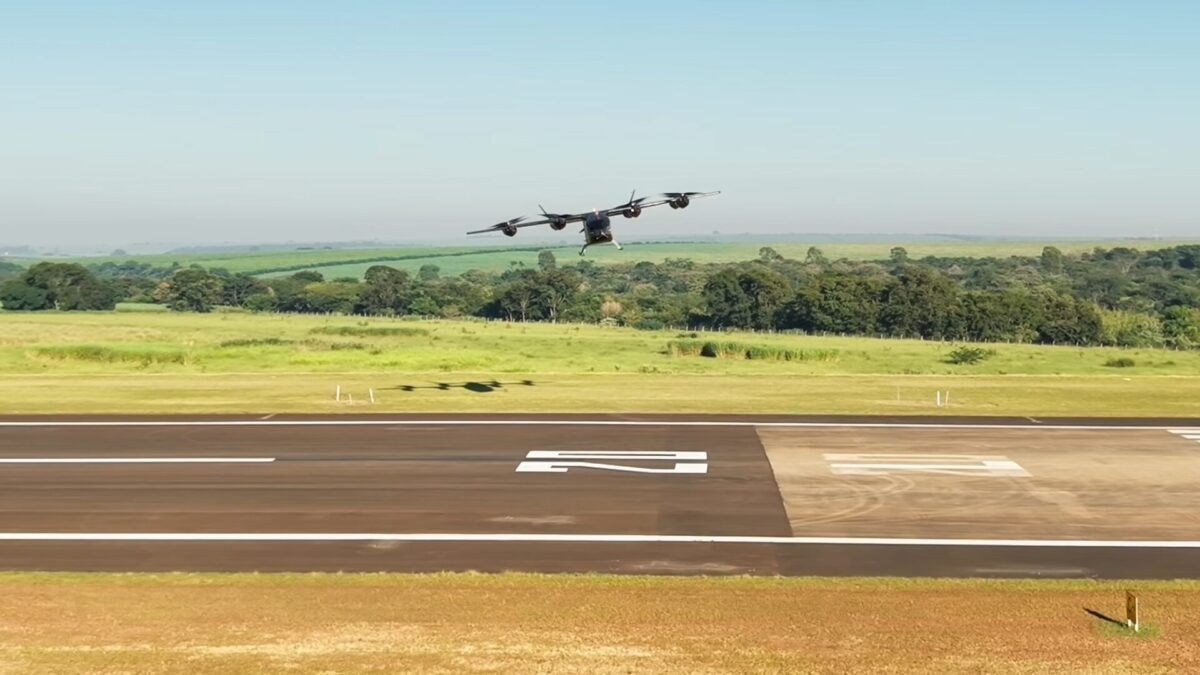
Notable firsts during the block included demonstrations of autoland and the simplified fly-by-wire mode, a backup layer of the fly-by-wire system designed to activate when the normal mode is unavailable. Eve also said recorded noise levels remained in line with expectations, while propulsion and battery performance exceeded predictions.
Marcelo Basile, Head of Tests at Eve, said the data set from the completed block gave the team the confidence required to refine its aerodynamic, propulsion, and load models before the transition flight phase, which is designed to validate the synchronization between the eight vertical lifters and the pusher propulsion system before cruise testing.
Certification effort targets 2027 approval in Brazil
The Brazilian developer is targeting type certification with Brazil’s civil aviation authority ANAC in 2027. Eve plans to build six conforming prototypes for the certification campaign and is producing the aircraft at a dedicated facility in Taubaté, São Paulo, where capacity will scale modularly toward an annual run rate of up to 480 aircraft.
The order backlog has continued to grow ahead of certification, including a February 2026 letter of intent from Japanese operator AirX for two eVTOLs intended for sightseeing and last-mile missions in Tokyo and Osaka, alongside earlier agreements with Revo in São Paulo and US operator Helicopters Inc.