
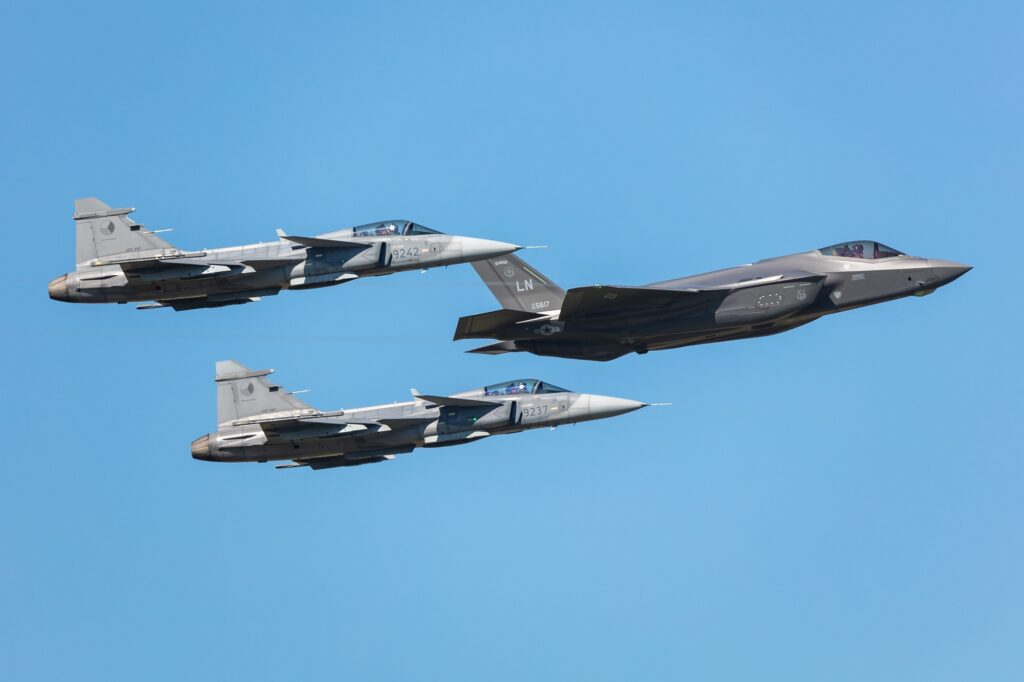
Newly released internal data obtained by Radio-Canada shows that the Lockheed Martin F-35A Lightning II was the overwhelming top-scoring aircraft in Canada’s fighter competition, outperforming Saab’s Gripen E by a wide margin across all major capability categories.
The evaluation was conducted in 2021 as part of the Future Fighter Capability Project (FFCP), Canada’s second attempt in over a decade to replace its aging CF-18 fleet, following an earlier procurement effort that collapsed amid cost concerns and political controversy.
The FFCP restarted the process with new requirements, independent scoring and a commitment to a competitive open tender. Dassault withdrew due to Five Eyes interoperability and security constraints; Airbus exited, arguing the terms favored the F-35; and Boeing’s Super Hornet was later disqualified, leaving only the F-35 and Gripen in the final evaluation.
According to the Radio-Canada documents, the F-35 scored 57.1 out of 60 points (95%), while the Gripen E achieved 19.8 points (33%). Both aircraft met Canada’s mandatory requirements, but their performance diverged sharply once rated operational criteria were applied. Several experts, along with representatives from both competing manufacturers, told Radio-Canada they had never seen the precise evaluation figures before their release.
F-35 dominated all five rated categories
According to the table obtained by Radio-Canada, the F-35 significantly outperformed the Gripen in every category:
| Category | Weight | F-35 Score (%) | Gripen Score (%) |
| Mission Performance | 52% | 97% | 22% |
| Upgradability | 28% | 100% | 28% |
| Sustainment | 11% | 85% | 81% |
| Technical Criteria | 6% | 86% | 55% |
| Capability Delivery | 2% | 67% | 54% |
The most striking gap was in mission performance, where the F-35 scored nearly five times higher than the Gripen. Saab’s best performance was in sustainment, where the Gripen earned 81%, still trailing the F-35’s 85%.
The F-35’s overall score, 57.113 points, placed it near the top of the evaluation scale, while the Gripen’s 19.762 fell below one-third of the achievable total.
Scoring gap adds pressure to Canada’s fighter choices
The data has emerged at a time when Ottawa is reviewing its decision to purchase 88 F-35s, following a directive from Prime Minister Mark Carney amid rising trade tensions with the United States.
Former Royal Canadian Air Force commander Lieutenant-General Yvan Blondin (2012–2015) also reacted to the renewed debate during an interview on Montréal’s 98.5 FM, underlining the stakes involved in choosing a frontline combat aircraft.
“If we send our sons and daughters into combat, it will be in these aircraft,” he said. “If you put them in an F-35 against Chinese or Russian jets in the Arctic, the aircraft scores 95%. If you put them in a Gripen, it’s 33%. That should be the first factor we consider when deciding which fighters to buy.”
Saab still lobbying, pushing the industrial argument
Despite the results, Saab continues to pitch the Gripen E to Ottawa, emphasizing:
- lower operating costs
- rapid maintenance and dispersal capability
- potential for Canadian industrial participation
- possibility of local assembly in partnership with Bombardier
Those industrial benefits have taken on new relevance as Canada re-examines its procurement strategy. Saab is currently in discussions with Bombardier over a possible joint production arrangement, and Ottawa has signaled that industrial return remains a core criterion in its ongoing fighter review.
However, with the newly revealed capability data showing such a decisive performance gap, advocates of a Gripen-based or mixed fleet may face a tougher argument.
The Department of National Defence has reportedly completed its internal reassessment of the F-35 program, but the report has not yet been made public.
With Radio-Canada’s scoring chart now circulating widely, pressure is likely to grow on the government to justify any move away from a full F-35 fleet, or to explain how industrial policy will be balanced against operational capability.