
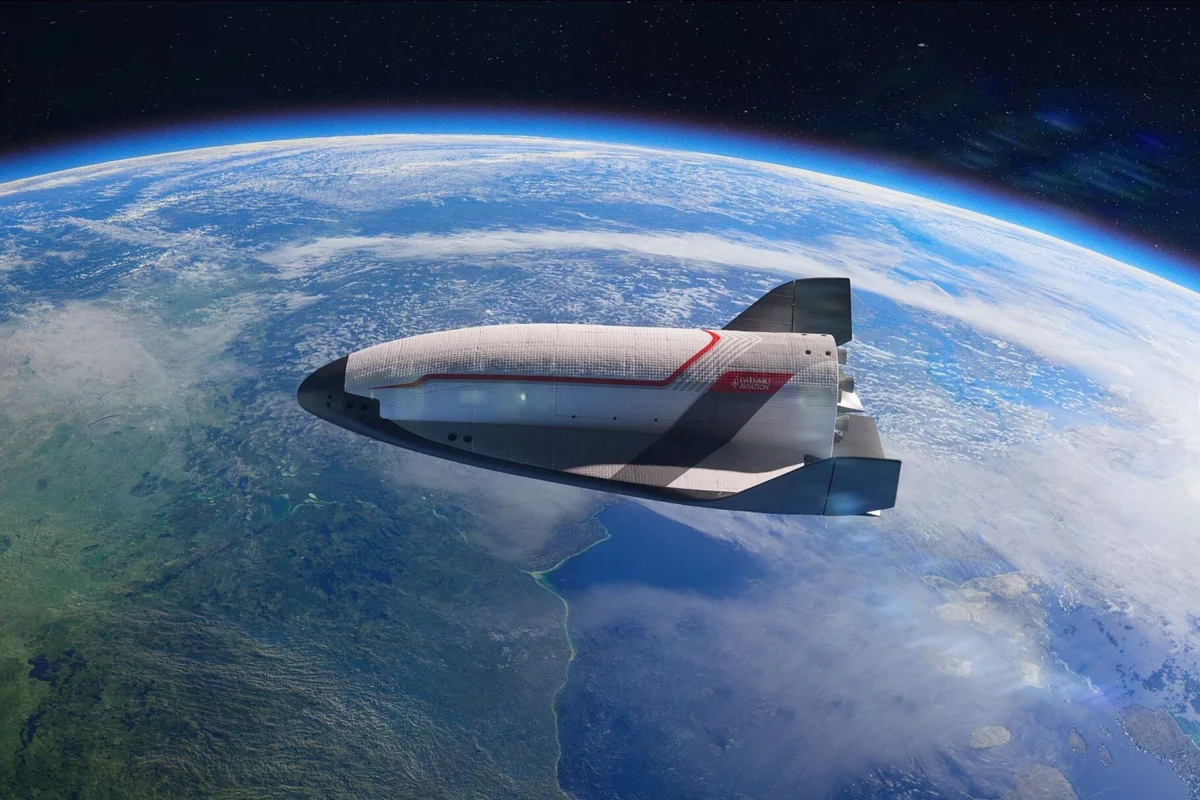
France will support Dassault Aviation’s VORTEX reusable spaceplane program, extending French backing beyond the VORTEX-D technology demonstrator that received €30 million in funding in 2025.
In a statement issued on September 10, 2026, Dassault said that French President Emmanuel Macron had announced the decision at the International Space Summit in Paris. An official Élysée document that lists the summit’s announcements also confirms French support for VORTEX.
Neither document specifies the amount, form or duration of the latest support, or whether fresh funding has been committed.
What is Dassault’s VORTEX spaceplane?
Dassault describes VORTEX as a family of reusable spaceplanes, designed to operate in orbit and return to Earth for a conventional runway landing. The company envisages both civil and military uses, including cargo transport, autonomous orbital missions, in-orbit servicing and intervention.
Planned applications include transporting cargo to low Earth orbit, conducting experiments and production in microgravity, technology demonstrations, in-orbit services and defense missions, with crew transportation envisaged at a later stage.
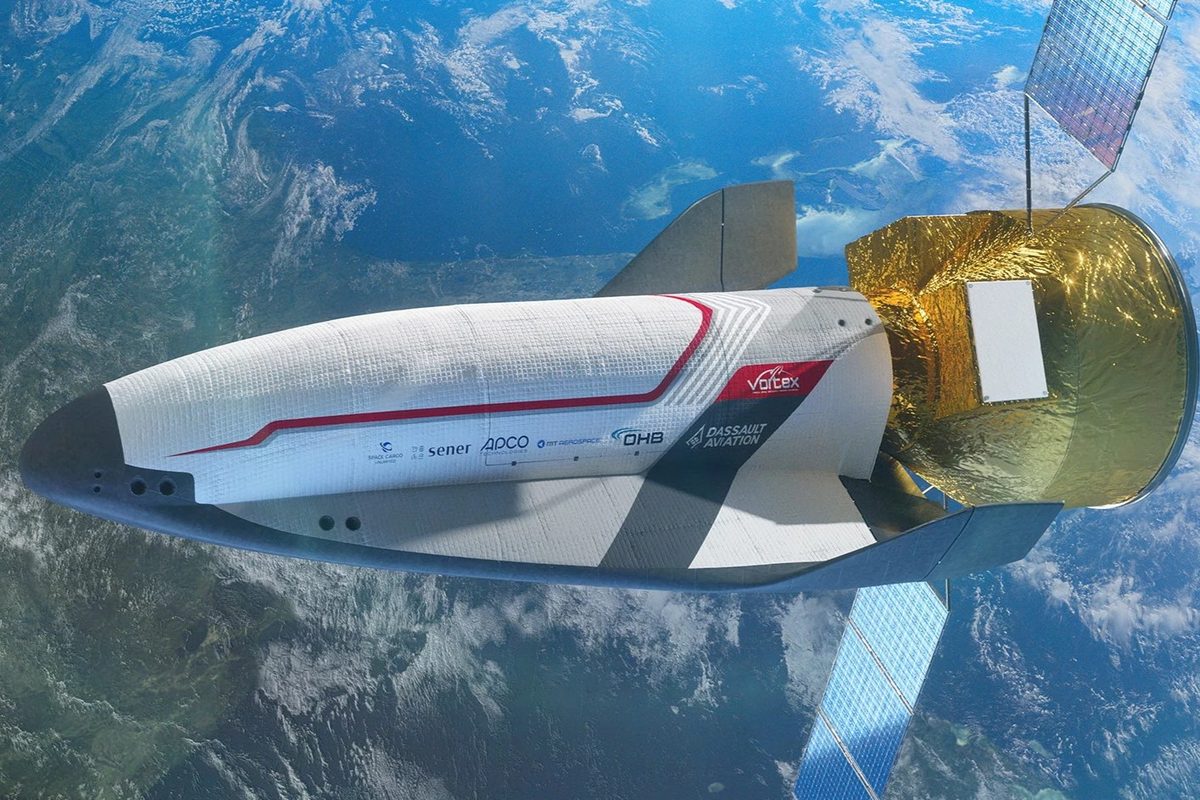
Dassault is acting as global architect and integrator of the spaceplane, with development being carried out in partnership with OHB. APCO Technologies, MT Aerospace, Sener, Sonaca and Space Cargo Unlimited have also joined the project, according to Dassault.
“This project, supported by France, should lead several countries, Germany and others, to join this ambition for mastering mobility in space,” said Éric Trappier, chairman and CEO of Dassault Aviation.
OHB is already involved as a German industrial partner. Dassault’s statement does not specify what form participation by Germany, or other countries beyond the existing industrial partnerships, w take.
From little interest to €30 million in French support
The latest announcement follows a rapid change in the level of public backing for Dassault’s spaceplane ambitions.
On April 9, 2025, Trappier told the French National Assembly’s Defense Committee that France did not have a spaceplane. He said that he had a specific concept in mind and wanted to pursue it, but felt it attracted little interest, contrasting the situation with the attention being given to space capabilities in the United States and China.
Just over two months later, at the Paris Air Show on June 20, 2025, the French Ministry of Armed Forces and Dassault announced an agreement to support the development of VORTEX-D. The ministry subsequently declared that the demonstrator was being financed to the tune of €30 million.
The three-year effort is intended to validate critical technologies for hypersonic flight and atmospheric reentry, rather than develop an operational spaceplane for a defined military mission.
Dassault also signed a separate Letter of Intent with the European Space Agency (ESA) during the Paris Air Show. The two sides announced that they would explore cooperation on orbital vehicles and potentially work on a scaled-down suborbital VORTEX testbed to reduce risks associated with critical technologies.
Five days later, Trappier told the French Senate that VORTEX was beginning to attract military interest, but that Dassault had not been assigned an operational mission. He described the immediate objective as demonstrating the ability to send a vehicle into space and bring it back, before military and strategic applications were defined.
VORTEX roadmap runs from demonstrator to crewed vehicle
Dassault’s program roadmap divides VORTEX into four successive phases.
VORTEX-D is a one-third-scale flight demonstrator, followed by VORTEX-S, a two-thirds-scale ‘Smart Free Flyer’. VORTEX-C would be a full-scale cargo vehicle, while VORTEX-M would ultimately introduce a full-scale crewed version.
VORTEX-D is intended to reduce risks associated with the vehicle’s configuration during hypersonic reentry, validate flight-control principles, and integrate and test key systems and technologies.
On April 21, 2026, Spanish company Arkadia Space announced that it had been selected to supply the VORTEX-D propulsion system.
Dassault builds European team around VORTEX
On May 11, 2026, Dassault and OHB stated that they would jointly propose VORTEX-S to ESA. Under that arrangement, Dassault would serve as prime architect and global integrator of the spaceplane, while OHB would be responsible for the architecture and integration of its service module.
At the time, the companies said that discussions were underway to bring additional European companies into the team.
The German partnership comes against a different backdrop from Dassault’s other major Franco-German aerospace project. In June 2026, France and Germany abandoned plans for a jointly built Future Combat Air System fighter following a prolonged workshare dispute between Dassault and Airbus.
However, VORTEX is structured differently. Dassault retains overall architectural and integration responsibility, while OHB is responsible for the architecture and integration of the VORTEX-S service module.