
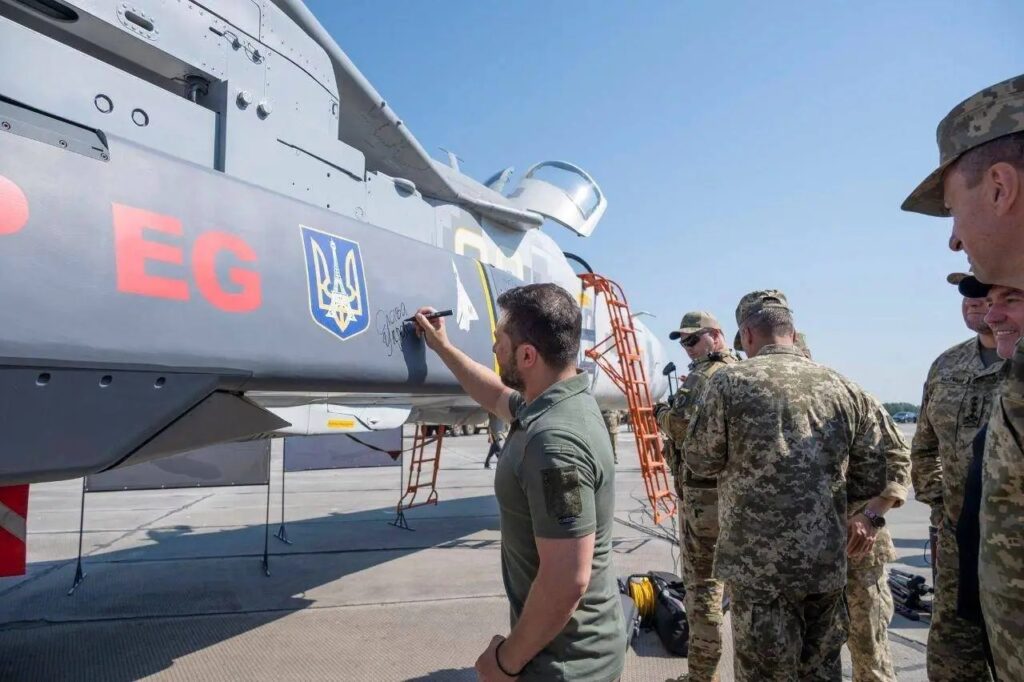
A report by The Telegraph claims that France has opposed an EU plan that would allow Ukraine to use EU-backed loans to buy British-made Storm Shadow cruise missiles.
Citing documents seen by the paper, Ukraine’s weapons requirements exceed what the European Union can currently provide within the bloc, with Ukrainian defense officials estimating they will need €24 billion in military equipment from outside the EU in 2026. The figure is said to be driven mainly by demand for US-made Patriot air defense systems and the associated PAC-3 interceptor missiles.
The article adds that long-range missiles have also been identified as a requirement that European nations may not be able to meet in sufficient numbers. Europe’s options in this category are indeed limited. Germany’s Taurus KEPD 350 is another European air-launched long-range cruise missile, broadly comparable to the Storm Shadow, but Berlin has so far refused to deliver it to Ukraine.
In that context, European officials involved in the effort are reportedly viewing Britain’s Storm Shadow as one potential option to plug the gap.
But what exactly is Storm Shadow, and is it truly a uniquely British solution that only the UK can provide?
What the EU loan scheme actually proposes
In January 2026, the European Commission proposed a €90 billion Ukraine Support Loan for 2026–27. About €60 billion would fund defense-related spending with two parallel aims: keep Ukraine supplied and strengthen Europe’s defense industrial base.
The draft regulation sets eligibility rules for defense products financed under the scheme. It says the criteria should steer spending toward “the reconstruction, recovery and modernisation of the Ukrainian Defence Technological and Industrial Base,” with a view to its gradual integration into the European Defence Technological and Industrial Base.
In simplified terms, it prioritizes manufacturers and key subcontractors established in the EU, EEA-EFTA states, or Ukraine. The UK, as a non-EU and non-EEA country, sits outside the default eligibility perimeter.
At the same time, it allows derogations where Russia’s war creates an “urgent need” and no equivalent product can be delivered at the required scale, or where a non-compliant option can be delivered significantly faster.
What the Storm Shadow is

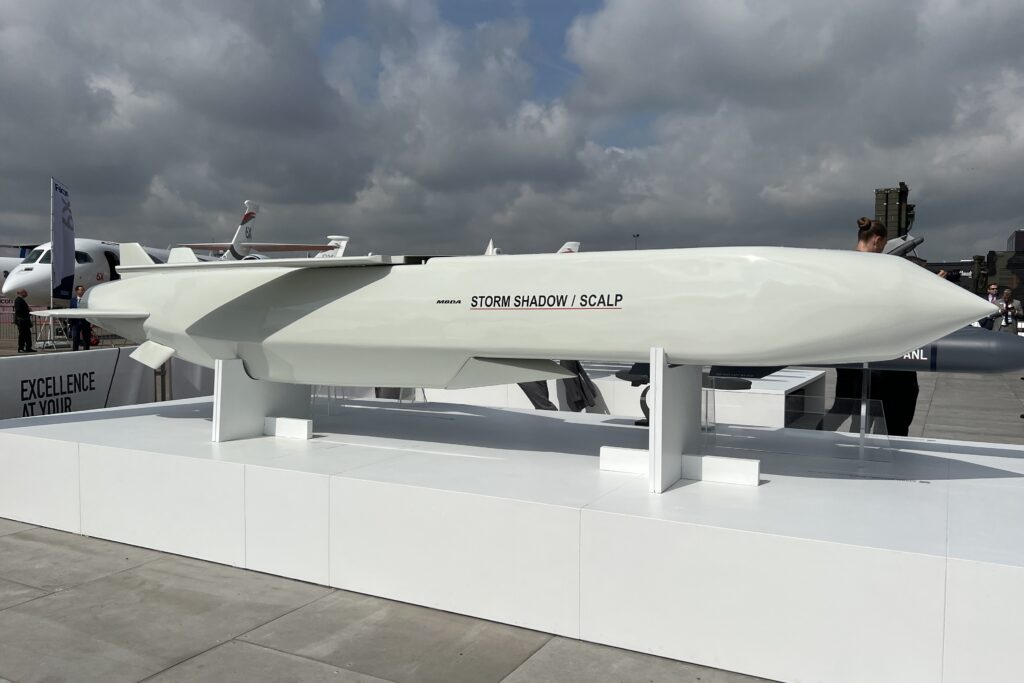
The Storm Shadow is a long-range, air-launched cruise missile built for precision strikes against high-value, well-defended targets. It flies low to reduce detection, navigates using a mix of inertial navigation, GPS, and terrain-matching, and then uses an imaging infrared seeker in the final phase to lock onto the target scene.
That terminal guidance method is one reason it remains useful in heavily contested electronic warfare environments, as it does not rely solely on GPS to hit accurately.
Its warhead, called BROACH, is a two-stage penetrator meant for hardened targets. The first charge opens a path; the main charge follows through and detonates inside. In practical terms, it is designed for things like bunkers, command posts, ammunition depots, and protected infrastructure, targets that simpler warheads or smaller drones struggle to reliably defeat.
Ukraine has integrated the missile onto its Su-24M tactical bombers, and the Mirage 2000-5 fighters donated by France have also been modified to carry out Storm Shadow strikes.
Where it is produced


The Storm Shadow missile was developed by MBDA as part of a Franco-British program. In France, it is referred to as the SCALP-EG. Both versions have already been supplied to Ukraine through national donations.
MBDA’s industrial footprint matters here because it gives Paris a very straightforward counter-argument: if the EU wants to spend EU-backed money inside the EU, there is an EU industrial route for this missile.
In France, SCALP integration is linked to MBDA’s Selles-Saint-Denis site in Loir-et-Cher, which hosts final integration and pyrotechnics lines. In the UK, Storm Shadow is tied to MBDA’s Stevenage site. Both France and the UK have said they want to restart or ramp up production to rebuild their own stockpiles after donating missiles to Ukraine.
Reporting in Le Monde has suggested the question of restarting was especially relevant on the UK side because Stevenage was not fully operational in the same way as Selles-Saint-Denis.
So, what is France opposing?
What France appears to be pushing back on is the idea that EU-backed loans should be structured to make it easy to spend EU money on a UK production line, even when an EU production line exists for the same capability.
In his New Year address to the Armed Forces on January 15, 2026, French President Emmanuel Macron delivered an unusually blunt message to the national defense industry, warning that “there is no guaranteed market, no protected turf,” and telling manufacturers to stop treating the French armed forces as captive customers. Macron added that France may look for “European solutions if they are faster or more effective.”
The only question that really matters to Ukraine is whether missiles can be delivered quickly, in sufficient numbers. If Selles-Saint-Denis can produce enough SCALP missiles fast enough while France is also rebuilding its own stocks, then the EU-first logic looks coherent. If it cannot, then the regulation already contains a mechanism to make exceptions on urgency grounds.
AeroTime has contacted the French Ministry for Europe and Foreign Affairs for comment.