
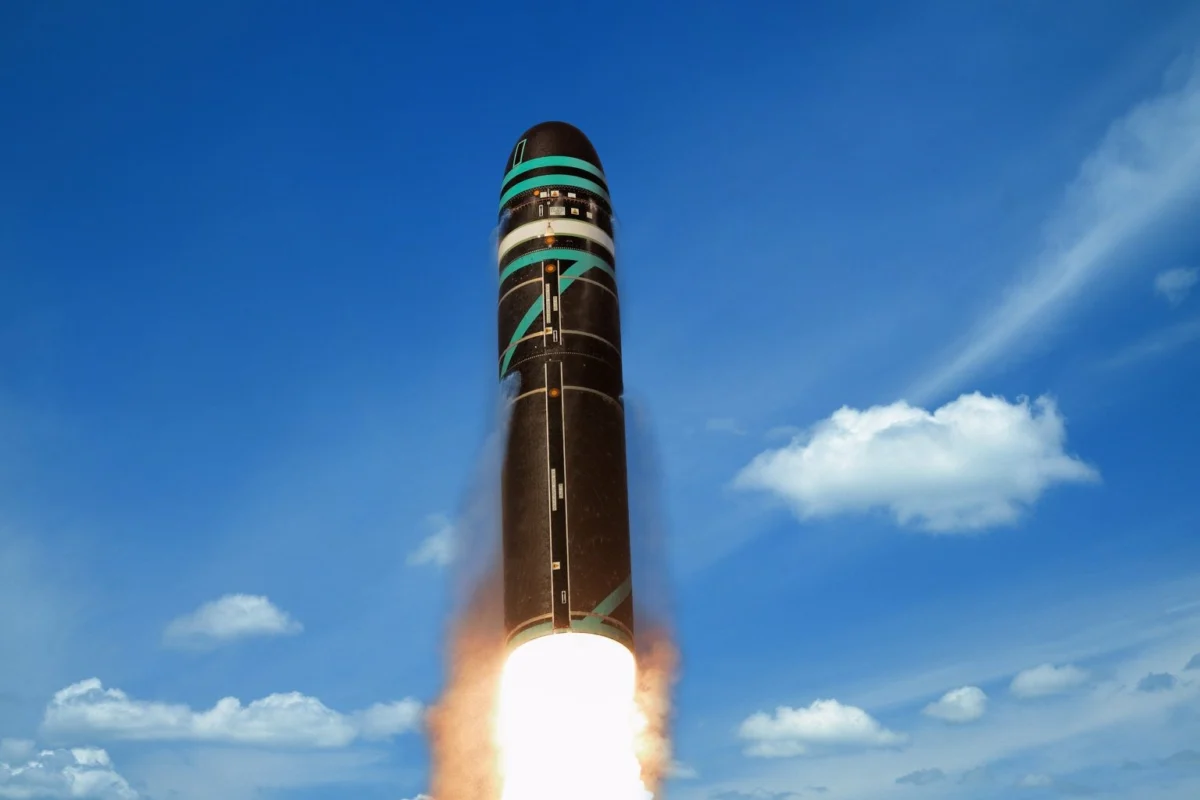
France’s defense procurement agency (DGA) announced on October 6, 2026, that the French Navy’s ballistic missile submarine (SSBN) Le Vigilant had successfully carried out an acceptance firing of an unarmed M51.3 submarine-launched ballistic missile.
The test validates Le Vigilant’s strategic weapon system after a three-year overhaul. It is a key step before it rejoins the rotation of SSBNs that keeps at least one French submarine on nuclear deterrence patrol at all times.
French President Emmanuel Macron attended the firing from the FREMM frigate Auvergne off the coast of Brittany. He described the test as “a new demonstration of the credibility of our deterrence,” adding that the long-term sustainability of France’s nuclear forces was assured.
Macron also pointed to the wider modernization of France’s nuclear arsenal, saying that construction of the future third-generation SSBNs was underway and that a program for new hypersonic, maneuvering strategic missiles for the airborne component had been launched in 2026.
À bord de la frégate multi-missions Auvergne, j’ai assisté au premier tir du nouveau missile balistique M51.3 depuis le sous-marin nucléaire lanceur d’engins Le Vigilant. Très peu de nations disposent d’un tel savoir-faire. Félicitations à tous les acteurs de cette réussite exceptionnelle : DGA, CEA, Ariane Group, Naval Group et Marine nationale. Votre professionnalisme, votre rigueur et votre maîtrise technique sont la fierté de la France. Ce succès technique est une nouvelle démonstration de la crédibilité de notre dissuasion, dont la pérennité est assurée. Pour être libre, il faut être craint. Et pour être craint, il faut être puissant. Pour protéger les Français dans la durée face aux menaces, j’ai engagé dès 2017 le renouvellement de nos moyens pour les décennies à venir. En dix ans, le budget de nos armées aura doublé. Nos futurs sous-marins stratégiques sont actuellement en chantier. Le programme de missiles stratégiques hypersoniques et manœuvrants, qui équiperont notre composante aérienne de dissuasion, a été lancé cette année. Notre dissuasion nucléaire nous protège et continuera à nous protéger. Vive la République et vive la France.
— Emmanuel Macron (@EmmanuelMacron) October 6, 2026
First submarine launch of the M51.3
Based on publicly disclosed tests, the firing also marks the first time the M51.3 has been launched from a submarine. A navigation warning had closed a maritime area off Finistère, in western Brittany, from October 5 to October 21, 2026, to accommodate the firing.
The first firing of the M51.3 version, which qualified the new variant, took place at Biscarrosse, in southwestern France, on November 18, 2023.
French Armed Forces Minister Catherine Vautrin signed the missile’s entry into operational service on October 24, 2025.
For a closer look at how such a launch unfolds, the infographic below by Étienne Marcuz and CalvaireDrach walks through the sequence from the transmission of the launch order to the reentry of the missile’s payload over the Atlantic.
🇫🇷🚀☢️ French Ministry of Armed Forces just confirmed the successful launch of an M51.3 intercontinental ballistic missile from the SSBN Le Vigilant, confirming its return to the operational cycle after 3 years of maintenance. This was the first operational launch of this new version of the missile from a SSBN. For the occasion, @CalvaireDrach and I prepared an infographic showing how such a launch unfolds, from the transmission of the order to the impact of the reentry vehicle(s) — without their nuclear warheads — in the Atlantic Ocean, 4,700 km West of the launch area. This infographic is based on the analysis of American documentation, which is very extensive on the subject. There may be slight differences between the French and American systems (M51 vs. Trident II D5), but the general principles described here are common to this type of missile. The major differences lie in the details — network meshing and encryption, number and type of vectored objects, bus maneuvering capability and accuracy, weapon energy and governmental control systems, etc. These are protected by the utmost secrecy. I will soon publish a more detail article on this on Letstalkdeterrence. Many thanks to @CalvaireDrach for the work — if you wish to reuse this diagram, please credit her🙏
— Etienne Marcuz (@Etienne_Marcuz) October 6, 2026
Le Vigilant completes three-year overhaul
Le Vigilant began its periodic maintenance and repair period, known in France as IPER, in fall 2023 at Île Longue, the home port of France’s SSBN force.
There, crews offloaded its weapons and nuclear reactor fuel. The submarine then spent 18 months in dry dock at the Brest naval base before returning to Île Longue on July 18, 2025, for the final phase of the work.
According to prime contractor Naval Group, the overhaul represented four million hours of work and included around 700 major modification orders to modernize the submarine’s systems.
The French Navy’s fleet support service (SSF) managed the maintenance, while the DGA oversaw the modernization work.
A routine validation with a troubled precedent
French SSBNs typically conduct an M51 firing after a major overhaul to validate the complete strategic weapon system.
Le Vigilant’s previous post-overhaul firing ended differently. On May 5, 2013, following the boat’s conversion to carry the M51, the missile self-destructed shortly after launch off Brittany. It remains the only publicly reported failure in the M51’s flight history.
Before the latest test, the most recent French submarine launch of an M51 had taken place in April 2023, from Le Terrible.
M51.3 enters the fleet as M51.4 follows

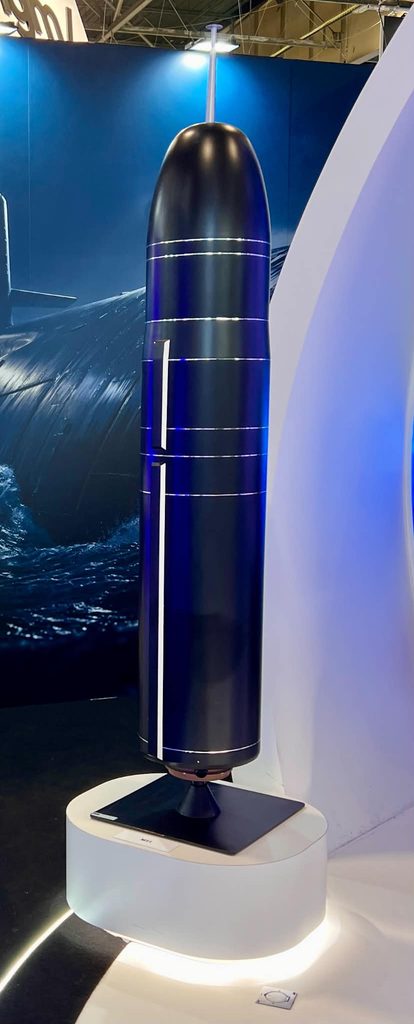
ArianeGroup has developed the M51.3 under DGA supervision since 2014. The missile features an improved third stage intended to extend its range and improve its ability to penetrate missile defenses.
It carries the TNO-2 oceanic nuclear warhead developed by France’s Alternative Energies and Atomic Energy Commission (CEA) and is gradually replacing the M51.1 and M51.2 aboard the French Navy’s four Triomphant-class SSBNs.
Its successor is already in development. The DGA awarded ArianeGroup the M51.4 contract on August 28, 2025.
The new variant is set to follow the M51.3 in the 2030s aboard both the Triomphant-class boats and France’s future third-generation SSBNs.
Macron announced on March 2, 2026, that the first of those new submarines would be named L’Invincible. He made the announcement during the same Île Longue speech that introduced “forward deterrence” to France’s nuclear doctrine.