
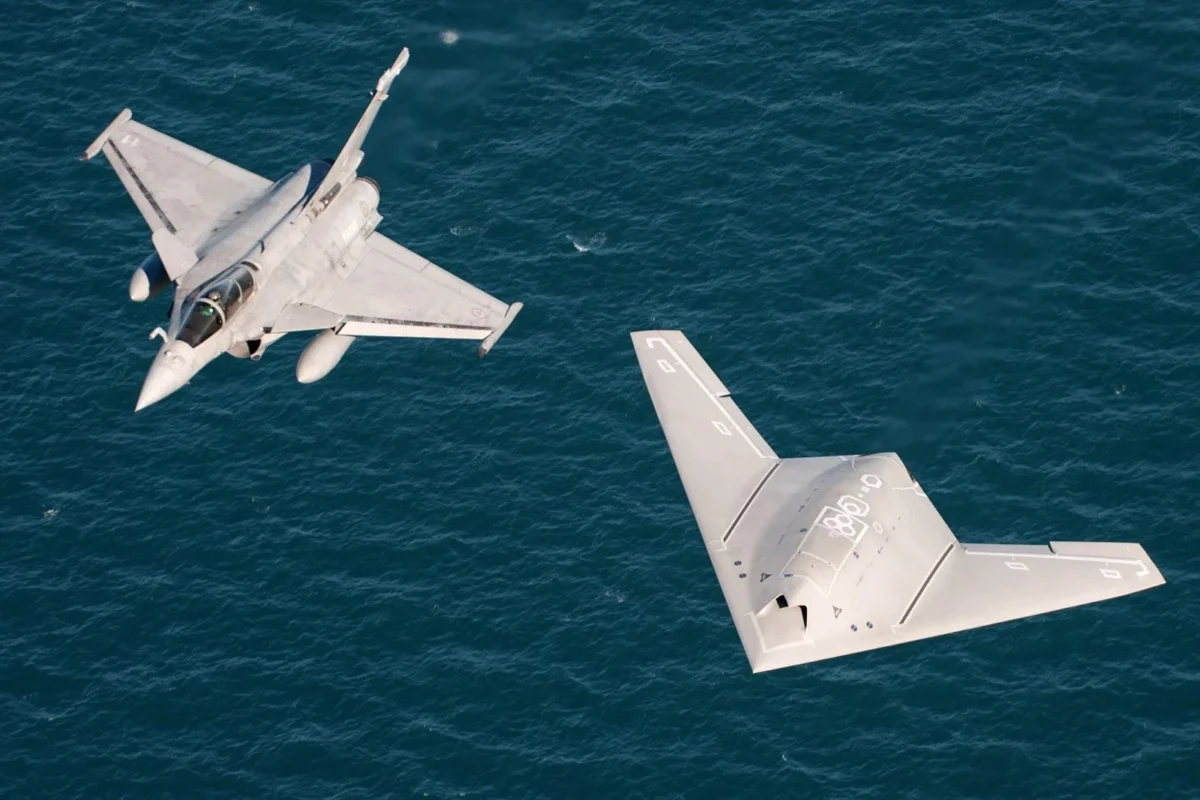
France will shoulder the full development cost of the Rafale F5 after a co-financing partnership with the United Arab Emirates fell apart in late December 2025, La Tribune reported.
The breakdown adds billions to a French defense budget already under severe strain, delays deliveries of the next-generation fighter standard, and leaves the accompanying stealth combat drone without a funded program.
A €3.5 billion partnership that never materialized
Abu Dhabi had been prepared to contribute up to €3.5 billion ($3.8 billion) toward a roughly €5 billion ($5.7 billion) outstanding bill for the F5 program, according to La Tribune. But the deal collapsed after months of impasse over what the UAE would get in return. The Emirates wanted close involvement in the fighter’s development, particularly access to advanced technologies, including optronics. France initially entertained the idea but ultimately refused to share those capabilities, leaving Abu Dhabi facing a multibillion-euro invoice with no meaningful technological return.
The friction came to a head during President Emmanuel Macron’s visit to Abu Dhabi in late December 2025. The meeting with UAE President Sheikh Mohamed bin Zayed reportedly went poorly. The UAE walked away, and Macron reportedly directed his anger at the Direction générale de l’armement (DGA) and the French Chief of Staff (EMA) over the botched negotiation.
The fallout is now being absorbed into France’s updated Military Programming Law (LPM), due before the Council of Ministers on April 8, 2026. The revised law adds €36 billion to the original €413 billion envelope, but officials concede it will not be enough.
What the Rafale F5 is, and what it costs
The scale of the bill that France must now absorb alone reflects the ambition of the program.
Often described as a “Super Rafale,” the F5 standard will incorporate the Thales RBE2 XG gallium nitride radar, an overhauled SPECTRA electronic warfare suite, new optronic sensors, and conformal fuel tanks. It will carry the ASN4G, a scramjet-powered hypersonic nuclear missile being developed by MBDA for France’s Strategic Air Forces.
The airframe will also be powered by Safran’s M88 T-REX, an upgraded variant of the current M88 engine unveiled at the Paris Air Show in June 2025. The T-REX raises afterburning thrust by 20% to 88 kN (19,840 lb), up from the current 73 kN (16,500 lb), through an improved low-pressure compressor, next-generation turbine materials, advanced cooling circuits, and an aerodynamically optimized nozzle, all within the same physical envelope as the baseline M88.
The DGA has notified development contracts worth more than €4 billion for the F5 overall, with entry into service targeted around 2035.
Another ambitious element is an accompanying stealth combat drone derived from the nEUROn demonstrator, designed for suppression of enemy air defenses (SEAD) missions in tandem with the manned fighter. But that program might also be facing a funding problem.
UCAS announced but not launched
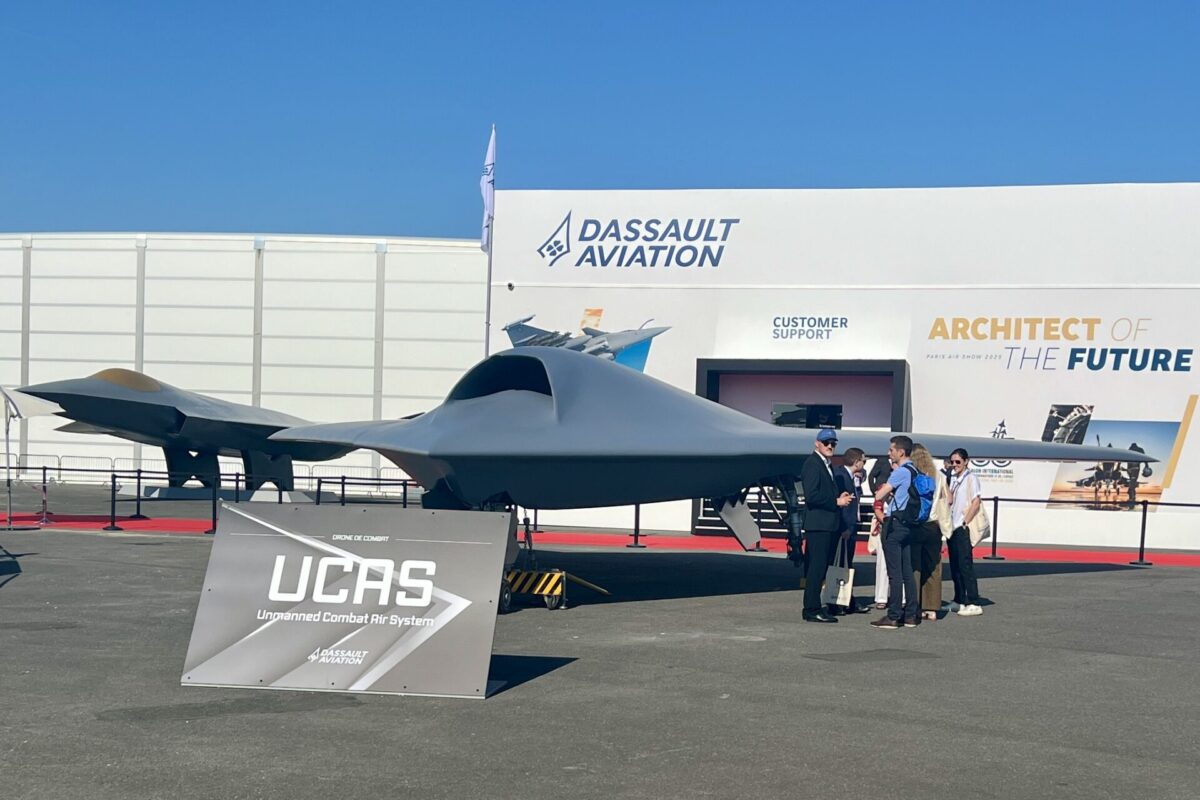
Speaking to Boursorama on March 5, 2026, the day after presenting Dassault Aviation’s record 2025 results, CEO Eric Trappier was blunt about the UCAS status.
“There is no program launched to this day,” he said. “It was announced by our authorities in past years but it has not been launched yet. We are looking for partners.”
The UCAS was formally announced by then-Armed Forces Minister Sébastien Lecornu in October 2024, and a full-scale mockup was exhibited at the Paris Air Show in June 2025. The French LPM allocated just €128 million for UCAV preparatory work between 2024 and 2026, a fraction of what full-scale development will require.
Dassault’s own $200 million investment in AI startup Harmattan AI in January 2026, focused on manned-unmanned teaming for the F5 and UCAS, suggests the company is not waiting for a formal program launch before advancing the drone’s technological base. But without a notified contract from the DGA, the UCAS remains an announcement without a budget line. The loss of a potential Emirati co-financing partner makes the path to launch even less clear.
SCAF collapse narrows France’s options further
Trappier’s search for partners comes at a time when France is running short of allies willing to co-fund combat air programs at any level.
The tri-national SCAF (Future Combat Air System) with Germany and Spain is on life support. Berlin and Paris set a mid-April 2026 deadline for a resolution, but the Airbus Deutschland works council has publicly opposed mediation, and German political voices are openly favoring an exit toward the GCAP or a national alternative.
The lost Emirati contribution also tightens the envelope available for other programs already competing for the same budget, including whatever remains of SCAF. Should the European program be formally buried, France would face the prospect of financing a next-generation combat aircraft capability entirely on a sovereign basis.
Technology transfer as a recurring sticking point
The Emirati experience also fits a broader pattern for France’s defense export diplomacy. India’s Defence Acquisition Council cleared a proposal in February 2026 for 114 Rafale jets under the Multi-Role Fighter Aircraft (MRFA) program, a deal estimated at up to $40 billion that would make it New Delhi’s largest-ever defense procurement. Dassault is expected to establish a second assembly line in Hyderabad, with roughly 96 aircraft to be manufactured locally.
But Indian media and defense commentators have raised concerns that echo Abu Dhabi’s frustrations, pointing out that India would remain dependent on Dassault and its subcontractors to integrate indigenous weapons and sensors, a limitation that sits uncomfortably with New Delhi’s self-reliance ambitions under the Make in India banner. The final contract has not yet been signed and is not expected before late 2026 at the earliest.
Rafale diplomacy over the Gulf restores trust, for now
The Franco-Emirati relationship has reportedly recovered from the December 2025 rupture. The ongoing conflict in Iran and France’s concrete support to Abu Dhabi, including French Rafale pilots flying daily intercepts against Iranian Shahed drones over Emirati airspace, has restored trust between the two capitals. France is, along with Greece and the United Kingdom, one of the European nations providing direct military assistance to the UAE under a bilateral defense agreement.
The UAE remains Dassault Aviation’s largest export customer by volume. Its 80-aircraft Rafale F4 order, signed in December 2021 and valued at approximately €16 billion ($17.3 billion), is the biggest export contract in French defense history, with deliveries expected between 2026 and 2031. Discussions over a follow-on order of 20 additional aircraft have also been underway.
La Tribune noted that several sources did not rule out Abu Dhabi returning to the F5 financing table after 2027, once the geopolitical turbulence settles and the terms of engagement become clearer. But for now, France is on its own.