
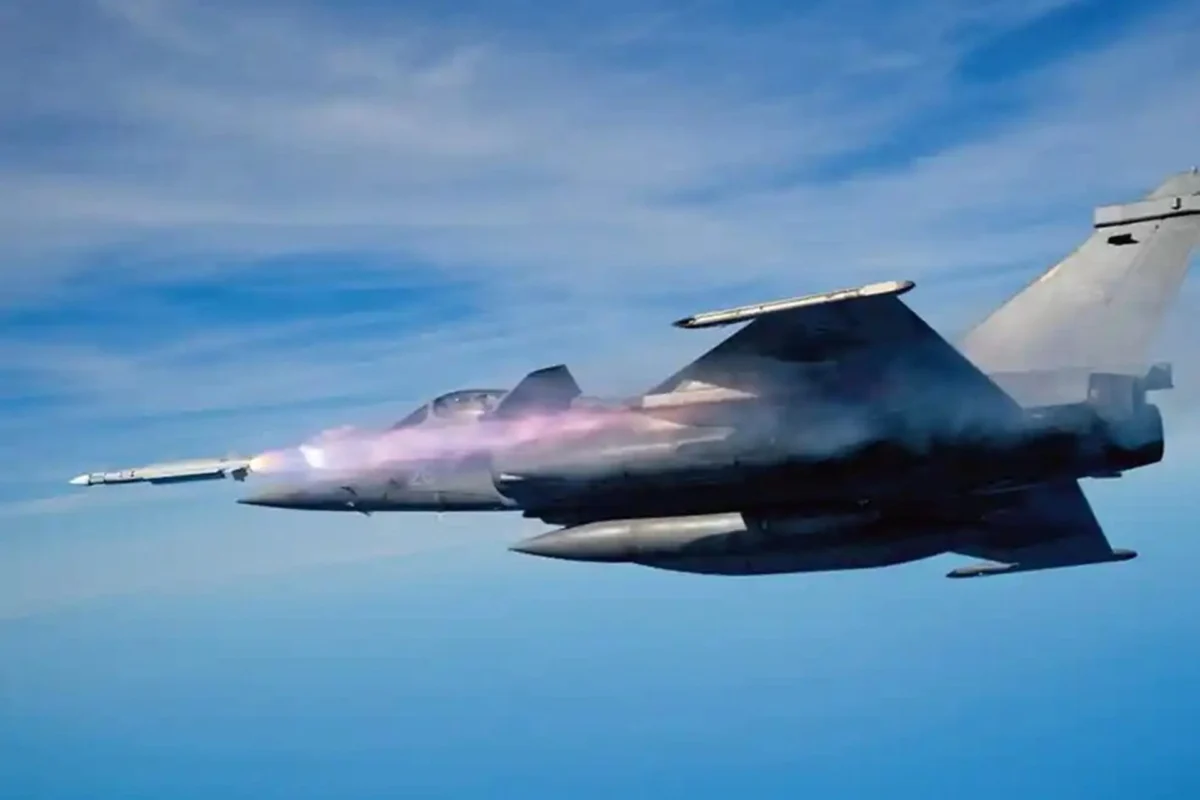
In a step towards qualifying the MICA NG air-to-air missile, France has carried out the first firing of the next-generation weapon from a Dassault Rafale in supersonic flight, the country’s defense procurement agency announced.
Reporting the result on June 5, 2026, the Direction générale de l’armement (DGA) declared that the test took place on June 1, from an instrumented aircraft at its DGA Essais de missiles range on the Mediterranean coast.
Conducted under DGA direction with MBDA, Dassault Aviation, and the French Air and Space Force, the launch evaluated the performance of the missile’s infrared seeker under what the agency described as very demanding conditions.
[#Essai 🚀] Succès du premier tir du missile MICA NG depuis un Rafale en vol supersonique
— Direction générale de l'armement 🇫🇷 (@DGA) June 5, 2026
Ce tir, réalisé le 1er juin 2026, marque une étape clé vers la qualification de ce système d’arme de nouvelle génération ⤵️ pic.twitter.com/jbcNWtWrmK
While the DGA called it the first firing in a supersonic configuration, it was actually the second development launch of the MICA NG from a Rafale. The first development firing, on June 19, 2025, over the same Mediterranean range, validated the infrared variant’s guidance and engagement chain against a target drone. However, it was not conducted at supersonic speed.
At speeds above Mach 1, the missile and its infrared seeker face higher ambient temperatures, the DGA explained. The hotter the surroundings, the weaker the contrast between the target and the background image, and the harder it becomes for the seeker to detect and track the target. The June 1 firing validated the MICA NG’s infrared seeker in those conditions and confirmed the missile’s complete implementation chain in its infrared version.
Five DGA centers behind the launch
Five DGA test and expertise centers were involved in the preparation and running of the firing. DGA Essais de missiles and DGA Essais en vol oversaw the launch, target operation, and range safety; DGA Ingénierie et projets led the technical coordination; and DGA Maîtrise de l’information and DGA Techniques aérospatiales handled the weapon system’s operational safety, including its resistance to mechanical, climatic and electromagnetic environments. The work followed several flight-test campaigns flown with DGA Essais en vol’s Fokker 100 test-bench aircraft.
What MICA NG brings to the Rafale
In development at MBDA since late 2018, the MICA NG will replace the in-service MICA on the Rafale and is being integrated as part of the aircraft’s F4 standard, renewing interception, close-combat and self-protection capabilities for the French Air and Space Force and the French Navy. Like the current MICA, it will be produced in infrared and electromagnetic (active radar) seeker versions. According to MBDA’s datasheet, the 112-kilogram (247-pound) missile uses a dual-pulse motor for added range and end-game maneuverability, offers up to 40% more range than the MICA, and handles both beyond-visual-range and short-range engagements. It complements the longer-range MBDA Meteor in the Rafale’s air-to-air arsenal.
Further firings are planned in order to qualify the MICA NG across its different versions, altitudes and flight speeds ahead of initial deliveries. The DGA highlighted that the production line is being set up to meet French and export demand as industry prepares for high-intensity conflict. A vertical-launch variant, VL MICA, is also being fielded for ground-based air defense.