
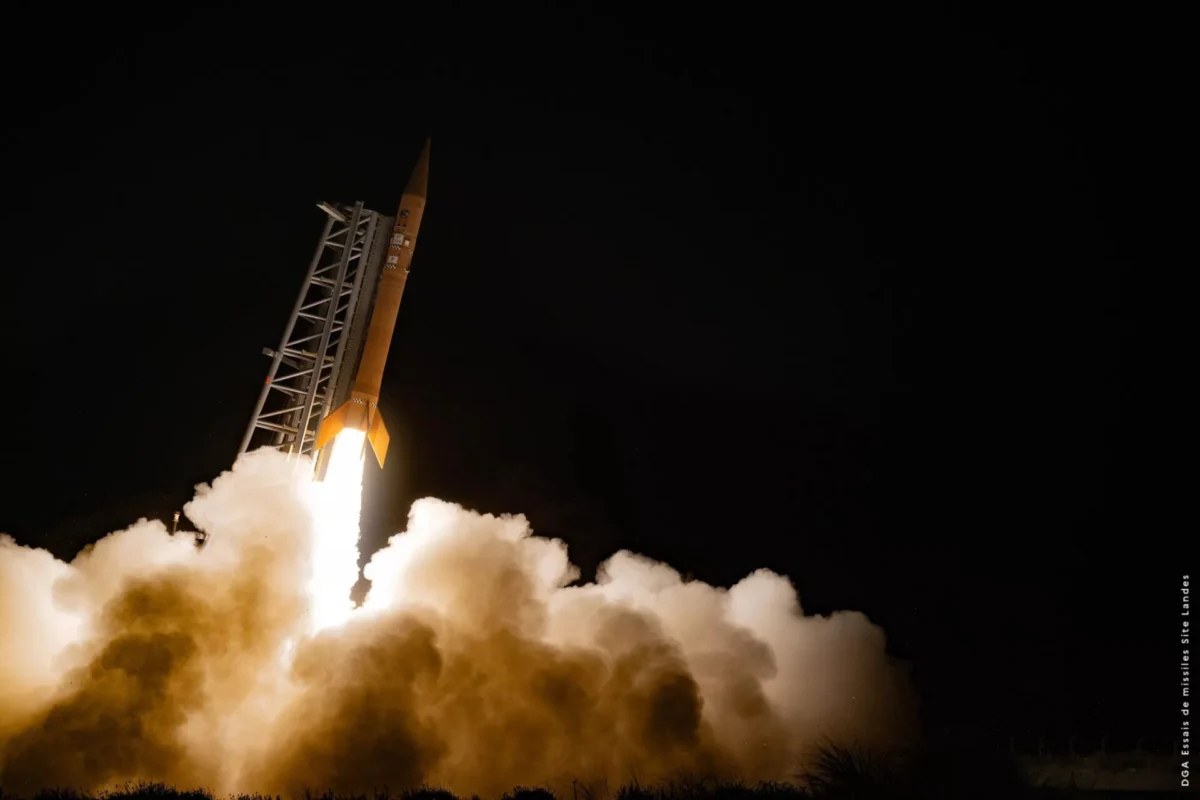
France’s defense procurement agency, the Direction générale de l’armement (DGA), launched a SyLEx sounding rocket during the night of November 3 to 4, 2026, carrying experiments for the future M51.4 submarine-launched ballistic missile (SLBM).
French Minister of the Armed Forces and Veterans Catherine Vautrin announced the launch in a post on X on November 4, 2026. The rocket lifted off from the Landes site of the DGA Essais de missiles test center in Biscarrosse, southwestern France.
According to Vautrin, the flight made it possible to conduct new experiments essential to the development of the M51.4.
It came less than a month after the October 6, 2026, acceptance firing of an unarmed M51.3 missile from the ballistic missile submarine Le Vigilant. That earlier launch also supported the M51.4 program. ArianeGroup said the M51.3 had carried additional experiments for the next version of the missile.
Une nouvelle avancée pour notre dissuasion ! Cette nuit, la @DGA a réalisé avec succès, depuis le site Landes à Biscarosse du centre d’essais et d’expertise DGA Essais de missiles, un tir expérimental de la fusée-sonde française SyLEx (système de lancement d’expériences), développée par @ArianeGroup sous son pilotage. Ce lanceur national permet de tester en vol de nouvelles technologies au profit de la dissuasion française, du développement de démonstrateurs hypervéloces et d’applications civiles. Plus encore, il redote la France d’une capacité souveraine de vols suborbitaux et d’essais en haute atmosphère, dont elle était privée depuis plusieurs décennies. Moins d’un mois après le tir d’acceptation n° 6 réalisé depuis le SNLE Le Vigilant, ce tir a permis de conduire de nouvelles expériences essentielles au développement du missile M51.4. Félicitations à toutes les équipes mobilisées pour cette avancée technologique au service de notre souveraineté!
— Catherine Vautrin (@CaVautrin) November 4, 2026
SyLEx gives France its own suborbital flight-test capability
Developed by ArianeGroup under DGA management, SyLEx, short for Système de lancement d’expériences (Experiment Launch System), is designed to carry experimental payloads on suborbital flights. Vautrin said the system will support the development of France’s nuclear deterrent, hypersonic demonstrators, and civilian research.
Vincent Péry, ArianeGroup’s director of defense programs, said that the launch showed the company could provide “a sovereign suborbital test platform,” and that work with the DGA continues on a two-stage version.
SyLEx made its first flight from Biscarrosse during the night of November 27 to 28, 2025. The DGA said the test validated the critical liftoff phase and the in-flight tracking of the onboard demonstrator.
That first flight used the single-stage Block 1 version, which ArianeGroup lists as 10 meters (33 feet) tall, with a payload capacity of 300 kilograms (661 pounds). A two-stage Block 2, capable of carrying 600 kilograms (1,323 pounds), is expected to make its first flight by 2027. Depending on the configuration, SyLEx is designed to reach altitudes between 140 and 400 kilometers (87 and 249 miles).
France previously relied on US launch systems for some of its hypersonic flight tests. When the DGA tested the V-MAX hypersonic glider from Biscarrosse on June 26, 2023, it used a three-stage Terrier-Oriole-Oriole sounding rocket assembled and launched by the US Navy’s Naval Surface Warfare Center, Port Hueneme Division.
According to the US Naval Sea Systems Command, the center’s White Sands Detachment had been helping the French Ministry of the Armed Forces establish a sounding rocket program at Biscarrosse since early 2020.
M51.4 missile to equip France’s current and future nuclear submarines


The DGA awarded ArianeGroup the contract to develop and produce the M51.4 on August 28, 2025. It will be the fourth version of the M51, the ballistic missile used by France’s sea-based nuclear deterrent.
The M51.4 is expected to enter service in the 2030s aboard both the current Le Triomphant-class ballistic missile submarines and France’s future third-generation boats.
According to the DGA, the new version will offer greater range and accuracy, as well as improved capabilities to penetrate adversary missile defenses.
It will succeed the M51.3, which completed its qualification flight from Biscarrosse on November 18, 2023, and entered operational service in October 2025.