
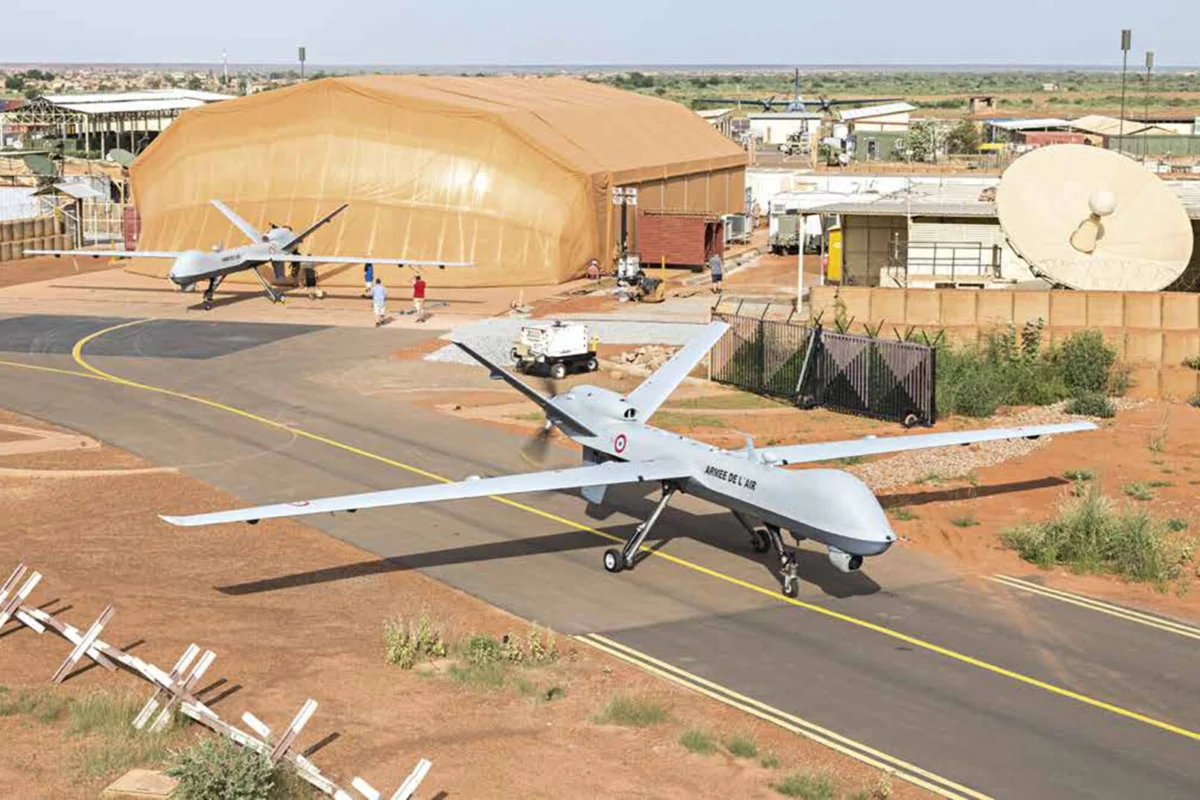
A new parliamentary report on French military dependence on foreign suppliers identifies gaps in sovereignty ranging from MALE drones to satellite-based early warning. The findings are not entirely new, but together they form a coherent map at a time when European armed forces are reconsidering long-standing US-origin dependencies.
Produced by deputies François Cormier-Bouligeon and Aurélien Saintoul for the Defense Commission, the report draws on months of hearings with the DGA, industry executives, and military officials.
It lands as France absorbs the effects of Operation Epic Fury and a wider European reorientation on weapons procurement and supply.
Where French sovereignty still holds

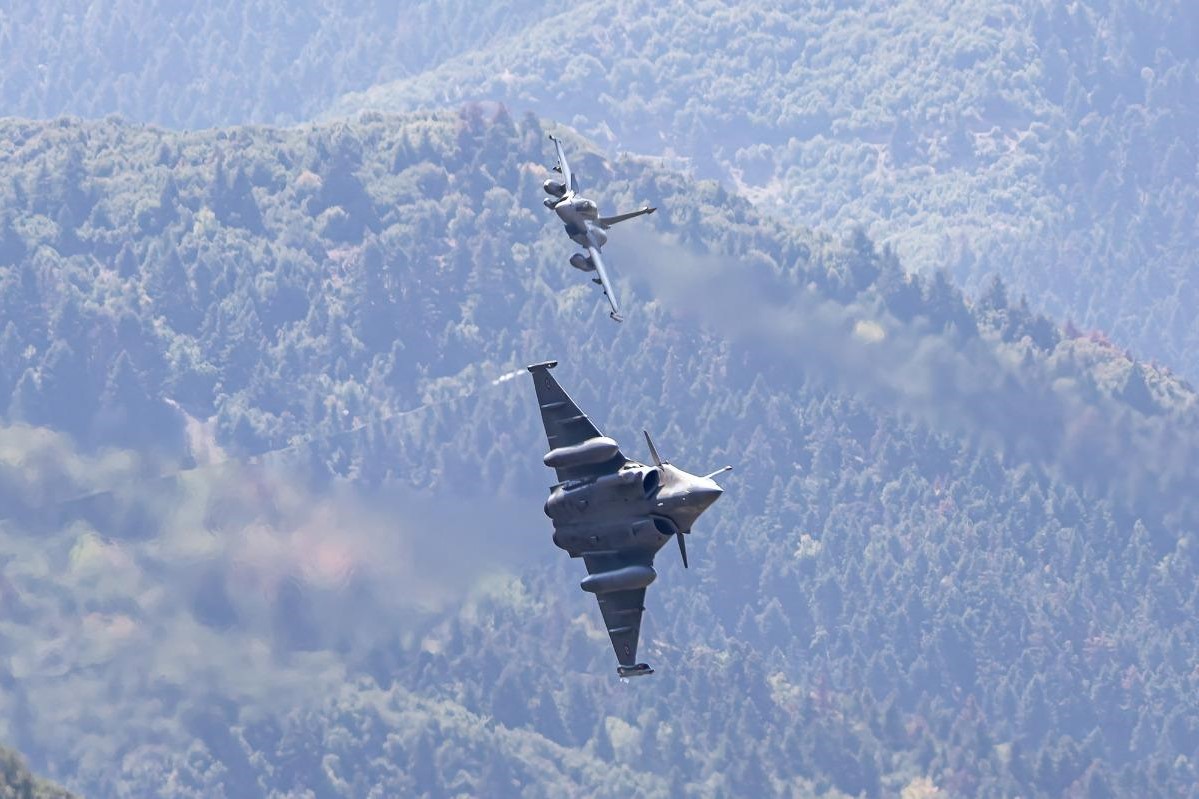
The French Air and Space Force retains sovereign capabilities on combat aircraft, liaison aircraft, helicopters, surface-to-air, air-to-ground, and air-to-air weapons, and radars.
The French Navy retains them on combat vessels, embarked air groups, anti-ship cruise missiles, helicopters, and maritime surveillance aircraft.
Safran covers engines for combat aircraft and helicopters, Thales covers satellites and electronics, and ArianeGroup is preparing a second iteration of its VMAX hypersonic glider demonstrator.
However, the rapporteurs argue that this inheritance is being eroded, and that the budget choices made during the “peace dividend” years (1997 to 2017) created dependencies that are harder to reverse now than to acknowledge.
A drone fleet built around a single foreign platform
On medium-altitude long-endurance (MALE) drones, France operates only one model: the General Atomics MQ-9 Reaper. Pilot training has been conducted exclusively on US soil, and growing US Air Force demand has cut the slots available to European operators.
National contenders are advancing: the Aarok by Turgis & Gaillard, which carried out its first piloted flight on September 9, 2025; the ENBATA by Aura Aero; and a model by Fly-R. The rapporteurs see a sovereign solution as achievable but caution that scaling production for high-intensity conflict remains unresolved.
France’s updated military programming law, presented on April 8, 2026, confirmed the cancellation of the Eurodrone and Patroller programs, citing the lessons of Ukraine and the Middle East.
Air transport and tankers: autonomy, but not at scale
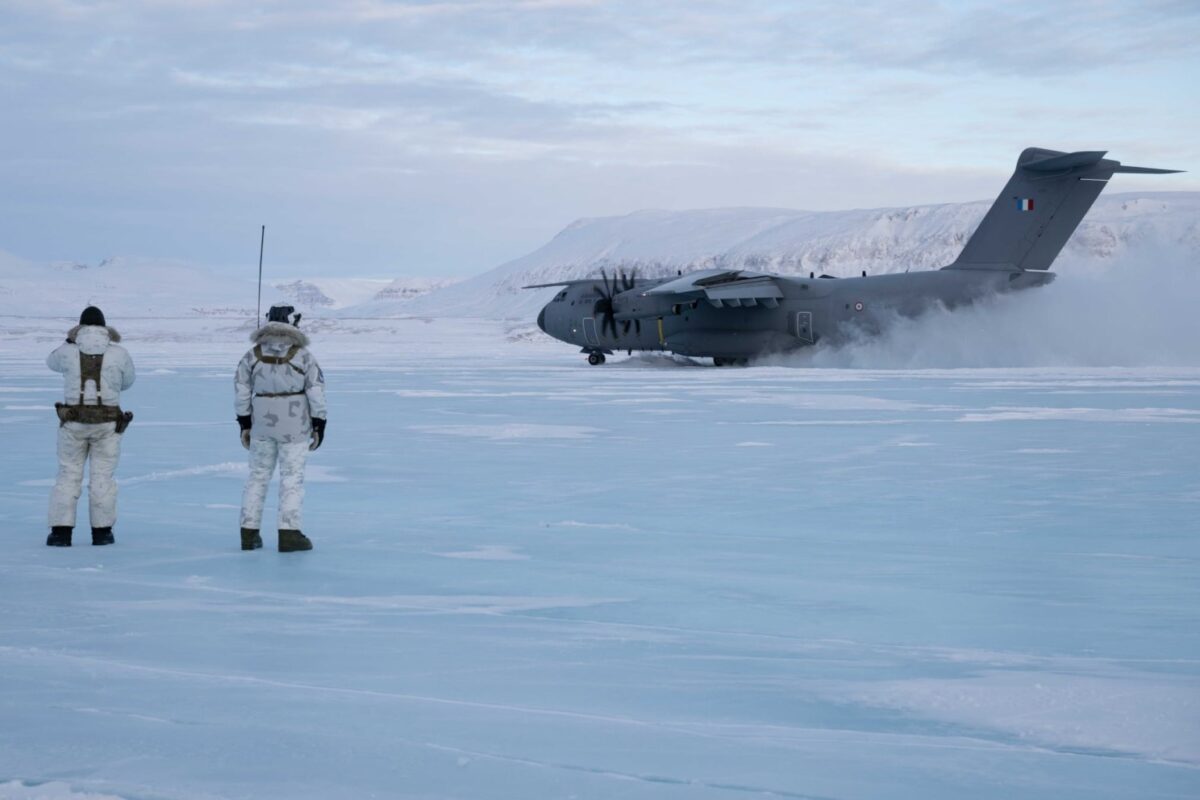
The A400M and A330 MRTT fleets are described as a clear French strength, but the inventory is not sized for sustained, high-intensity conflict.
During the war in Mali, the US Air Force assured 80% of in-flight refueling, although the French fleet at the time was still largely composed of older KC-135s rather than MRTTs. Part of the MRTT fleet is earmarked for nuclear deterrence, and France would likely need Ukrainian Antonov heavy-lift again for outsized payloads, such as a Leclerc tank, in a major deployment.
A short-lived commercial alternative did not change that picture: Airbus launched its BelugaST oversized cargo service in 2022 after the An-225 was destroyed in Ukraine, then shut it down in January 2025 for lack of external customers. The BelugaST’s 35-ton ceiling would in any case have fallen well short of the An-124’s 150-ton capacity. Recent crises in New Caledonia and Mayotte are cited as reminders that sovereign air logistics also matter outside hot conflicts.
France turns to Europe for AWACS and maritime patrol
The four French E-3F Sentry AWACS are to be replaced by the Saab GlobalEye, with two aircraft on contract since December 2025 and an option for two more.
The rapporteurs frame the choice as part of a deliberate reorientation toward European partners and revisit a 2012 episode in which they say the United States blocked an upgrade of the French AWACS due to the sensitivity of the modules involved, a precedent they cite as evidence that US content can carry political risk.
For maritime patrol, the report flags an alert on the engines of the Atlantique 2 fleet, whose first flight dates back to 1981. The DGA selected the Airbus A321 MPA in February 2025, with deliveries planned around 2035. The Marine nationale is expected to retire four ATL2 airframes early, raising the prospect of a capability gap before the new platform arrives.
It is the same gap that the failed Maritime Airborne Warfare System (MAWS) cooperation with Germany was meant to close before Berlin opted for the Boeing P-8A Poseidon in 2021.
The France Libre and the EMALS question

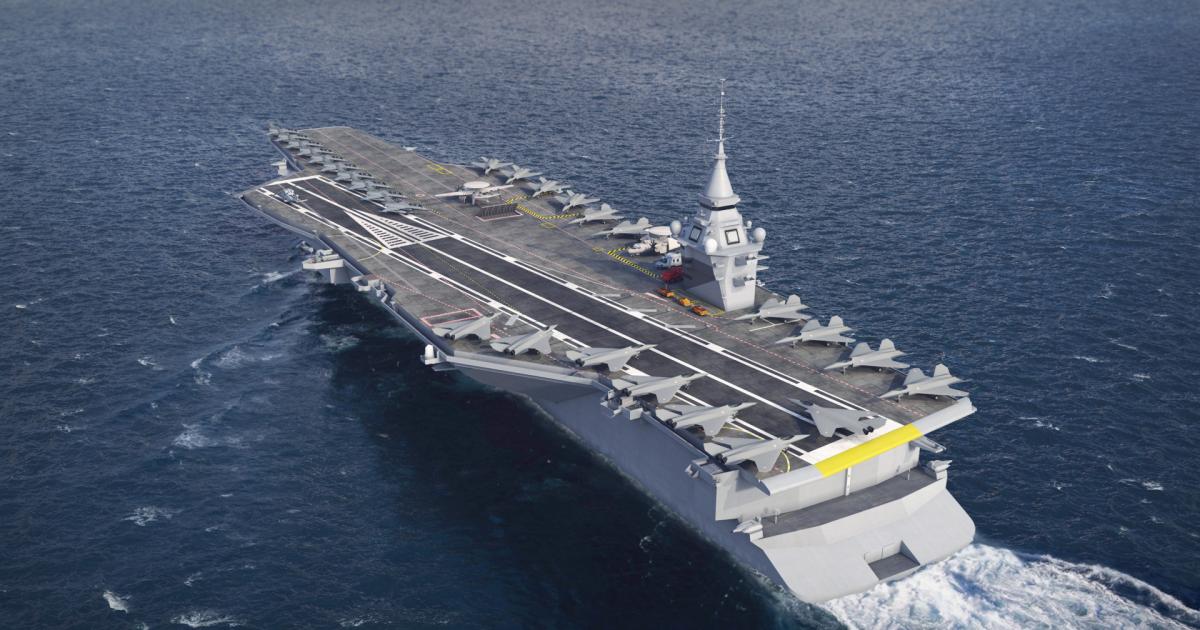
The next-generation aircraft carrier, France Libre, and particularly its catapults, has become a focal point in France’s sovereignty debate.
France’s naval industry association GICAN has estimated the US-origin content of the program, including the catapults, arresting gear and E-2D Hawkeye airborne early-warning aircraft, at roughly €3 billion, well above the official estimate that US content represents around 10% of the carrier’s total cost.
The ship is planned to use three General Atomics Electromagnetic Aircraft Launch System (EMALS) catapults and three Advanced Arresting Gear (AAG) systems. That configuration is operated only by the US Navy on the Gerald R. Ford class and by China’s People’s Liberation Army Navy on the Fujian.
The US State Department’s original DSCA authorization, covering two catapults and associated arresting gear, was approved in 2021 and valued at around €1.2 billion. In February 2026, the Pentagon notified General Atomics of a $43 million Foreign Military Sales contract modification to complete design work specific to the French carrier.
President Trump’s public criticism of EMALS, and his stated preference for steam catapults, has added another layer of political uncertainty around the program.
On April 17, 2026, deputies Yannick Chenevard and Jean-Louis Thiériot, rapporteurs on the bill revising the military programming law, tabled an amendment calling for a feasibility study into a sovereign French EMALS.
Space: where the dependency runs deepest

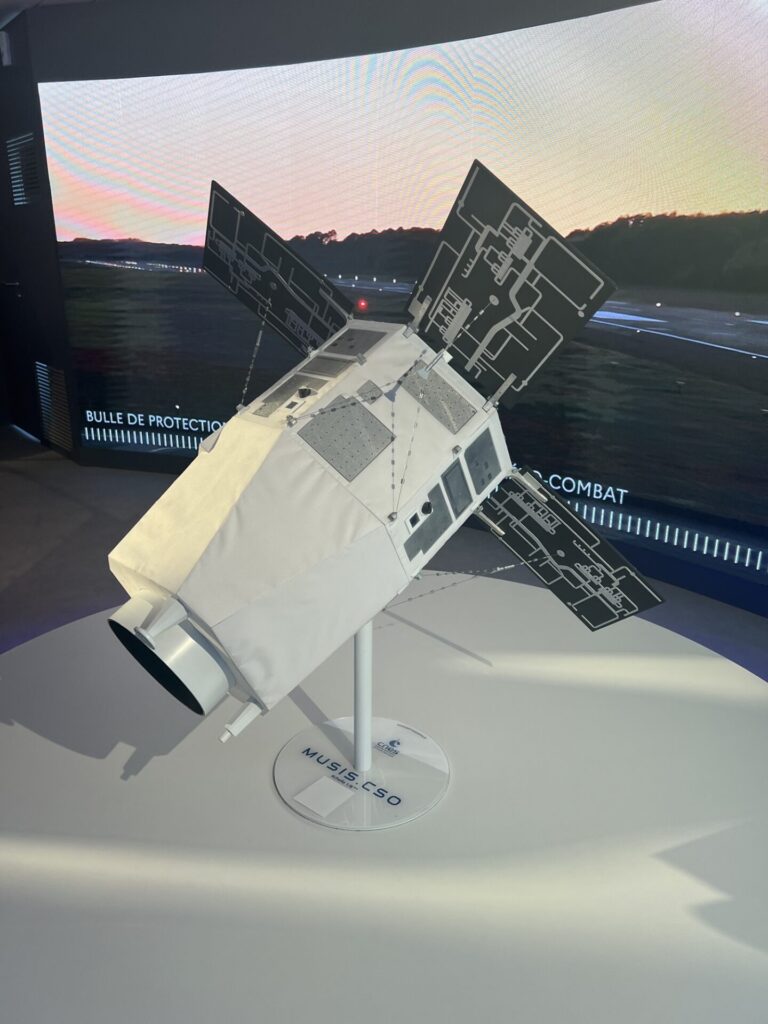
France retains capability in image intelligence (CSO and the upcoming IRIS), electromagnetic intelligence (CERES), military telecommunications (Syracuse IV), and space surveillance through the GRAVES radar. Beyond those, dependence on the United States is either partial or total.
For early warning, France is fully dependent on US capabilities. Galileo is widely used by the armed forces, but partner nations still lean heavily on GPS. Around 90% of the small-debris data used by the European Union comes from the US Spacetrack system.
In low Earth orbit, OneWeb operates around 650 satellites, compared with more than 10,000 for Starlink, and allies continue to use the latter despite documented service interruptions, including over Ukraine. Germany’s announced departure from IRIS² to pursue a national constellation is seen as a serious threat to the European alternative.
The report records delays exceeding three years on the YODA satellite patroller program and on CELESTE, a Low Earth Orbit Positioning, Navigation, and Timing (LEO-PNT) constellation. It flags the saturation of Ariane 6, and the absence of a contingency plan should climatic conditions in French Guiana, including rising humidity, affect launch availability.
On the VMAX hypersonic glider, ArianeGroup waited a year for access to a US suborbital launcher for its first test before initiating the development of its own Sylex capability, expected within three years.
F-35, ITAR, and the question of leverage
The report devotes a section to the operational and legal levers attached to US-origin equipment.
It cites the well-known concerns surrounding the F-35, in which European operators have voiced doubts about the United States’ ability to operate remotely on combat cloud or maintenance functions. It also weighs the cumulative impact of the Export Administration Regulations and the International Traffic in Arms Regulations (ITAR) on the French defense industrial base, noting that French companies file close to 1,000 license requests each year with the US Directorate of Defense Trade Controls.
The recently published America First Arms Transfer Strategy, included in the appendix, is described as a step toward a more transactional and conditional approach to US military sales.
FCAS, cooperations: what the report recommends
In its review of European cooperation, the report lists SCAF/FCAS as a program in stagnation, alongside the canceled Common Indirect Fire System and MAWS.
On FCAS, the rapporteurs argue for a redistribution of New Generation Fighter workshare that preserves Dassault’s unmatched competence in combat aircraft design, and they emphasize that the engine question, where Safran and MTU Aero Engines are working under the EUMET joint venture, remains a sovereignty issue in its own right.
If cooperation breaks down, the report calls for protecting Dassault and the projection capability tied to the airborne component of the nuclear deterrent.
The report calls for a renewed political and budgetary commitment to IRIS², which it describes as the only credible path out of dependence on foreign-operated space infrastructure beyond what is strictly required to cover French overseas territories.
It also calls for a sovereign approach to the maintenance in operational condition (MCO) of major equipment, starting with the Charles-de-Gaulle aircraft carrier and its successor, La France Libre.
The conclusion is sober rather than alarmist: France retains greater sovereign capability than most of its European partners, and 20% of its arms imports between 2019 and 2023 came from the United States, compared with 63% for Germany and 99% for the Netherlands. The rapporteurs argue that this inherited edge is real but no longer sufficient, and that consolidating it has grown more urgent as the transatlantic relationship has shifted into less predictable territory.