
Aviation journalist Andreas Spaeth talks to Martin Gauss, who took over the CEO job at Gulf Air in Bahrain in November 2025 to reposition the smaller Arabian airline to former glory, only to find himself and his carrier in the midst of the Gulf war from February 28, 2026, leading to the longest airspace closure of any country in the region in Bahrain and forcing the airline to move its entire operation on short notice.
Martin Gauss, 57, is a German national who started his career in aviation as a First Officer flying Boeing 737-300s for Deutsche BA in 1992, later working at the carrier in management roles. After the German airline was absorbed by Air Berlin, he went on to take CEO posts at Cirrus Airlines and then-Hungarian flag carrier Malév before joining airBaltic in Riga in November 2011.
During his time at airBaltic, he actively promoted the Airbus A220 to many airlines at airshows, also relying entirely on the type for the single-type airBaltic fleet. In late 2020, Gauss himself got rated as Captain on the A220 and flew stints as management pilot. In April 2025, a new Latvian government fired him from the national carrier after 14 years at its helm. In November 2025 he became CEO of Gulf Air in Bahrain.
Andreas Spaeth: After a six-month break following your departure from airBaltic, you have been CEO of Gulf Air since November 2025. Did you have any prior connection to the country or the airline?
Martin Gauss: I started at Gulf Air on exactly November 4, 2025, and at that time I came directly from a private trip to Nepal, although I did not make it all the way up Mount Everest. I have been an airline CEO for more than 20 years; you never take time for these big trips and always say you will do them later, so this was my opportunity. I have now been living in Bahrain for seven months and was able to approach my new role intensively with newly gathered energy. I had never been to Bahrain before, although I had often been to the Arabian Gulf region. I first went there for the interview, and of course I had informed myself beforehand about the region and specifically about Bahrain and Gulf Air.
Spaeth: You did not have much time to settle in and develop the airline…
Gauss: Yes, on February 28, 2026, the Gulf war began, our last flights departed, and then the airspace over Bahrain was closed. At that time, nobody knew how long it would last, and our airspace remained closed for 40 days. We initially left the aircraft that were abroad where they were and rebooked the passengers. The passengers who were in Bahrain were accommodated in hotels and the aircraft here remained on the ground. Then it became clear that we had to supply Bahrain in some form, as we were the only airline and others were no longer flying in.
Within an hour, we relocated all aircraft to Al Ula International Airport (ULH) in western Saudi Arabia and brought all of our long-haul aircraft from around the world into Saudi Arabia as well, also to other airports. We then received permission from the Saudi government to build up flight operations out of Dammam, the Saudi airport closest to Bahrain.
Spaeth: How can one imagine this relocation?
Gauss: We built up a complete airline operation: initially in a hotel in Bahrain, a check-in area was set up for people, they received their visas for Saudi Arabia there, and shuttle buses were arranged to Dammam. It is a journey of one and a half hours including border clearance; we transported everyone who wanted to leave Bahrain there and back.
From Dammam, we built our own route network while our home airport was closed. Later in Bahrain, we converted a conference center into a temporary check-in terminal, complete with its own business class check-in and a separate business class bus transfer.
At the same time, we had to move all the necessary technology, including spare parts and maintenance, all crews, and even our catering operation from Bahrain to Dammam. We then produced the catering there. The move and the temporary rebuilding took six days, but we were already flying a service on the first day.
Spaeth: How was the population of Bahrain supplied through this route?
Gauss: Securing the supply of goods to Bahrain was crucial. We operated shuttle flights with our Boeing 787s, whose cargo holds were loaded abroad. In total, we flew 2,000 tons of food and essentials into Dammam and then moved it to Bahrain with 300 trucks. At no point did Bahrain face any shortages or supply problems, precisely because Gulf Air handled it this way. No other airline would have flown and done that. After 76 years of our existence, this once again made it clear how important it is for Bahrain, as an island state, to have a national airline during such circumstances.
Spaeth: What happened next when Bahrain’s airspace reopened in April?
Gauss: We had our entire flight operation and the necessary logistics in Dammam and had to decide: how long would the ceasefire hold, and what should we do? Then, day by day and route by route, we resumed more flights from Bahrain while leaving others in Dammam. Over seven weeks until the beginning of June, we brought one flight after another back to Bahrain. Since then, we have again been operating the full schedule from our home airport as we did before the war. And we are doing so with an average load factor of 82% because we rebuilt it step by step with discipline and agility. The other Gulf airlines around us did not have this problem, because their airspace was not continuously closed for the whole period.
Spaeth: Did you personally not have the instinct to flee when the war broke out?
Gauss: Of course, nobody would have chosen that. When the German embassy’s call to leave came in early March, I asked myself, what do I do? I now have resident status in Bahrain, so I said I am staying here, I am running the company. It was a period unlike anything I had ever experienced, and I believe that was true for everyone. We regularly experienced alarms and missile and drone attacks, and we went through it like everyone who was in the country at the time.
Fortunately, Bahrain’s air defense worked very well; that was impressive. During the time of the war, tourism naturally dropped. But since tourism mainly comes from neighboring states on weekends, we are currently already back to the same levels as pre-war times. Life is 100% back, Bahrain is recovering much faster because, in comparison to other Gulf nations, we are small and not so dependent on inbound tourism. Forward bookings are already above last year’s level. In any case, in my first seven months as CEO of Gulf Air, I have experienced more than others do in three years. That helped me understand the airline very deeply and is now helping me with the strategy we will present shortly, outlining what we plan for the future.
Spaeth: But first, back to the past: Gulf Air used to be a shining brand…
Gauss: Gulf Air is very well known in the Gulf region and used to be world-famous as well. I always compare the Gulf Air and Pan Am brands; these are two legendary brands. I now have the honor of leading one of these brands, and I have a lot planned for it; there is a great deal of hope attached to it. At the head office, many pictures from the “golden era” are still hanging on the walls. Back then, Gulf Air was a pioneer, for example with the first-class lounge with a stand-up bar on board the TriStar fleet.
Spaeth: At that time in the 1970s, young Tim Clark, now President of Emirates, began his career at Gulf Air, whose stand-up bar became the model for the A380 lounge. But none of the old glamour is left at Gulf Air, is there?
Gauss: In premium service, Gulf Air is still a leader on its long-haul 787s, and Bahraini hospitality is known beyond the country’s borders. I am now reconnecting with the golden years and combining that with what we can do today. It is my task to bring Gulf Air back as a premium connector for the Gulf. Of course, it makes no sense to try to copy the big neighbors — Emirates, Qatar, or Etihad — so we are following our own path.

Spaeth: What will that look like?
Gauss: Recently, Bahrain as Gulf Air’s home country was not being highlighted, and I will change that. Bahrain, with its bridge to Saudi Arabia, is enormously attractive in the region. Roughly 80% of inbound tourism comes from neighboring Gulf states, and Bahrain is also the banking center of the Gulf. Its history goes back 5,000 years as a trading post with truly historic sights. As an island, we have natural beaches, plus of course large hotels, and shopping malls, all attractive for stopovers. So far, 70% of all passengers merely transfer in Bahrain. With just 40 minutes, we have the shortest minimum connection time in the entire Gulf region thanks to the new terminal opening in 2021. We want to capitalize on that speed; we are small but refined, and we are approaching it with many innovations.
Spaeth: Does that also apply at the airport, given that airports elsewhere in the Gulf are now so large that a lot of time is needed just inside the terminal?
Gauss: Ground processes in Bahrain are very fast. If you depart from Bahrain in Golden Falcon Business Class and check in here, it takes less than 10 minutes from curbside to the gate, including all formalities. We can maintain that even as we grow. At present, we have six and a half million passengers, while the airport as a whole handles just under 10 million, but it is designed for 14 million passengers. Distances are generally short in Bahrain—when you step off the aircraft on arrival, including transfer to the terminal and the drive to the capital, Manama, it takes just 20 minutes. You can then go out for a traditional meal or visit attractions. We offer both fast transfer options and stopover packages, but our product will be decisive.
Spaeth: So, a mix of rediscovered old virtues and new innovations. Which ones?
Gauss: It is still too early to talk about that in detail. Gulf Air is now entering a transition phase in which it will bring back what has always been its strength: service and hospitality. And in the future, we will introduce innovative things that will make people say, “I want to fly Gulf Air.” I took the first step immediately and introduced Starlink internet connections on board as the 14th airline in the world to do so. One aircraft is already flying with it, and by the end of 2027 all aircraft are expected to have Starlink on board. We do such things very quickly. When you are small, you can act quickly.
Spaeth: On which intercontinental routes does it particularly make sense to fly via Bahrain instead of through the Gulf mega-hubs?
Gauss: The top route always has been and still is Bahrain to London Heathrow (LHR), which we serve three times a day. In Europe we also fly to London-Gatwick (LGW), Frankfurt (FRA) and Munich (MUC), Milan (MXP) and Rome (FCO), Paris CDG, and Athens (ATH). This means that, unlike the major Gulf carriers, we do not serve secondary airports but focus on these hubs, and we will grow by adding a few more European destinations.
Via Bahrain, we connect them first and foremost with all Gulf states and with India, where much growth is coming from, also because many Indians live and work in Bahrain. We also serve Bangladesh, China, and Nairobi in Kenya. We have 54 routes, all of which go via Bahrain. If we grow, then in places where we have an advantage—where customers say they want to fly with Gulf Air. But many passengers from Munich and Frankfurt, for example, actually want to go to Bahrain. We have only 1.7 million inhabitants, but we are a banking center, and there are many places of comparable size around the world with a lot of air traffic. In any case, if you want to go to Bahrain, it is hard to avoid us.
Our longest route is the 14-hour flight to New York, and after the recent airspace closure ended, we achieved a load factor of 91% there. We connect all of our other 53 destinations with the New York flight, which is often faster than going through the large Gulf hubs.
Spaeth: What will be in your strategy plan, which you want to present soon?
Gauss: The strategy for the next few years at Gulf Air will explain what Gulf Air stands for, what the fleet will look like over the next ten years, which aircraft types we will use, how many passengers we expect, and which destinations we will serve. It will not be about shrinking, but we also do not want to grow into a mega-carrier.

Spaeth: What does your current fleet look like, and what additions will there be?
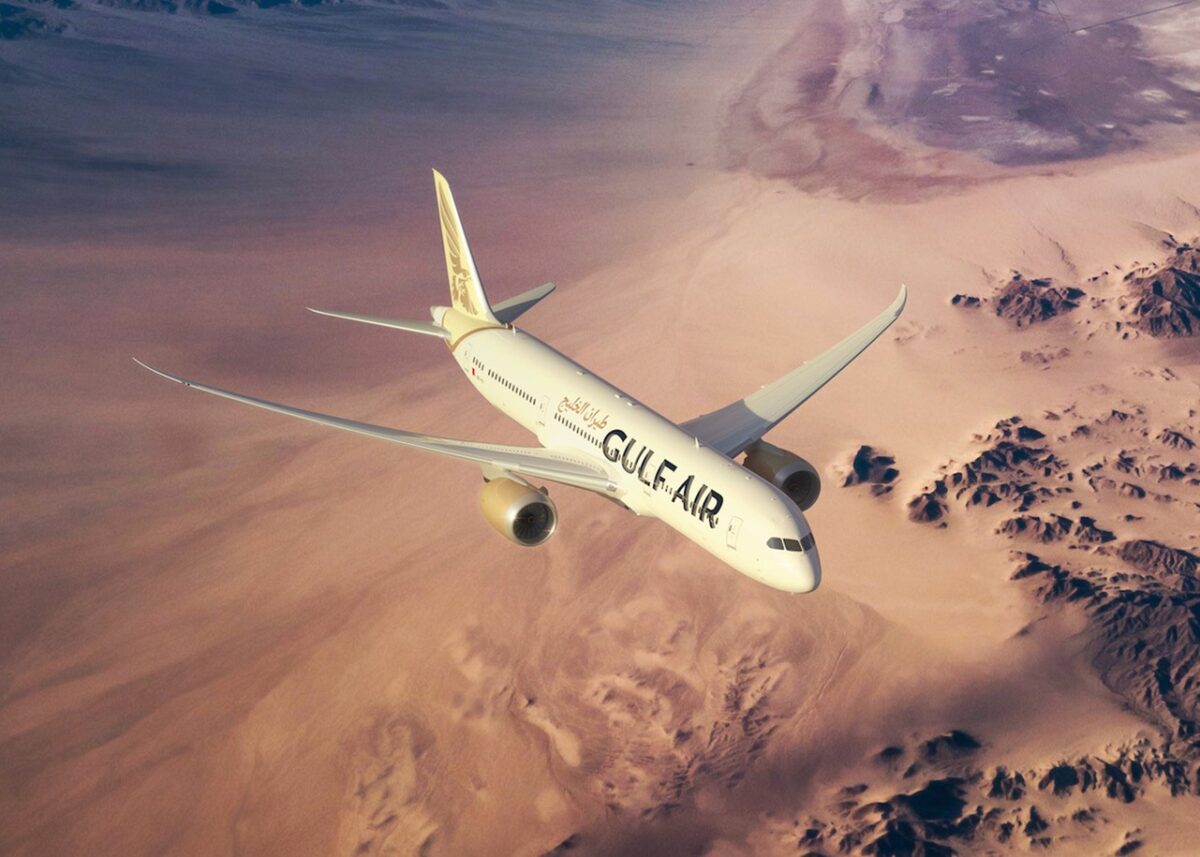
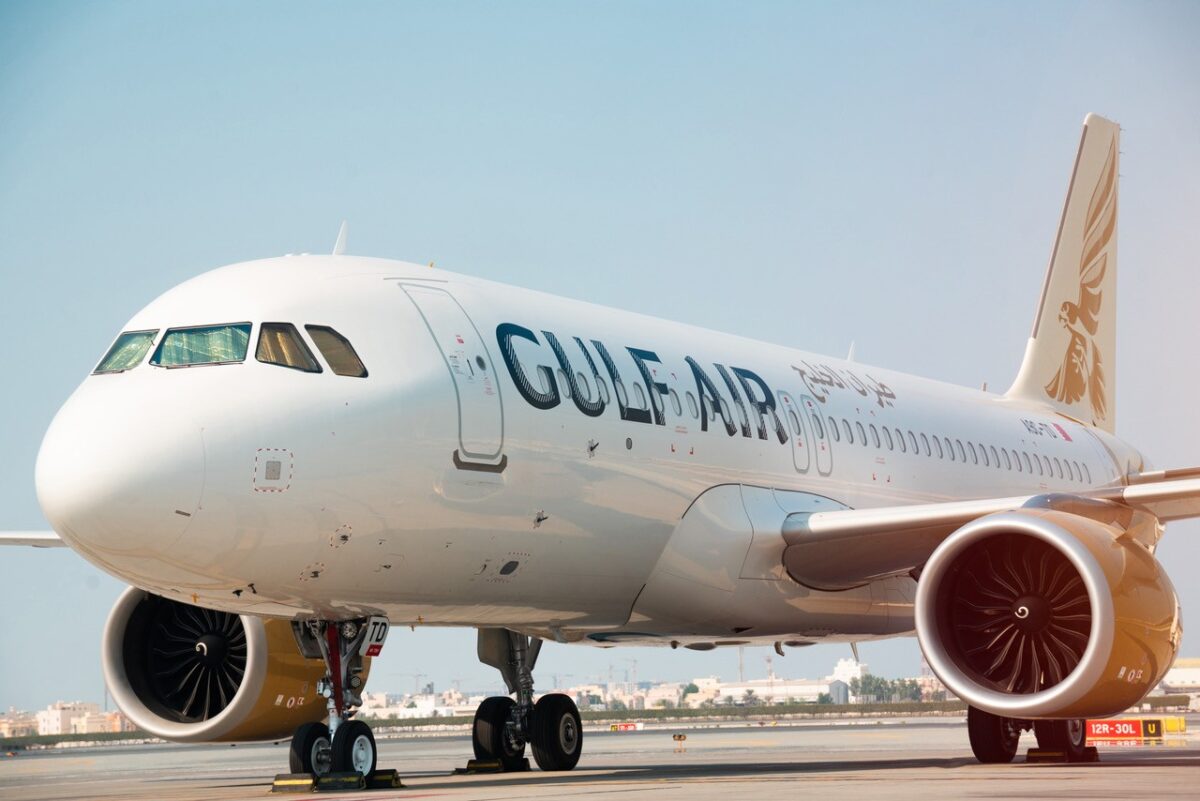
Gauss: We currently have 10 Boeing 787-9s, with two more arriving in early 2027. 15 more are on order, and we hold three options, so we are heading toward a doubling of the 787 fleet. We will retire most of the A320/321ceo aircraft this year; the majority of the A321s are already neos, and we have ordered more, with four additional aircraft arriving this year. As soon as we present the new strategy, there will be further growth. In addition to the two-track approach of Boeing 787-9s for long-haul flights and otherwise the A320/321neos, another type could also be added.
Spaeth: I immediately have an idea which type that could be…
Gauss: When people read my name, they automatically think of the Airbus A220 and, of course, that is a very interesting aircraft for any airline today if it fits the strategy. During my time at Gulf Air, I want to implement the new strategy so that results can already be seen within three years. I want to help Gulf Air become again what it once was, in a way that suits the Kingdom of Bahrain. In the future, I see it as a “Premium Signature Connector” for the Arabian Gulf. That includes everything—a tailor-made premium product and creating connections to and within the Gulf region.