
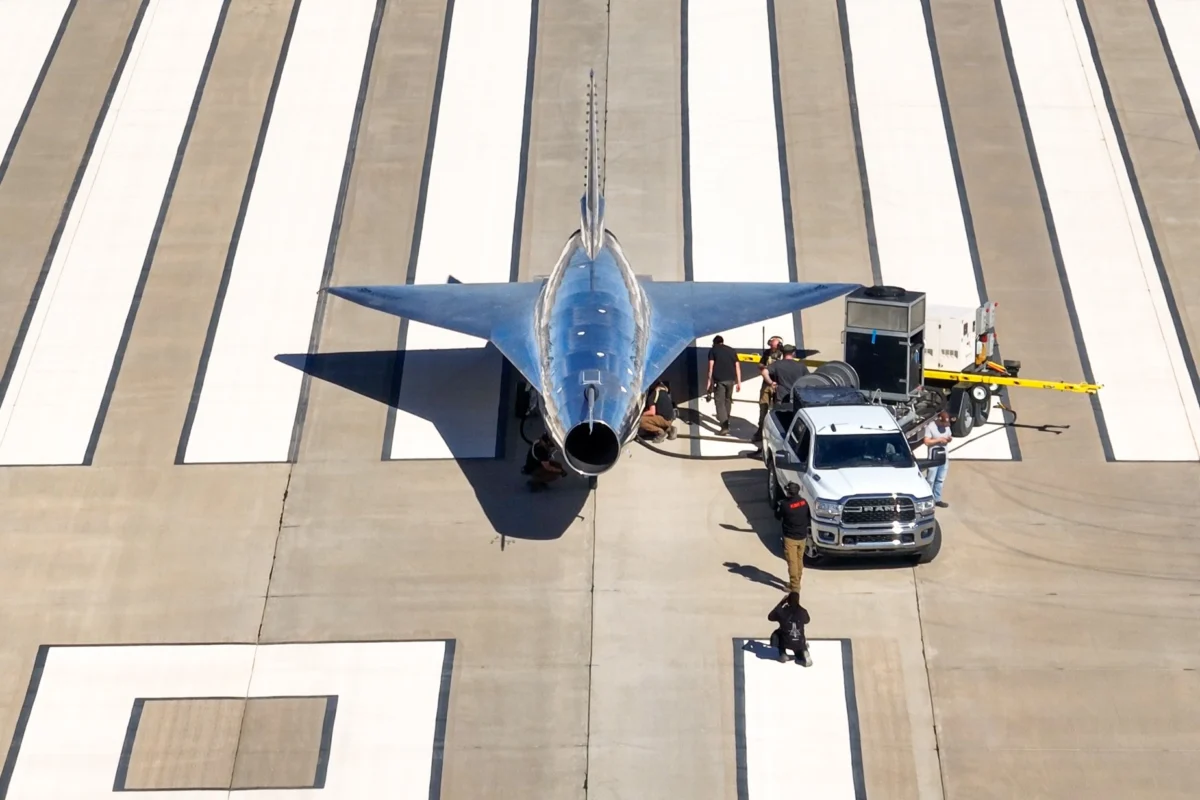
Hermeus announced on March 12, 2026, that the Federal Aviation Administration (FAA) issued a Special Airworthiness Certificate in the Experimental Category (SAC-EC) for its unmanned Quarterhorse Mk 2.1 aircraft. The certification clears the way for Hermeus to proceed with flight testing as it works toward achieving supersonic flight.
According to the company, the process involved a rigorous inspection by FAA agents, who assessed the aircraft ahead of its planned flight-test campaign.
“We are thankful for the diligent work of the FAA,” said Jay Wagemann, Hermeus’ Director of Mission Operations. “Their team conducted a rigorous inspection and gained real confidence in the aircraft.”
A Special Airworthiness Certificate in the Experimental Category authorizes flight under specific limitations set by the FAA, typically restricting operations to designated test areas and prohibiting commercial passenger flights.
For Hermeus, the SAC-EC enables flight testing at Spaceport America in New Mexico, operating within White Sands Missile Range airspace.
Quarterhorse Mk 2.1 and the path to supersonic
Quarterhorse Mk 2.1 is the largest and most capable aircraft in the Quarterhorse development program to date. Roughly the size of an F-16, it is powered by a Pratt & Whitney F100 engine and is nearly three times larger and four times heavier than its predecessor, the Quarterhorse Mk 1, which completed its first flight at Edwards Air Force Base in May 2025.
The Quarterhorse program is built around a rapid iteration model in which Hermeus designs, builds, and flies progressively faster aircraft, using flight data from each vehicle to inform the next. The Mk 2.1 is the first aircraft in the Mark 2 phase, a multi-aircraft series focused on achieving and expanding the supersonic flight envelope. Hermeus has said the next iteration, Mk 2.2, is expected to become the fastest unmanned aircraft in the world.
Further down the line, the company aims to transition from a conventional turbine engine to a ramjet-powered propulsion system. Hermeus is developing an in-house engine called Chimera, a turbine-based combined cycle (TBCC) powerplant that combines a turbine with a ramjet for sustained hypersonic flight.
Funding and relocation
The certification milestone comes as Hermeus undergoes a period of significant expansion. In April 2026, the company announced a $350 million Series C funding round, bringing its total capital raised to $500 million and its valuation to $1 billion. Led by Khosla Ventures, the round included participation from Founders Fund, RTX Ventures, and In-Q-Tel, among others. Hermeus is also relocating its corporate headquarters from Atlanta, Georgia, to El Segundo, California.
Hermeus is using the Quarterhorse program to de-risk the technologies, manufacturing methods, and flight operations it will need for its longer-term ambition of developing high-speed military aircraft and, eventually, a hypersonic passenger aircraft.