
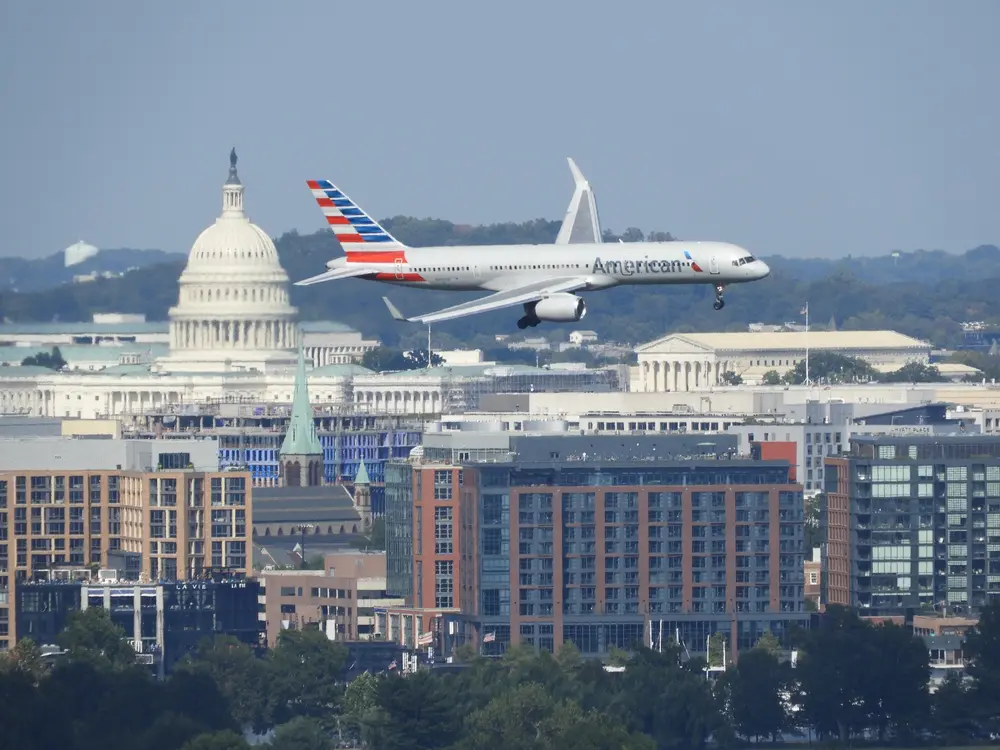
A comprehensive aviation safety bill introduced in the US House would implement National Transportation Safety Board recommendations following the January 2025 midair collision of a regional airliner and Army helicopter near Washington Reagan National Airport (DCA).
The measure, titled the Airspace Location and Enhanced Risk Transparency Act, or ALERT Act, would require changes to collision-avoidance technology, helicopter routing, air traffic control training, and FAA oversight practices. Lawmakers say the bill addresses every safety recommendation issued by the NTSB after its year-long investigation into the crash, which involved an American Airlines CRJ700 and a US Army Black Hawk helicopter and killed 67 people.
The ALERT Act arrives as the House also prepares to consider the Senate-passed Rotorcraft Operations Transparency and Oversight Reform Act, better known as the ROTOR Act. That narrower bill focuses primarily on expanding the use of ADS-B and related traffic awareness technology in congested airspace.
The House proposal goes much further. Under the ALERT Act, the FAA would require broader adoption of ACAS-Xa on certain turbine-powered airplanes and develop standards for ACAS-Xr tailored to rotorcraft operating in busy Class B airspace. The bill also calls for collision-mitigation systems that can process ADS-B In data and provide integrated aural and directional alerts to pilots.
The bill also directs the FAA to revise controller recurrent training in areas such as threat and error management and visual separation. It calls for reviews of supervisory time-on-position practices and upgrades to controller conflict-alert systems. It would also require a reassessment of helicopter routes and vertical separation standards around DCA.
Beyond equipment and procedures, the legislation would mandate a closer evaluation of FAA culture and oversight. The bill calls for reviews of the agency’s safety practices and its management of complex, high-density airspace. It also addresses coordination between civil and military operators around DCA, an issue that drew scrutiny during the NTSB investigation.
Industry groups quickly weighed in. The National Business Aviation Association said the ALERT Act would increase aviation safety by addressing lessons identified in the investigation. Vertical Aviation International voiced support as well, saying the bill represents a comprehensive response to the NTSB’s findings.
The ROTOR Act passed the Senate unanimously in late 2025. It would require expanded use of ADS-B, including in certain military and public aircraft operating in congested airspace. House leaders now must decide whether to act on the Senate bill as written, advance the broader ALERT Act, or combine elements of both into a final package.
Congress often responds to accidents with targeted fixes. The ALERT Act signals a willingness to revisit airspace design, training standards and technology mandates all at once.
For aircraft operators, especially those flying in and out of congested US airspace, the outcome could reshape equipment requirements and procedures in the years ahead. For the FAA, the bill represents a clear message from lawmakers to implement the safety board’s recommendations in full, and do it quickly.