
Founded in 1932, EgyptAir holds the distinction of being Africa’s oldest airline. But Egypt’s flag carrier is not just one of the world’s oldest, it also plays a major role in underpinning the Egyptian tourism industry, one of the pillars of the country’s economy.
EgyptAir is much more than a conduit for tourists interested in ancient civilizations and Nile cruises. It also serves as the primary gateway to a country of more than 100 million people, with a geographical position that places it at the crossroads of Africa, Europe and the Middle East, giving it the significant potential to act as a nexus between continents.
As we progress into 2026, and despite a complicated geopolitical environment with several conflicts raging in its vicinity, EgyptAir aims to capitalize on continued tourism flows, the growth of air travel in the Middle East and the still largely untapped potential of African connectivity.
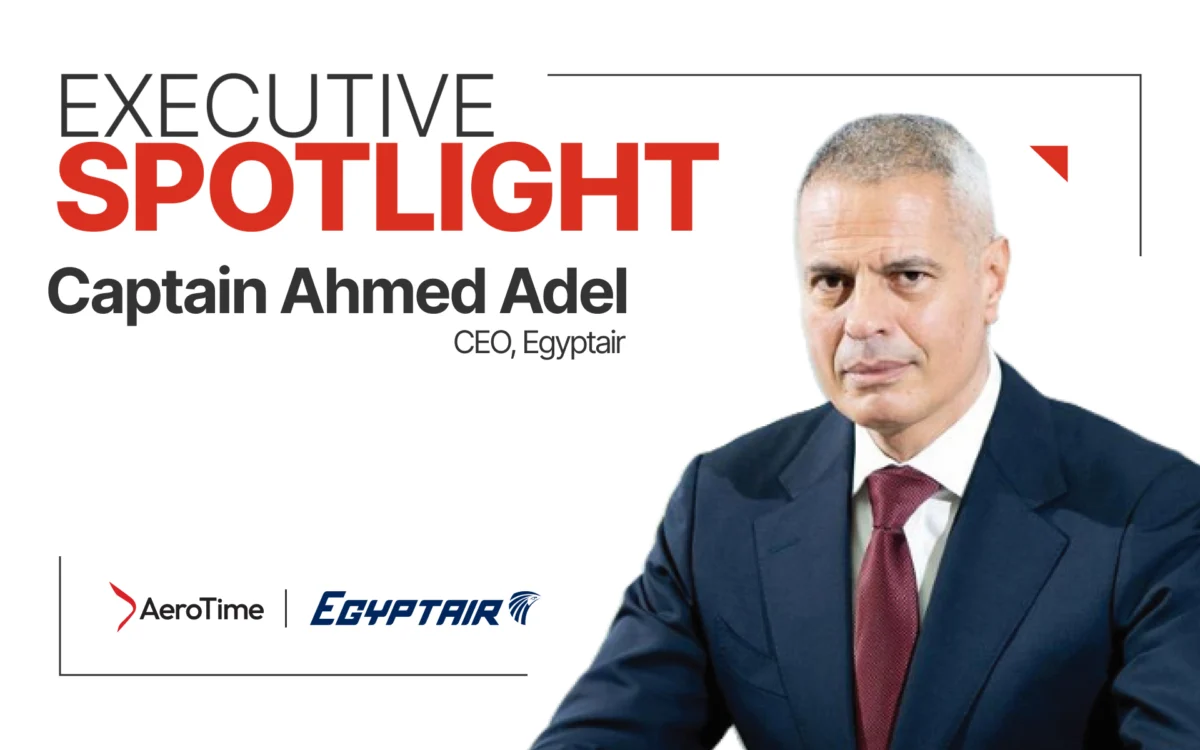
AeroTime sat down with EgyptAir’s CEO, Captain Ahmed Adel for an exclusive interview in which we talked about all these matters and discussed the airline’s roadmap for the years ahead.
Captain Adel began by giving a general outline of EgyptAir’s position in the market.
“In aviation, you can draw a line between the pre-COVID and post-COVID eras. I will talk about the post-COVID era,” he stated. “All over the world the demand has come back because of so-called ‘revenge tourism,’ which is great for tourism and the aviation industry.”
“We are seeing very good demand,” he continued. “We’re trying to catch up!”
Figures are certainly on the rise. In 2024 EgyptAir passed the 10 million passenger mark, with traffic up nearly 5% over the preceding year. While the figures for 2025 were not available at the time of interview, it is likely that they will confirm this upward trend.
Driving Egypt’s tourist boom
Tourist arrivals are surging in Egypt on the back of massive projects such as the new Grand Egyptian Museum or the greenfield resort developments at El Alamein, located on the Mediterranean coast near the site of the epic World War 2 battle.
According to Egypt’s Ministry of Tourism and Antiquities, the country welcomed 19 million tourists in 2025 (an increase of 21% over the preceding year), something in which EgyptAir, as the country’s flag carrier and largest air operator, has played a significant role.
“Whenever there’s a boom in tourism, we benefit from it,” said Captain Adel. “Our traffic is not necessarily all tourism, but we benefit from it. The government has very big plans and aspirations for tourism and it affects us positively.”
Captain Adel appeared undeterred by geopolitical instability in the region, despite feeling the effects of the conflict in Gaza as well as military operations in Syria and further afield in the region.
“Of course, this affects the demand, and it disrupts operations,” he said. “When there was the incident in Doha [the Israeli air strike on September 9, 2025 – ed. note] and when there have been incidents in Iran it has affected our operations. And you don’t adjust your operations in 24 hours. There’s an overflow of repercussions that can last for 72 hours, and that’s very costly for airlines.
“When it comes to Gaza, we’re proud of the role that Egypt has played in settling this dispute. On the aviation front, we are happy that things are now more stable and there’s no destruction.”
Captain Adel also shared another interesting fact about EgyptAir’s traffic: around 30% of the airline’s customers connect through Cairo. He mentioned specifically Europe to Africa and North America to the Middle East and Africa as some of the main passenger flows when it comes to connecting traffic.
“We are lucky. We have a very strategic location when it comes to our hub,” he explained. “We have connectivity to everywhere. The through-traffic is also very important for us because our model is also about the connectivity provided through Cairo Airport.”
Captain Adel said he expects to see faster transit passenger growth as soon as Cairo’s new Terminal 4, which will double the capacity of the current airport, becomes operational.
The new facility is also expected to enhance passenger experience. This will also make it easier for EgyptAir to offer new services to its passengers, including the potential for stopover products such as those offered by other hub-and-spoke airlines.
“Right now, it is challenging to do this,” Captain Adel explained. “Cairo Airport is over its maximum capacity. So, this definitely affects the experience.”
“As a passenger, one of the most important things, of course, is the experience, the product, the options,” he continued. “If you plan something, and you want to change it, the change must be seamless. For example, if you came to Egypt and you liked it, and wanted to stay for an extra day.
“So, we will realize this vision with the completion of our fleet, and also with what the government is doing, focusing on tourism. We will benefit from having big capacity in Cairo and we are adjusting our fleet plans accordingly.”
On fleet strategy
In this regard, and in line with the expectation of continued growth, during the 2025 Paris Airshow EgyptAir confirmed it had increased its A350-900 order from 10 to 16 aircraft. The airline also has 18 Boeing 737 MAX aircraft on order and is refurbishing 19 B737NGs and two A330-200s. The latter, Captain Adel explained, will be fitted with the same cabin as the A350s.
Besides the fleet additions, EgyptAir recently disposed of its relatively new A220 fleet. This, however, is a matter on which Captain Adel did not want to comment.
“It’s an old chapter,” he said.
The airline is fulfilling the first stage of a growth plan with a timeframe of 2031, Captain Adel said.
“We’re going from 67 to 97 aircraft by 2031,” he said. “We consider this the first phase and we’re now prepping ourselves for our plan beyond that.”
But what’s in the pipeline beyond that? Without disclosing too much, Captain Adel hinted that more orders could be coming.
“We are working behind the scenes, having discussions with the big manufacturers,” he said. “We’re having discussions with all the major industry players, and we will have a clear plan by the second half of 2026 or the beginning of 2027.”
On product and network strategy
When it comes to the onboard product, EgyptAir is clearly committed to its position as a full-service airline.
“For the A350-900s, the B737 MAX and the rest of our fleet that’s being refurbished, we have a two-class cabin: a business class and an economy class. We also have some old products that we’re phasing out once we start receiving the new aircraft,” Captain Adel explained. “So, by the end of 2027 we will have two types of cabin: one for the widebody aircraft and a another for narrowbody aircraft, always two classes of service: business and economy.”
EgyptAir is also investing in the “soft” elements of the passenger experience.
“One of the main things that we’re looking into is to enhance customer experience through digitalization, through integration of AI,” Captain Abel said, emphasizing the importance of providing a seamless experience when it comes to passengers booking online. “AI is a fact of life now, so we need to be front and center when it comes to these developments.”
Egypt, however, has also seen growth in the low-cost airline segment. EgyptAir holds a 60% stake in Air Cairo, one of the major players in this segment in the country.
While Air Cairo and EgyptAir operate as entirely separate businesses, Captain Adel explained that he is looking at ways to enhance the cooperation between the two carriers. In an arrangement not unlike that existing between Emirates and flydubai, EgyptAir and Air Cairo are looking for network complementarities.
“We have issued a request for proposal (RFP) to have one of the big network planners onboard to look at our network from the point of view of the expansion of the fleet, and also from Air Cairo’s point of view, to look at our respective networks complementary,” he said. “So that the network of EgyptAir and Air Cairo don’t compete but complement each other.”
The conversation soon turned towards network strategy.
“We have two or three actions that we’re going to take when we get the new fleet. First of all, we are increasing our capacity and frequency on high-yield routes,” Captain Adel explained. “Next, we are opening new routes that we couldn’t reach or were not economically viable with our old fleet.”
He continued: “When we receive the A350-900s, we will have an aircraft that can do the same missions as the older fleet, but with fewer emissions and better economics. It is 45 tons lighter than its predecessor in the fleet that is now being phased out. For us, this opens up long-haul routes like Los Angeles (LAX) and Chicago (ORD).”
With such a large investment in the A350s, long-haul routes will inevitably be a significant vector of expansion for the airline.
“North America is one of the directions we are going to; the Far East is another one. We are looking at having higher frequency into China and Japan and opening new routes there,” Captain Adel said. “We’ll announce them once we receive the number of aircraft that we like.”
However, this does not mean overlooking other markets closer to home.
“Europe will see increased frequency and a better product,” Captain Adel said. “Once the A350 arrives, we’re going to operate it on the Paris route, together with the B787-9. When we receive the third aircraft, we’re going to put it on the London route. It’s going to be integrated, plug and play, like they say.”
Africa, the Middle East, and, of course, the domestic market, are other important pieces of the network.
“We also fly to almost 26 points in Africa. We have high connectivity from Europe to Africa. So, it is an important market for us, Eastern Africa in particular,” Captain Adel explained. “There’s a lot of connectivity through Cairo.”
He went on to emphasize how the international network compliments the domestic one as they both feed into one another.
“We also have a great domestic network that also serves our international one very well. Regionally, we have a lot of Egyptians living in Saudi Arabia, in the Emirates, in Jordan, in Lebanon,” he said. “We also have a lot of traffic of Saudis, Emiratis, Bahrainis, Kuwaitis, coming to visit Egypt. So, it’s a very important network for us.
“When tourism is high, we have a lot of people connecting through Cairo, going to Sharm-el-Sheikh (SSH), Hurghada (HRG), Luxor (LXR), and Aswan (ASW), visiting these leisure destinations, visiting the temples and so on. So, it’s also very important to us.”
At this point in the conversation, we stepped away from the airline’s core business to talk about other areas of activity. In tune with global market trends, the maintenance, repair and overhaul (MRO) business has received increased attention. Here, Captain Adel referenced recent agreements EgyptAir’s MRO arm has signed with the likes of CFM and Rolls-Royce.
“We do a lot of our maintenance in-house, so, the MRO is a very strong arm for us,” he proudly stated.
What’s next for EgyptAir?
“The main challenge is always going to be the relation with the OEMs and whether they are going to be able to catch up with demand,” Captain Adel explained. “Because in aviation, if you’re late you are not going to capture as much demand as you could, or, alternatively, you may receive the equipment at a time that doesn’t coincide with peak demand. So, the timely manner which you receive your products is very important.”
We concluded our conversation with Captain Adel touching upon the role EgyptAir is expected to play in the country’s ambitious tourism strategy.
“We are an arm of our government. So, when the government has ambitious plans, we need to move fast and coincide with and abide by these ambitious plans,” he said. “One way to do so, as I mentioned before, is through the expansion and refurbishment of the fleet. The other important development is the expansion of the Cairo hub, and the new terminal.
He added: “When the new terminal is open, we will have to revisit our plan, or elaborate a new plan that goes beyond 2031, because we’re going to be the biggest operator from this terminal.”