
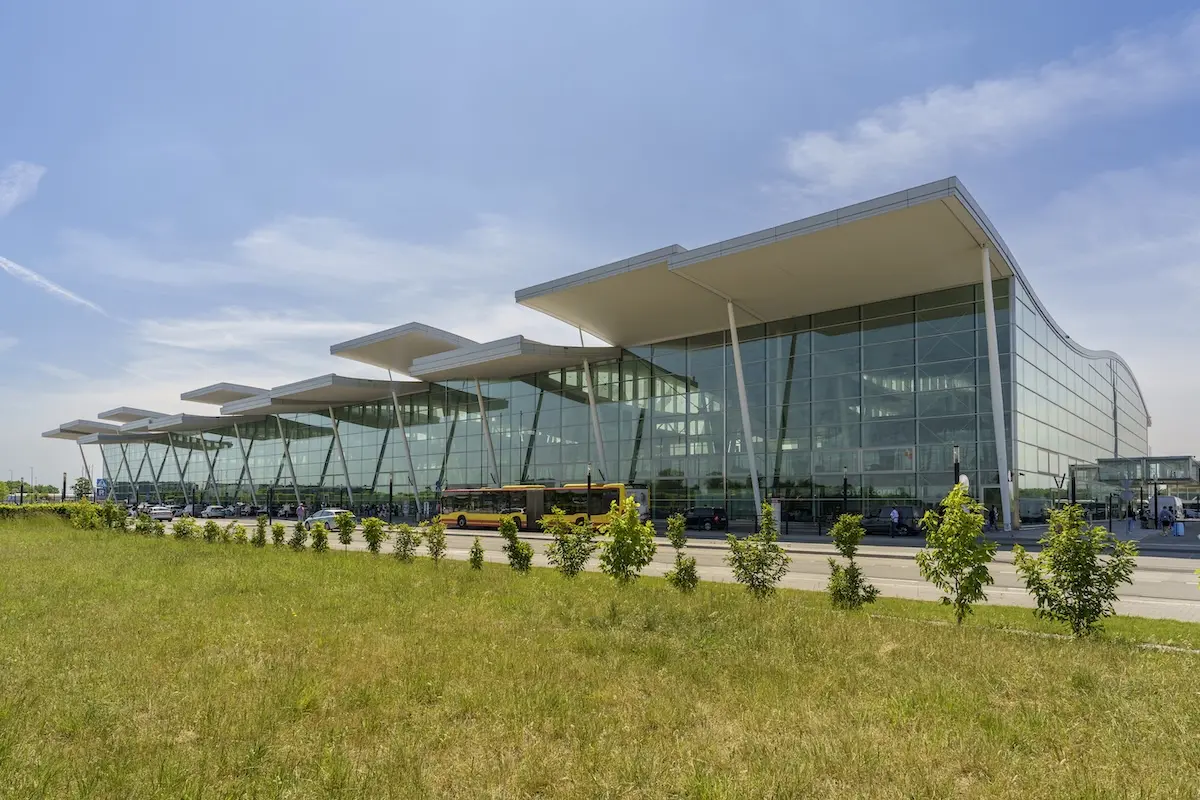
Over the last few years, Poland has become one of Europe’s economic success stories, and, as it is usually the case, its airports have become strong signifiers of that growth.
The capital city, Warsaw, remains the country’s main economic center and hub of the national airline LOT, and a new large airport and multi-modal transport hub (the so-called CPK, for Centralny Port Komunikacyjny, now rebranded as Port Polska) is being built in Baranów, some 40 km west of it. Meanwhile, though, airports elsewhere in the country have seen passenger numbers rise as they fulfill their role as key infrastructure for local economies.
In a nutshell, foreign investment keeps pouring in. Visitors flock to Poland’s fairytale-like historical cities and Poles are showing an increasing propensity to fly, too.
Wroclaw is a clear example of all this. The city is one of Poland’s main economic hubs, acting as the gateway to Lower Silesia, a region with a long industrial tradition.
Silesia was one of the first areas in continental Europe to industrialize and nowadays it is one of the key magnets for technology investment in Poland. Besides a flourishing entrepreneurial landscape, some flagship projects have recently been announced. These include the setting-up by GE Aerospace – in a joint venture with Lufthansa Technik – of its state-of-the-art XEOS facility in Środa Śląska, near Wroclaw, where the latest generation of aircraft engines are serviced. There’s also the project announced in June 2026 by TEEMA (the Taiwan Electrical and Electronic Manufacturers’ Association) for the creation of a technology park near the city.
How is Wroclaw Airport (WRO) responding to this greater global interconnectedness of the local economic base?
AeroTime attended the 35th Economic Forum, an annual event held in Karpacz, at the foot of the Sudetes mountains, which brings together economic and political leaders from across Central and Eastern Europe. There, we sat down with Karol Przywara, CEO of Wroclaw Airport, to discuss how the airport is adapting to the needs of the local economy and how it aims to continue supporting this growth.


Doubling down (literally) on expansion
Wroclaw Airport handled nearly five million passengers in 2025, despite being closed for around 40 days between late October and early December for infrastructure works. That was just below the threshold that allowed it to retain its recognition as Best Airport under Five Million Passengers, awarded by Airports Council International (ACI) in June 2026. The airport is on track to reach a total of six million during 2026.
These may sound like relatively small figures compared to Europe’s largest hubs, but it represents a more than ten-fold increase on the 465,000 it handled in 2005, the year after Poland’s EU accession.
Far from levelling off, this notable upward trajectory may just be about to accelerate further.
“There is still a lot of scope to grow organically in Poland,” stated Przywara, noting that Wroclaw Airport is already operating at the limit of its theoretical capacity.
Wroclaw Airport’s ability to handle sudden traffic surges was tested when Wroclaw hosted the 2025 UEFA Conference League final between Chelsea and Real Betis. Then, the airport was required to accommodate a large influx of fans from England and Spain in a short time.
However, with the underlying trends in mind, plans are already afoot to double the airport’s capacity over the next few years. An expansion program is expected to bring the airport’s capacity to 11 million annual passengers through a doubling of the terminal space.
Shorter term measures to gain more space include the setting-up of a temporary facility for non-Schengen departures next to the main terminal, plus the relocation of the airport’s lounge to free up space for passengers.

A low-cost market with long-haul ambitions
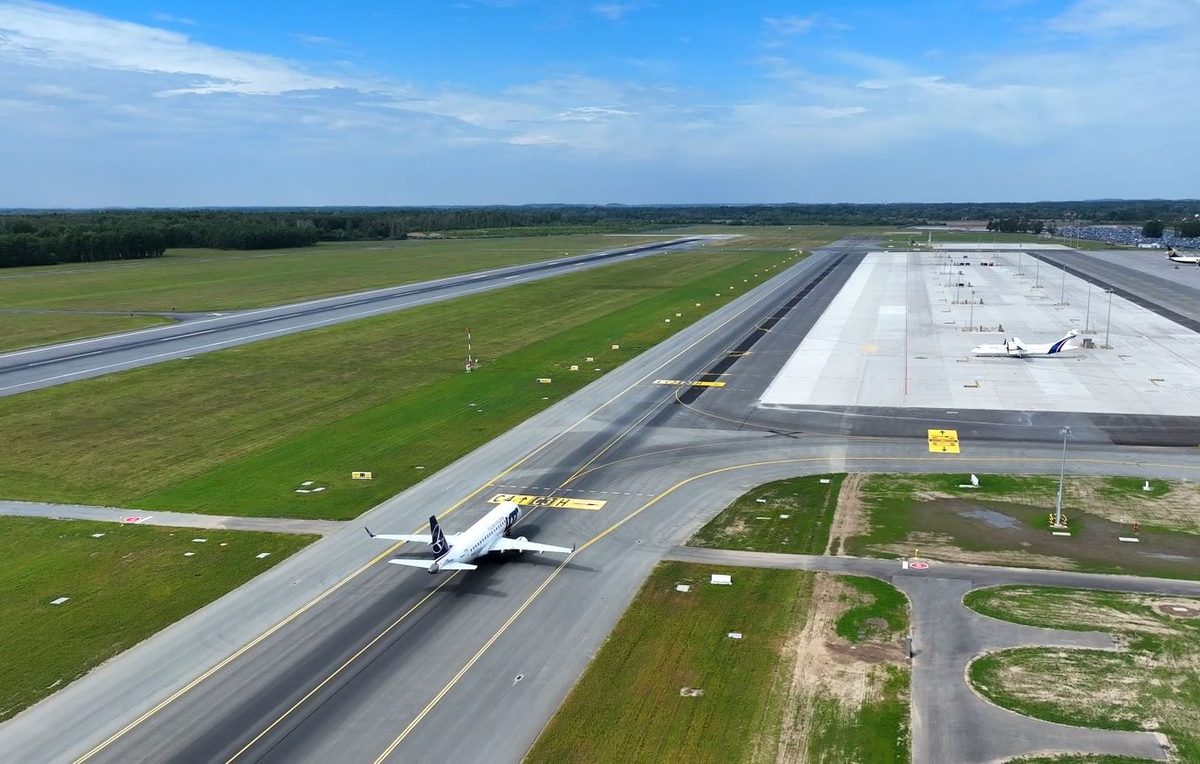
The other challenge faced by Wroclaw Airport is the diversification of its traffic profile and operator mix, from one that is overwhelmingly dominated by low-cost carriers to one which may even bring some long-haul air links.
As of 2026, low-cost carriers dominate traffic at Wroclaw, accounting for two-thirds of aircraft movements, while charter flights make up a further 20%. Ryanair is the largest operator at Wroclaw by far, accounting for around half of the market, with Wizz Air having also built a significant local presence.
In fact, the Irish carrier’s commitment to Wroclaw is quite strong on the ground as well. It has up to eight aircraft based permanently at the airport, where it also operates one of its bases for aircraft maintenance, repair and overhaul (MRO).
In addition, Wroclaw is connected to several major European hubs, such as Warsaw-Chopin International Airport (WAW), which represents the most popular destination from the airport in terms of passenger numbers, as well as Frankfurt (FRA), Zurich (ZRH) and Amsterdam-Schiphol (AMS).
London is also a major destination from Wroclaw, although this link is assured through low-cost carriers flying to Stansted (STN) and Luton (LTN), rather than to the major global hub that is Heathrow Airport (LHR). (British Airways operated a short-lived nonstop service between Wroclaw and LHR during the Summer of 2021).
However, Przywara highlighted the potential for long-haul development, noting the airport’s catchment area, which is home to approximately four million people, as well as the region’s numerous international links.
“We know there are currently around 40,000 people travelling between Wroclaw and New York City through indirect routes,” he explained. He noted that the airport is also a NATO base which sees regular transit of US servicemen.
The notion of a nonstop link between Poland’s regional airports and US cities, particularly those with strong Polish diasporas, is actually not that far-fetched. Polish flag carrier LOT has been operating flights between Rzeszów (RZE), in southeastern Poland, and Newark (EWR), and between Kraków (KRK) and both New York JFK and Chicago O’Hare (ORD), with frequencies stepped up during the summer season.
Wroclaw’s most immediate long-haul prospects are, however, in the East.
Since November 2023, Wroclaw has had a once-weekly LOT service to Seoul-Incheon (ICN), a route closely tied to the region’s economy. Before its launch, the airport estimated that some 35,000 passengers a year were already travelling between Wroclaw and Korea via other airports, a figure in the same ballpark as the desired New York link. This is backed by the fact that around 60% of Korean investment in Poland is concentrated in the Wroclaw area, including a large battery plant built by electronics giant LG.
Przywara believes that Taiwan could follow a similar path, on the back of the plans to build a large technology park with Foxconn in Miękinia, just outside Wroclaw. The park will be located on the site originally earmarked for Intel’s abandoned semiconductor plant.
Indeed, Taiwanese carriers have found in Central and Eastern Europe a beachhead for their European expansion plans. China Airlines is already serving Prague (PRG) and Vienna (VIE), Eva Air has made the Austrian capital its main European gateway and, in August 2026, Starlux Airlines started flying to Prague (PRG), the first European destination for this young full-service Taiwanese carrier.
The European expansion plans of airlines such as flydubai and Air Arabia, now using the increasing range of new generation narrowbody aircraft to reach the region from their Gulf bases, opens up another potential vector for increased connectivity, according to Przywara.
As these expansion projects get underway, Wroclaw Airport wants to ensure that infrastructure doesn’t become a limiting factor for the continued economic growth of Lower Silesia.