

René Armas Maes is a strategic advisor specializing in commercial development and strategy, with a focus on revenue optimization and margin enhancement.
As part of founding teams, he contributed to building a VIP business aviation operation from inception in the UAE and supported restructuring initiatives in Kuwait and Saudi Arabia.
The views and opinions expressed in this column are solely those of the author and do not necessarily reflect the official policy or position of AeroTime.
Airline and business aviation boardrooms are confronting the same defining cost question: what does the jet fuel crack spread (the price differential between Brent crude and refined jet fuel) do next, and how long can the industry absorb it?
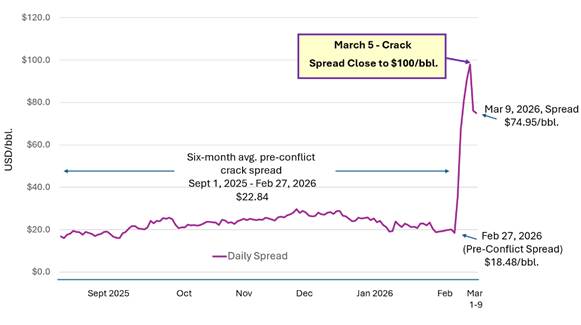
For 128 trading days before February 28, 2026, the answer was reassuringly stable. Brent averaged $65.15/bbl., ranging just $13.77 across six months. The crack spread held at roughly $21-22/bbl., barely above the $20/bbl. long-run norm. The Jet A-1 refining margin was, by every historical measure, normal. Then came February 28.
Nine trading days that repriced aviation’s cost structure
Brent closed at $78.07/bbl. on March 2 already $5.55 above the February 27 close of $72.52. By March 9, Brent closed at $98.96/bbl., up 37% from the pre-conflict close and 52% above the September 1, 2025 starting point, briefly touching $119/bbl. intraday earlier in the week.
The intraday data sharpens the picture further. The pre-conflict average high-to-close spread was $0.76/bbl. or a market with no intraday anchor anxiety. On March 2 alone it hit $4.30/bbl., 5.7x the norm, as traders priced the shock with no established reference point. By March 9 the character of volatility had shifted entirely: Brent opened at $99.75, briefly touched $119.50/bbl. intraday (a 52-week high) before closing at $98.96. The high-to-close spread of $20.54/bbl. on March 9 is 27x the pre-conflict average. The range of outcomes within that single session now exceeds the entire six-month pre-conflict trading range of Brent. A market that swings $20 intraday and closes $20 below its high has no settled view of where value lies.
The crack spread data (six months pre- and post-conflict up to March 9) is illustrated in Charts 1 and 2.


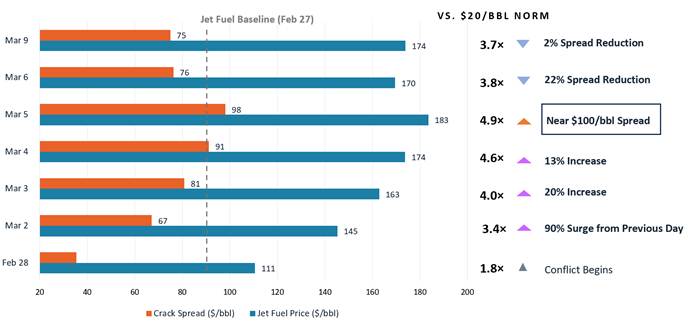
March 6 introduced a critical divergence. Brent hit $93.32/bbl., its highest point to that date, yet global jet fuel prices retreated to 403.67 cts/gal ($169.54/bbl.), compressing the crack spread from 4.9x to 3.8x the norm in a single session. March 9 confirmed the pattern: Brent surged a further 6.8% to $98.96/bbl. while the Platts Global Index settled at 414.07 cts/gal ($173.91/bbl.) or a crack spread of $74.95/bbl., holding at 3.7x the norm. Two consecutive sessions of spread compression against rising crude is the clearest supply-side relief signal yet. It does not mean the cost crisis has passed – at $174/bbl., jet fuel remains nearly double the pre-conflict level – but it is the single most important leading indicator to monitor in the weeks ahead.
Regional price divergence: Why geography matters
Jet fuel prices do not move uniformly across regions. Refinery proximity to crude supply, pipeline and shipping alternatives to the Strait of Hormuz, domestic market structure, and regulatory obligations each create differentiated exposure. When a Hormuz disruption occurs, regions dependent on Middle East crude flows and with the fewest alternative supply routes reprice fastest and furthest. That structural reality defines what the data shows in Chart 3.

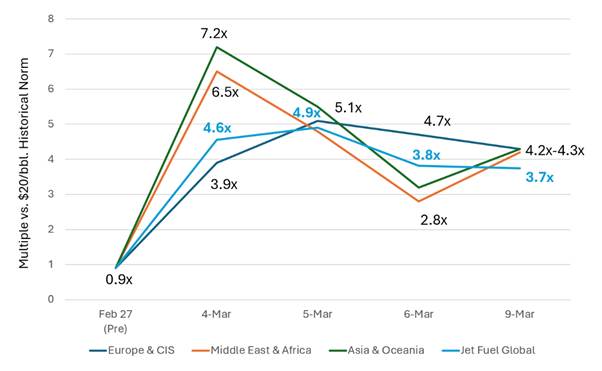
The Jet Fuel Global Index (the weighted composite of all regions) captures the aggregate shock but masks what is happening beneath it. On March 4, it escalated to 4.6x the norm and peaked at 4.9x on Mar 5, then compressed to 3.8x and 3.7x on March 6 and 9 respectively. That compression is the headline signal. But the regional breakdown reveals something the global index does not: the compression is not evenly distributed.
Asia and Oceania (22% of world index) recorded the highest peak: $143.40/bbl. on March 4 at 7.2x the norm, reflecting maximum Hormuz dependency and the greatest distance from alternative supply routes. By March 9, it had compressed to $86.65/bbl. (4.3x), the sharpest regional improvement of the period, consistent with non-Hormuz routing beginning to take effect. Asia is the primary driver of the global index compression.
Middle East and Africa (7% of world index) showed the most violent inversion: $130.54/bbl. on March 4 (6.5x) collapsed to $55.21 on March 6 (2.8x), briefly pulling below the global index and then rebounded to $83.15 on March 9 (4.2x). The March 6 collapse reflected temporary spot availability near production sources. The +51% single-session rebound on March 9 confirms it was not structural. The region is volatile.
Europe and CIS (28% of world index) is the most persistently exposed. Its spread moved narrowly from 5.1x on March 5, 4.7x on March 6, 4.3x on March 9. European refiners have fewer geographic alternatives than Asian buyers and carry an additional structural burden: SAF mandates at 3x to 4x the cost of conventional Jet A-1, which cannot be suspended regardless of market conditions. Europe is the region where the global index compression is least visible at the operating level.
On March 9, all three discussed regions converged at 4.2x to 4.3x or above the global index of 3.7x. The gap between the regional average and the global composite reflects the moderating effect of the Americas, which are not shown but are pulling the index down. That convergence is not relief. It is a market repricing uniformly at a structurally higher floor.
The Americas (not shown in chart) tell a different story. North America (39% of world index) sits at $59.05/bbl. (3.0x) on March 9, the least exposed of all regions, insulated by domestic Jet-A supply chains and distance from Hormuz. Latin America (4% of world index) follows at $68.06/bbl. (3.4x), having peaked at just $70.84 on March 4, representing the lowest peak and flattest trajectory of any region globally.
Together, the Americas are the only geography where crack spreads, while still above historical norms, have not triggered the structural repricing visible across the Eastern Hemisphere. Their weight in the global index is the primary reason the composite sits below the regional average for Europe, the Middle East, and Asia.
Impact and strategic implications: Airlines and business aviation
Airlines:
Fuel represents 30–38% of total airline operating costs, the largest or second largest variable expense depending on the carrier, and the most direct lever on profitability and capacity. At $169–183/bbl. against a pre-conflict average of $87-91/bbl., unhedged carriers face a near-doubling of that cost overnight. Higher fares and margin compression are inevitable. Airlines typically absorb 2 to 6 weeks before repricing, but the direction is not in question.
However, fare increases will be selective. Airlines will reprice high-demand, inelastic routes first. For example, key business corridors, thin-competition markets, and routes where fuel represents the highest share of Cost per Available Seat Mile (CASM). Leisure routes may face capacity cuts before fare increases, as demand evaporation risk on price-sensitive segments is too high to absorb through pricing alone.
Hedging offers limited escape. The pre-conflict $65/bbl. Brent environment provided little incentive to hedge aggressively. Those that did locked in well below current market may be covered only 30% to 60% of fuel needs for the next 6 to 12 months.
Airlines that move fastest across both tactical and structural dimensions will protect the most margin. On the tactical side, the priority actions are clear: raise surcharges, cut underperforming routes before the summer schedule locks, defer 2026 launches where load factor assumptions were built on pre-conflict fuel, and begin accelerating the retirement of fuel-inefficient aircraft ahead of the next planning cycle. On the structural side, sale-and-leaseback transactions offer the most immediate balance sheet lever, while flight route optimization technology delivers measurable fuel savings at the operational level. The direction of travel is clear. The variable is how quickly management teams move. In a market repricing this fast, speed of response is itself a competitive advantage.
The pressure compounds for European carriers under SAF mandates. Sustainable Aviation Fuel already 3x to 4x the price of conventional Jet A-1 becomes a punishing second obligation when the baseline has itself doubled. The result is a dual cost burden: market shock on one side, regulatory cost on the other.
Business Aviation:
Business aviation is structurally different but it is not insulated. The six-month pre-conflict crack spread of $22.84/bbl. kept Jet A-1 costs predictable enough to quote charter rates with confidence. That predictability collapsed on February 28.
Fuel represents 35–45% of private jet operating costs, bundled into charter rates, fractional fees, or borne directly by owners. Quotes issued before February 28 are now loss-making on fuel alone and the standard remedy, fuel surcharge clauses, is contentious with clients on pre-booked itineraries.
Exposure is not uniform across cabin classes. Ultra-long-range jets (the Global 7500/8000, Gulfstream G700/800, Falcon 10X) burn 380 to 530 gallons per hour, generating the highest absolute fuel cost per trip. Yet their clientele is the least price-sensitive. The real vulnerability sits in the light to midsize charter market with thinner margins, clients who comparison-shop, and limited ability to absorb or pass through sudden surcharges without losing bookings to competitors.
Owners using charter revenue to offset holding costs will find that equation deteriorating rapidly. Fuel is now eroding the gross margins that made charter placement worthwhile.
Operators have multiple levers to counter rising fuel costs: real-time surcharges, compressed quote validity windows, aircraft repositioning toward lower-cost fuel regions, and cruise profile optimization supported by route planning technology. On the commercial side, fleet partnerships, fuel consortium buying, next-generation aircraft transitions, and expanded charter availability each offer meaningful offsets to rising fixed costs.
Conclusion
Within nine trading days of February 28, Brent surged 37% from $72.52 to $98.96/bbl., briefly touching $119.50/bbl. intraday on March 9. The crack spread peaked at $98.05/bbl. on March 5, 4.9x the historical norm, wider than anything outside the post-COVID refining crisis of 2022–23, and well above the 3.2x reached in the first week of the Russia-Ukraine conflict.
Against that backdrop, one signal stands out: the crack spread has compressed for two consecutive trading sessions despite Brent continuing to rise. From the 4.9x peak on March 5, it fell to 3.8x on March 6 and 3.7x on March 9. Two sessions is not a trend, but it is the first evidence that physical jet fuel supply may be clearing through non-Hormuz channels. If it holds, airlines and operators may see partial cost relief before Brent itself falls. If it reverses, the industry faces a compounding shock with no near-term hedge available at current market prices.
For commercial carriers, the pressure is immediate and largely unhedgeable. For business aviation, the repricing is already underway quietly but consequentially. At $173.91/bbl. on March 9, jet fuel remains nearly double the pre-conflict level regardless of spread direction.
The single-session range on March 9 from $119.50 intraday high to $98.96 close now exceeds the entire six-month pre-conflict trading range of Brent. That is the most precise measure of how completely this market has repriced. Whether what follows is a shock with a defined end, or the start of a structurally higher energy cost era for aviation, remains the only open question.