
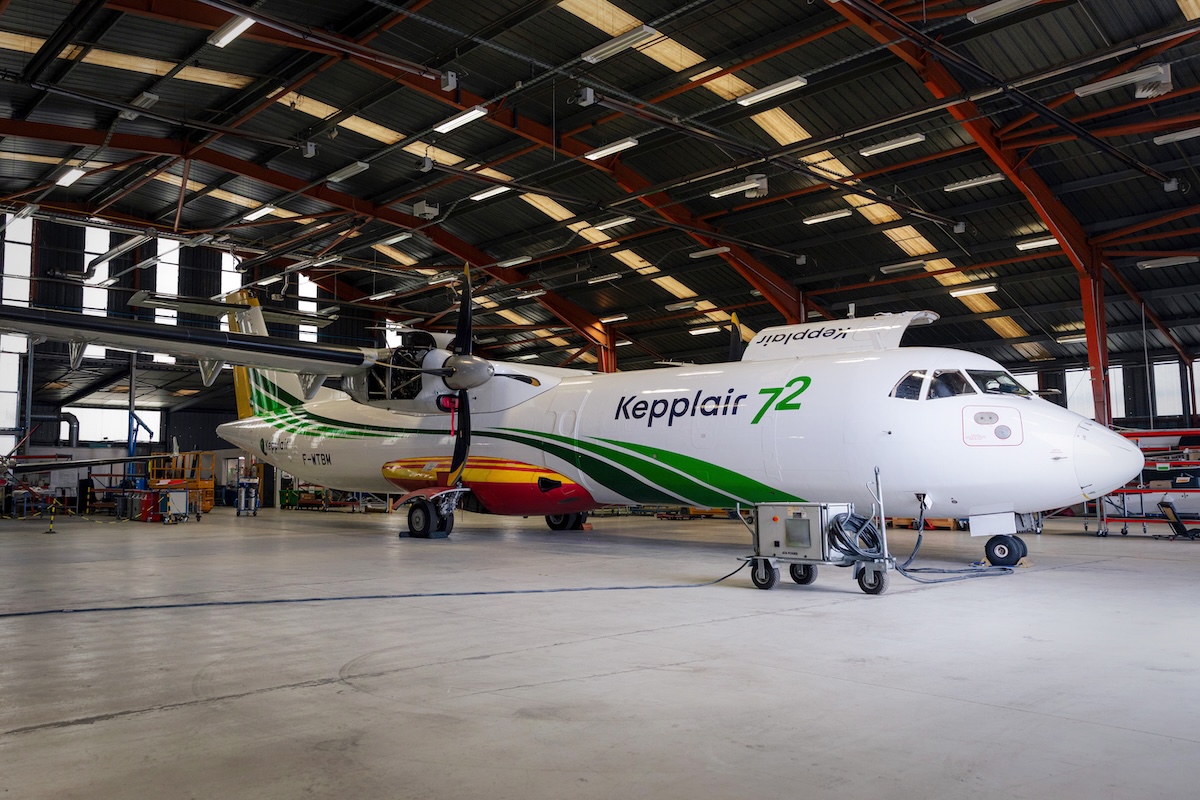
On September 1, 2026, an ATR aircraft took to the skies over Toulouse, France, which caught the attention of many, both in the aviation community and beyond.
Turboprops of this kind are hardly a rarity in the skies near the Occitan city, as it’s home to ATR’s assembly line. This flight, however, was somehow special.
The company operating this particular turboprop aircraft, French startup Kepplair Evolution, aims to validate the capability of a specially modified ATR72 to act as a new generation firefighting platform.
This recent outing was still a pre-modification flight, although Kepplair Evolution aims to move fast with this program. It is targeting beginning of 2027 for the first tests mimicking real firefighting conditions.
This may sound ambitious, but the need for greater aerial firefighting capacity is real and pressing.
Spurred by global warming, the danger posed by large-scale forest fires has been increasing, not just in frequency and scale but also in geographical scope. In 2026, for example, major forest fires have devastated large areas in locations such as western and northern France, and the Netherlands, which are far from the traditionally more fire-prone areas along the Mediterranean basin, adding urgency to the search for firefighting solutions.
However, the problem is that the aviation industry doesn’t really have a very compelling answer at the moment.
The Canadair CL-series amphibious aircraft, operated by several European countries as their primary firefighting platform, is no longer in production, and the existing airframes are starting to show their age. DeHavilland Canada, which took over Canadair, is working on a replacement, the DHC-515, but it will take a few years before this becomes operative.
Other platforms, such as helicopters and the single engine firefighting aircraft made by Air Tractor, have much smaller water-carrying capacity.
A number of startups are working on the development of clean sheet firefighting aircraft, but most of those designs are at a preliminary stage of the development process.
It is in this context that Kepplair Evolution, with its turboprop conversion, enters the picture. The trick is that, by pairing a tried and tested aircraft like the ATR72 to a state-of-the-art highly efficient water dropping system, this startup promises to have a state-of-the-art, mid-sized firefighting platform ready for certification and entry into service as early as 2027.
AeroTime spoke with David Joubert, founder and CEO of Kepplair Evolution, who provided some additional details on the vision behind the KEPPLAIR72 ‘Forest Keeper’ aircraft.

It transpires that Joubert had in fact started thinking about developing a firefighting aircraft for the European civil protection needs as early as 2012. At the time, the Joubert’s preference was for bringing large airliner conversions to Europe using aircraft such as the DC-10 or the B747, which some firefighting contractors have long been using in the United States.
As French and European officials warmed to the idea, the project soon developed towards considering the use of Airbus A330 aircraft as a platform which would have been capable of dropping around 40,000 liters of water in one pass.
Those early approaches were shelved, but in the process Joubert assembled a team which amassed a considerable amount of scientific and technical know-how in the field of aerial firefighting. This includes figures such as Professor Dominique Legendre, one of the world’s leading experts in the field.
Kepplair’s efforts were two pronged. On the technical side, the aim was to develop the best performing water dropping system possible. At the same time, there was also a political lobbying effort to pitch the concept to governments, often the ultimate users of these types of platforms.
Why the ATR72?
In time, Kepplair’s team settled on the ATR72 as the most suitable aircraft for its modular concept.
The KEPPLAIR72 Forest Keeper is in fact a multi-role platform, allowing operators to configure the aircraft for aerial fighting, but also for other uses related to civil protection tasks, such as medical evacuation or even tactical transportation. The different configurations can be changed on demand within a couple of days. It will also be possible for operators to combine two of those functions at the same time, although in that case some compromises would need to be made in terms of capacity.
When it comes to the firefighting role, the core of the system is the water release system. Known as KEDS (Kepplair Evolution Delivery System), it has been developed exclusively for Kepplair by Trotter Controls, a partner firm specialized in the development of telemetry and drop systems for water bomber aircraft, with the participation, as well, of the Toulouse Institute of Fluid Mechanics (IMFT as per its French acronym).
The KEDS can be installed in either the ATR72-500 or -600 versions and carry up to 7,500 liters of water (a little more than the current 6,000 liters of the Canadair C-415, although less than the new, larger CL-515).


Kepplair’s Forest Keeper is to be a ground-based plane, rather than an amphibian one. This, Joubert explains, doesn’t represent a significant drawback in operational terms, since it will be able to operate very fast rotations. Once on the ground, it is possible to refill the tanks in around four minutes, from a mobile or fixed pump, or even from a fire truck. The whole sequence – from landing to refill and take off again – can be completed in less than ten minutes, he explained to AeroTime.
By landing on a normal runway, no specific scooping training is required, which is an additional simplifying factor and lowers the total operational costs.
The topic of costs is clearly relevant, since the whole program is designed to be extremely capital efficient.
“We can complete the whole development program for less than €50 million,” Joubert explained.
Kepplair Evolution is already nearly halfway this goal.
On September 8, 2026, Kepplair Evolution announced it had closed a €6 million (US$7 million) Series A funding round, bringing the total raised to date to €17.5 million (US$20.3 million). The majority of this capital (€12.5 / US$14.5 million) was provided by private investors, with the remaining €5 million (US$5.8 million) coming from public funds, particularly from the French région of Occitanie, were Kepplair Evolution is based).
It helps that rather than an entirely new type certificate, as it would be the case with a clean-sheet design, Kepplair Evolution is working on obtaining a Supplemental Type Certificate (STC), which is the permission required to perform major changes on an existing aircraft. This process is significantly cheaper and faster than certifying a new aircraft, and Kepplair can count on the support of AeroTec, the MRO company which has performed the largest number of STCs in Europe.
The latter firm is already working to turn Kepplair’s first ATR72, provided by leasing firm ACIA-Aero, into a proper “Forest Keeper”. The first flight tests are expected to begin before the end of 2026 at a specialized testing ground in Provence, southern France.
Among those keeping an eye on those tests are, almost certainly, going to be staff of France’s Directorate General for Civil Security and Crisis Management, the country’s civil protection agency, which signed a Memorandum of Understanding (MoU) to evaluate the Forest Keeper. The French government has not committed to any specific orders yet but is evaluating the “Forest Keeper” as an asset of potential national interest.
A number of other operators, in France and overseas, have already signed MoUs for at least 22 aircraft. For example, as recently as July 2026, Kepplair Evolution announced that it had signed a Letter of Intent (LoI) with Corsica Technics, an MRO firm based on the eponymous Mediterranean island, to provide 10 KEDS kits for future ATR conversions.
How big could this market be?
When asked about this, Joubert didn’t hesitate to put a figure on the company’s commercial goals: operators will need around 400 firefighting aircraft over the coming 10 years worldwide, of which Kepplair aims to secure 25%.
Joubert is also confident that more than enough ATRs are going to become available for second-hand conversions over the years to come, as regional operators continue to replace the first generation of ATR turboprops with the latest generation model.
In any case, Kepplair also plans to offer its kit for installation in new aircraft.
In this regard, Joubert highlighted that Kepplair is fully independent from ATR, although, in conversation with AeroTime, he described the relationship with the aircraft maker as “supportive” (“soutien bienveillant,” to quote the original French).
Besides its potential to offer competitive capital and operational costs, Joubert also referred to an important card that Kepplair Evolution is able to play: its expected early arrival to the market.
Kepplair is betting on being the only new aerial platform offering availability from 2027. Even if the DHC-515 program is completed on time, most of the early production slots are already taken by the RescEu 22-aircraft order which the European Union and several individual placed with the Canadian manufacturer in 2024.
This means that any new orders will face a four-to-five-year backlog. However, other projects, such as Airbus-supported Hynaero’s clean-sheet amphibious aircraft, which is currently under development, may not become available until early in the next decade.
“We are here to complement all other platforms,” Joubert concluded.