
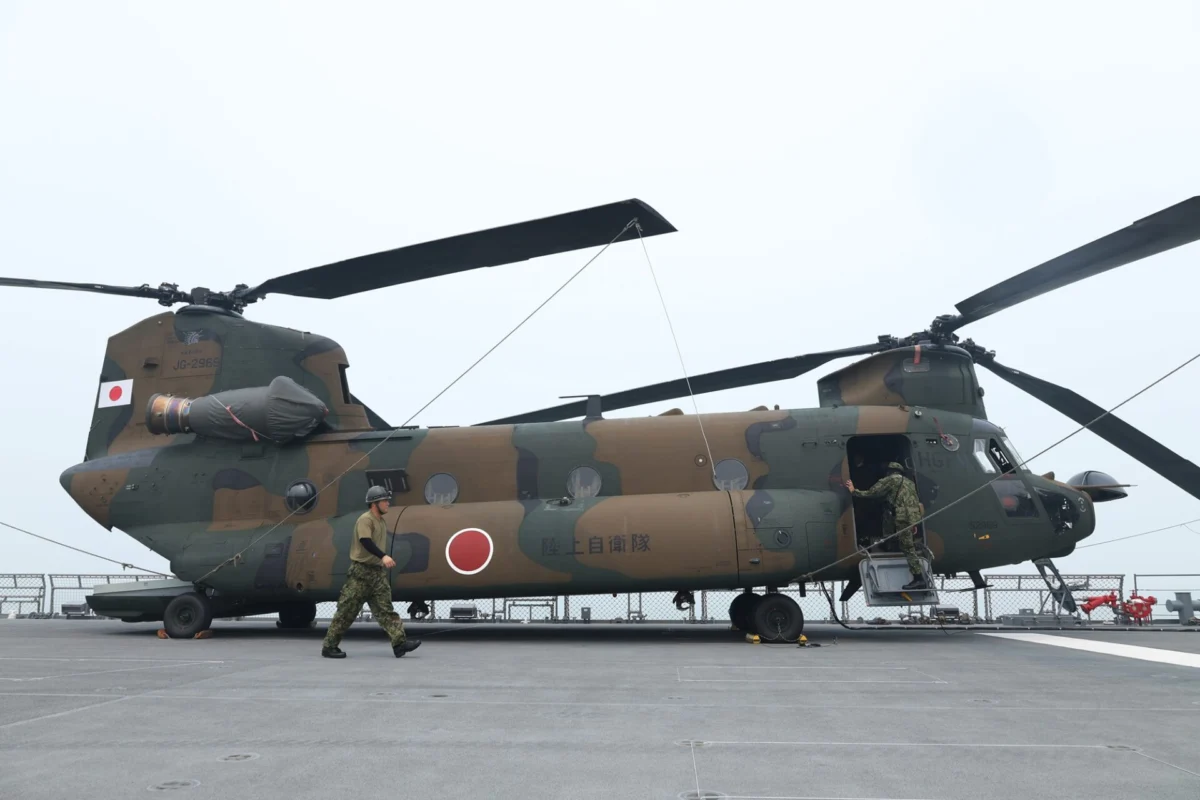
Japan has moved one of its three CH-47 Chinook helicopters to a landing ship off Indonesia’s West Kalimantan province, establishing a second operating base for its ongoing wildfire response.
The Japan Maritime Self-Defense Force (JMSDF) transport ship JS Kunisaki arrived off Ketapang on September 21, 2026, carrying a Japan Ground Self-Defense Force (JGSDF) CH-47, the Ministry of Defense said. The helicopter will begin firefighting operations as soon as preparations are complete.
Two CH-47s will continue operating from Kijing Port, north of the provincial capital Pontianak, while the third will operate from the ship off Ketapang, farther south along the coast.
JS Kunisaki, an Osumi-class landing ship, departed Japan on August 30, 2026, with all three CH-47s embarked and arrived at Kijing Port on September 10, 2026. Repositioning the ship to Ketapang allows the detachment to operate from two locations.
Smoke delays Japan’s first overseas military firefighting mission
Japan ordered the deployment on August 28, 2026, under its international disaster relief framework, mobilizing three helicopters and one transport ship. The mission also falls under a defense cooperation arrangement signed with Indonesia in May 2026, which includes humanitarian assistance and disaster relief.
Smoke and poor visibility initially prevented flying after the ship’s arrival. The first water drops took place on September 16, 2026, using river water carried in underslung buckets, according to Jiji Press.
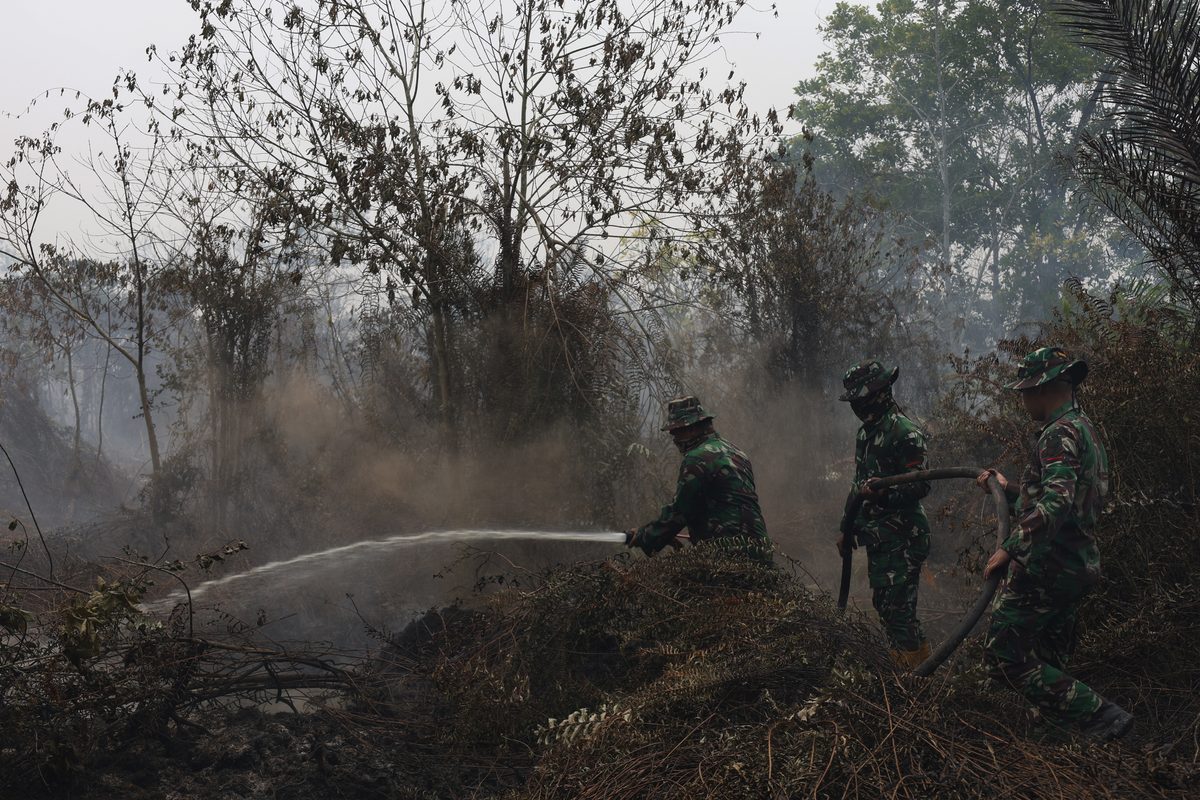
West Kalimantan is one of six priority provinces in Indonesia’s national firefighting effort. In its last report, the country’s disaster management agency, BNPB, put the area burned in the province at 48,535 hectares (103,784 acres) as of September 15, 2026, with 19 hotspots still active. Peat fires are particularly difficult to extinguish because embers can continue smoldering underground after surface flames disappear, requiring sustained firefighting efforts.
Japan’s Ministry of Defense described the deployment as the first overseas firefighting operation conducted by Japan’s Self-Defense Forces. It said its forces would continue supporting Indonesia’s firefighting efforts to prevent the damage from spreading.
The CH-47 is the backbone of the JGSDF’s heavy-lift helicopter fleet. Kawasaki Heavy Industries has license-built the type in Japan since the 1980s, and Boeing announced in February 2025 that Japan had ordered 17 CH-47 Block II Chinooks to renew its fleet.