
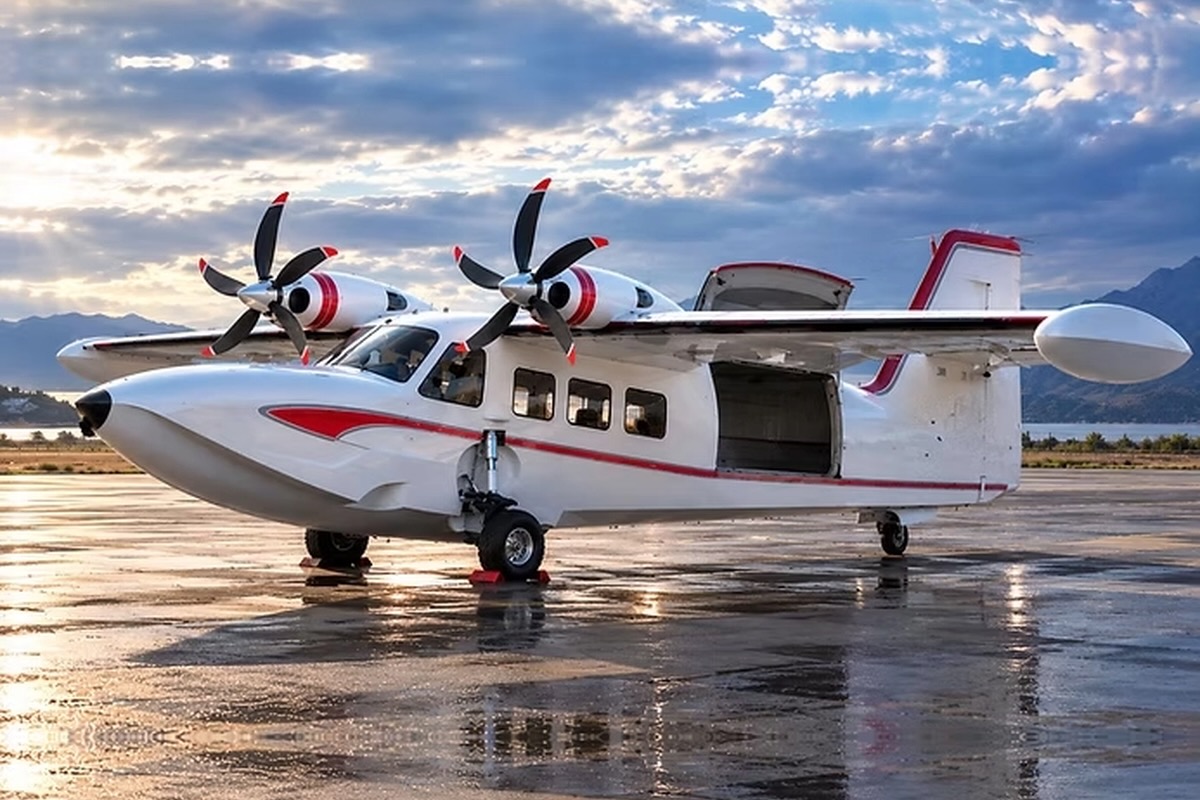
Florida-based aircraft developer Maxwell Aircraft has unveiled a hybrid amphibious aircraft concept designed to carry cargo between waterways and remote airstrips, using electric motors for additional takeoff power and jet-A-burning diesel engines in cruise.
The proposed M1 Hybrid Cargo, designated M1-HC, would be capable of carrying a 2,000-pound payload more than 1,000 nautical miles, according to the company. Maxwell is targeting island supply routes, remote communities, disaster response and government missions.
The propulsion system would combine electric motors and fuel-burning engines driving the propellers through a common gearbox. Maxwell is targeting up to 1,500 horsepower during takeoff and initial climb, with approximately 300 horsepower combined power in cruise.
Concentrating electric assistance on takeoff and climb would reduce the battery capacity and weight needed compared with an aircraft powered entirely by batteries, the company said. Turbocharged compression-ignition engines burning jet-A would provide power during cruise.
“Our goal with the M1 Hybrid Cargo was to rethink what an amphibious aircraft can do,” Maxwell CEO David Dillon said.
Maxwell initially focused on all-electric seaplanes for shorter flights. The company says advances in lightweight engines persuaded it to pursue a hybrid configuration that could carry more cargo over longer distances. It continues to list an all-electric M1-E alongside its hybrid designs.
The aircraft would use a carbon-fiber and Kevlar airframe derived from the Gweduck, a twin-engine amphibian that first flew in 2009. The original Gweduck was developed as a modern flying boat influenced by earlier Grumman designs. Its features include retractable wingtip floats and reversible propellers for maneuvering near docks.
Maxwell’s proposed cargo version includes a five-foot-wide loading door and internal tie-downs. The company lists a cruise speed of 135 knots for the M1-HC.
Based in Bartow, Florida, Maxwell works with airframe supplier Carbon Seaplanes. The developer says the first carbon-fiber and Kevlar Gweduck airframes have been produced and are headed for final assembly.
Initial flight testing is targeting to begin in 2027.