
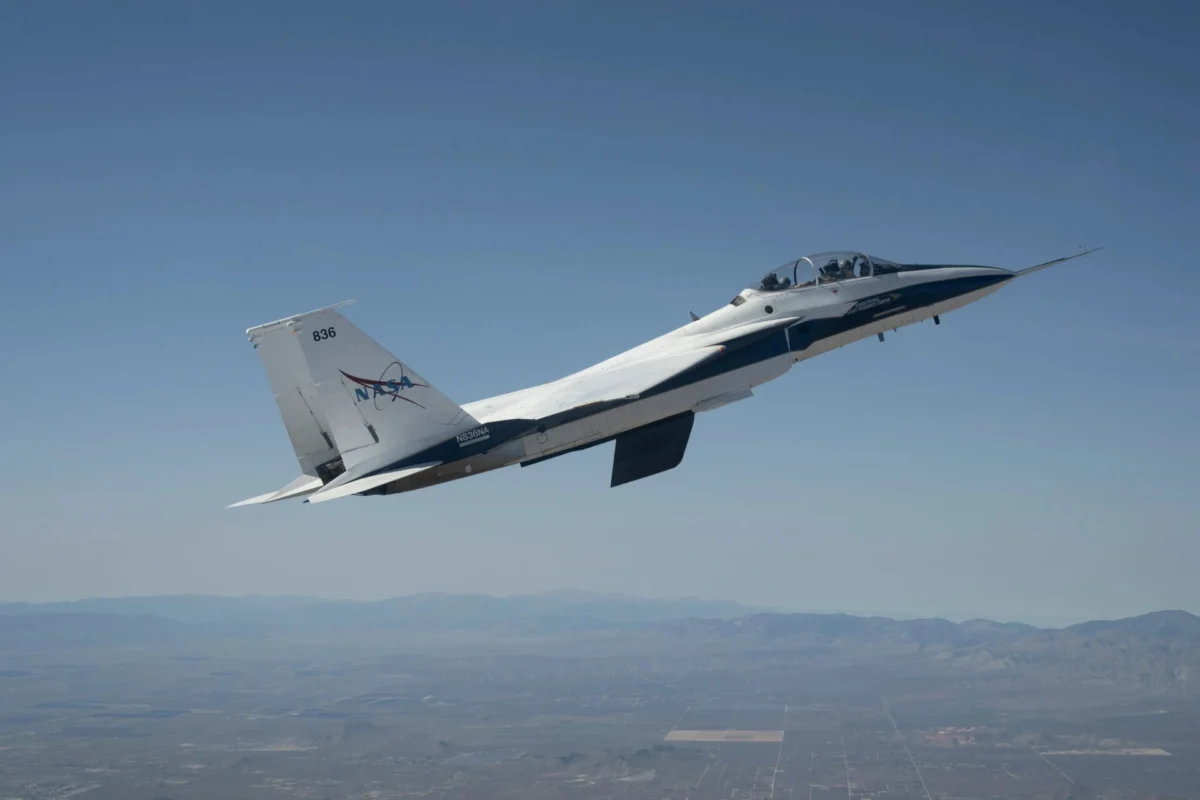
NASA has taken a small but important step toward cleaner, more efficient flight on future airliners by testing a new laminar-flow wing concept that aims to keep airflow more smooth, thereby cutting drag and reducing fuel burn.
According to the agency, it completed the first flight of its Crossflow Attenuated Natural Laminar Flow (CATNLF) scale-model wing during a test at its Armstrong Flight Research Center in Edwards, California. NASA used one of its F-15B research jets as the flying testbed.
The CATNLF article is not a full wing. It is a 40-inch-scale model that NASA mounted under the F-15’s belly, standing upright like a fin. NASA picked that configuration to enable the testing of the design in real flight conditions without building a new aircraft.
The first flight lasted about 75 minutes. The goal was to prove that the aircraft could fly safely and predictably with the test article installed, before the team moves into more aggressive research runs. “First flight was primarily focused on envelope expansion,” said Michelle Banchy, research principal investigator for the project.
NASA’s target is laminar flow, the smooth, orderly airflow that reduces drag. Aircraft designers desire laminar flow because it can lower fuel burn. The trouble is that modern airliners use swept wings, and swept wings tend to trigger ‘crossflow’ instabilities that trip the air into turbulence and add drag. NASA designed CATNLF to reduce those disruptions and hold laminar flow longer on swept surfaces, including wings and tails.
During the flight, which occurred on January 29, 2026, the team ran a set of basic maneuvers, including turns, steady holds, and gentle pitch changes. They flew at altitudes from about 20,000 feet to nearly 34,000 feet, to get a first look at how the model behaved across different conditions. NASA said that the early results showed airflow over the article closely matched the predictions of its computer models.
To measure laminar flow in the air, NASA is using multiple tools, including an infrared camera aimed at the test article to gather thermal data. The team will use that data to confirm key parts of the design and see how well the model maintains smooth airflow.
NASA plans up to 15 flights in the CATNLF series, testing the wing across a range of speeds, altitudes and flight conditions. The first flight builds on earlier work that included computer modeling, wind tunnel testing, ground checks, and a high-speed taxi test that reached about 144 mph, NASA said.