
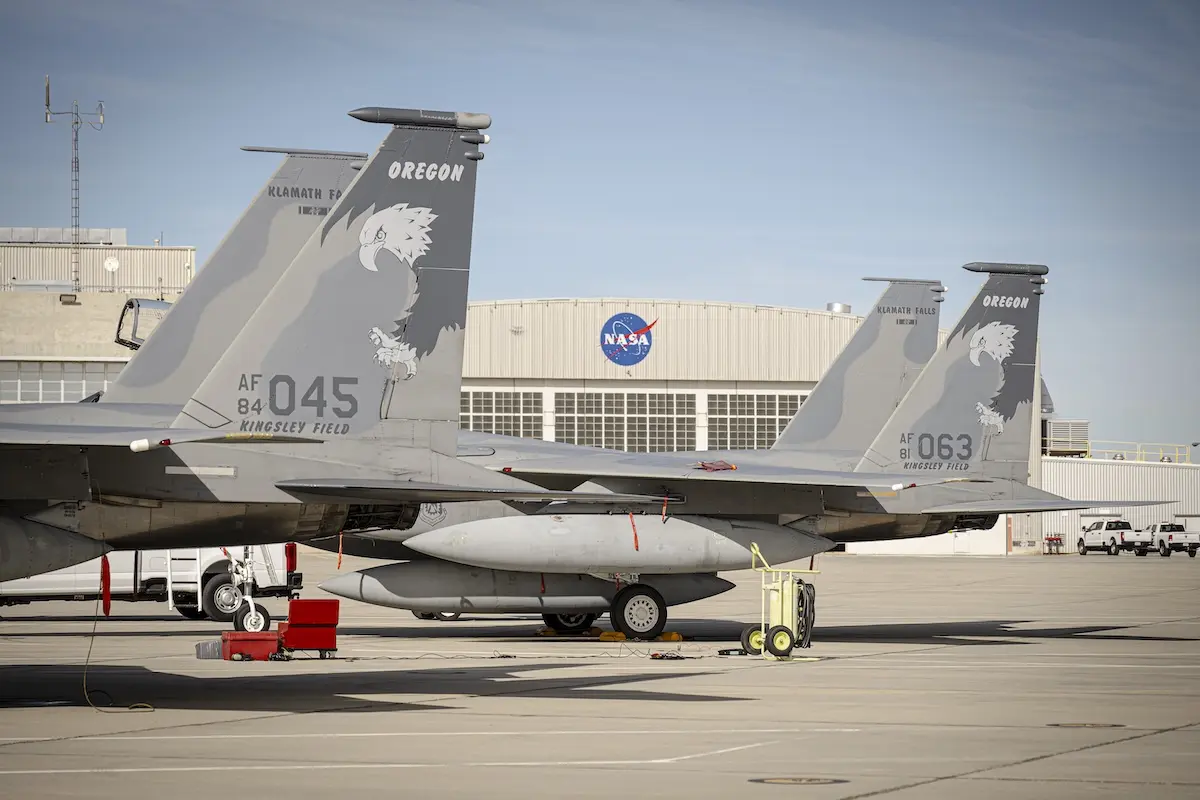
It was announced on January 15, 2026, that NASA has received two F-15 fighter jets to support its supersonic flight research program.
The two jets have been transferred to NASA after having been retired from service by the United States Air Force (USAF) and arriving at NASA’s Armstrong Flight Research Center at Edwards Air Force Base, California on December 22, 2025.
Prior to their retirement and repurposing as research aircraft, the two F-15s served in the Oregon Air National Guard’s 173rd Fighter Wing, based at Kingsley Field airbase, Oregon.
NASA has operated F-15s for research purposes since 1976, when it obtained its first pair of F-15As. Three other aircraft of this type (two F-15Bs and one F-15D) were also obtained by the US space agency in later years, with two of them still reportedly active as of late 2025.
The F-15 is particularly well suited for this type of research mission because of its capability to operate at high speeds and altitudes. For example, it enables NASA to conduct flight tests at up to 60,000 feet. This is higher than the planned flight envelope (55,000 feet) of the X-59, the agency’s new experimental aircraft, which is about to start its flight test program.
The X-59 is the centerpiece of NASA’s Quesst mission, a program intended to advance supersonic flight research, particularly in the field of low-boom supersonic flight.
This promising technology – on which several private startups such as Boom Supersonic and Spike Aerospace are also working – aims to mitigate the sonic boom produced when crossing the sound barrier. If this technology can be rolled out at scale, it would facilitate the launch of commercial supersonic services over land.
Renewed interest in supersonic travel in the US has been reflected in legislative proposals to relax the supersonic flight restrictions, plus the issuance by President Trump in June 2025, of an Executive Order setting the grounds for the comeback of civilian supersonic flight.
Another feature that makes the F-15 a platform of choice for this type of research is its high ground clearance and capacity to carry heavy payloads, which allows scientists to fit it with a broad range of sensors and equipment, under the wings and the central part of the fuselage. Researchers at NASA will also be able to modify and customize the aircraft’s electronic and software systems in order to suit the aircraft’s new missions.