
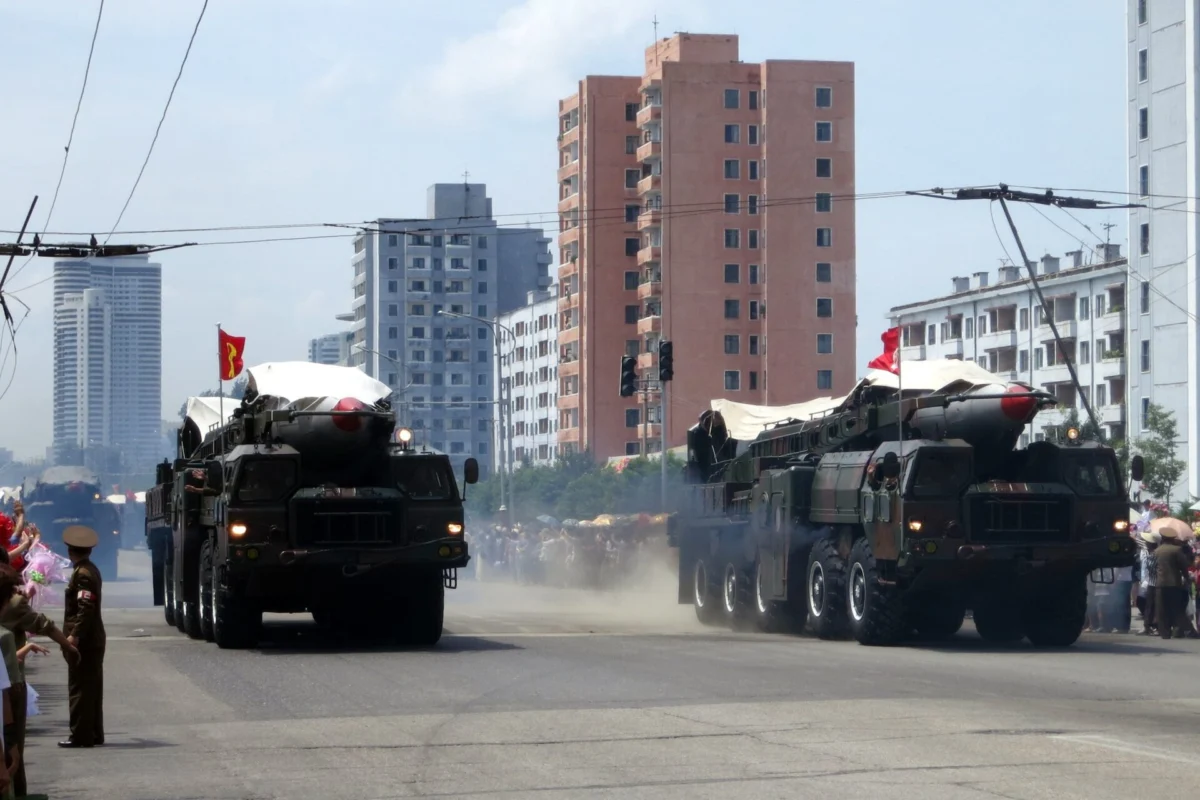
North Korea disclosed on September 14, 2026, that it had fired attack drones, cruise missiles, ballistic missiles and rocket artillery in a single exercise two days earlier.
The Korean Central News Agency (KCNA) said the joint firepower attack drill took place on September 12, 2026, and involved subunits from five artillery and missile units of the Korean People’s Army (KPA).
KCNA described the weapons used as “new combat systems such as attack drones of various kinds, tactical cruise missile, large-caliber thermal-pressure multiple rocket launcher and tactical ballistic missile.” It did not name individual types, provide designations, or identify the firing area.
The agency claimed all strike systems achieved “unity and simultaneity” in the attack and hit their targets with 100% accuracy.
The exercise was overseen by senior KPA officials, including Pak Jong Chon, Vice Chairman of the Central Military Commission, and Yu Chang Son, director of the artillery bureau of the KPA General Staff. Kim Jong Un was not reported to have attended.
South Korea detected several short-range ballistic missiles
South Korea’s Joint Chiefs of Staff (JCS) said it detected several short-range ballistic missiles fired from the Wonsan area at around 05:20 local time on September 12, 2026.
The missiles flew about 250 kilometers (approximately 155 miles) before falling into the sea, according to the JCS. South Korean and US authorities analyzed their specifications and shared the information with Japan.
Why synchronizing drones, missiles and rockets matters
The four categories of weapons involved fly very differently.
An attack drone is comparatively slow and typically remains at low altitude. A cruise missile follows a low, controlled flight path. A ballistic missile climbs on a steep trajectory before descending at high speed, while rocket artillery covers shorter ranges in a matter of seconds.
Coordinating them over the same target therefore requires firing units to share a common time reference and target set while keeping the different flight paths deconflicted.
The combination could complicate layered air defense, since each weapon category presents a different radar signature, trajectory and engagement window.
Drill followed US-South Korea-Japan Freedom Edge exercise
The North Korean exercise came one day after Freedom Edge 26, a trilateral exercise involving Japan, South Korea and the US.
US Pacific Command said the five-day exercise concluded on September 11, 2026, after expanding trilateral air defense communication and refining real-time data-sharing procedures between the three countries.