
The world of inflight entertainment (IFE) is in a state of flux. Over recent years, the advent of streaming content directly to passengers’ devices and increasingly ubiquitous (if generally expensive) inflight internet connectivity has transformed the way people consume content onboard airliners.
However, when it comes to the long-haul, the seatback screen continues to reign supreme. And in the field of IFE, one player has remained dominant: Panasonic Avionics. From its base in California, the IFE arm of the giant Japanese conglomerate, ensures that passengers on some 200 airlines, including some of the world’s largest carriers, can enjoy the latest Hollywood releases while cruising at 30,000 feet.
However, the advent of low-cost, high-speed low-Earth orbit (LEO) satellite connectivity, spearheaded by Elon Musk’s Starlink and followed by Amazon Leo (formerly Project Kuiper) and Eutelsat’s OneWeb, is fundamentally changing how the industry thinks.
So, should Panasonic be concerned about freely available broadband? And how does the market leader see the future of the IFE industry?
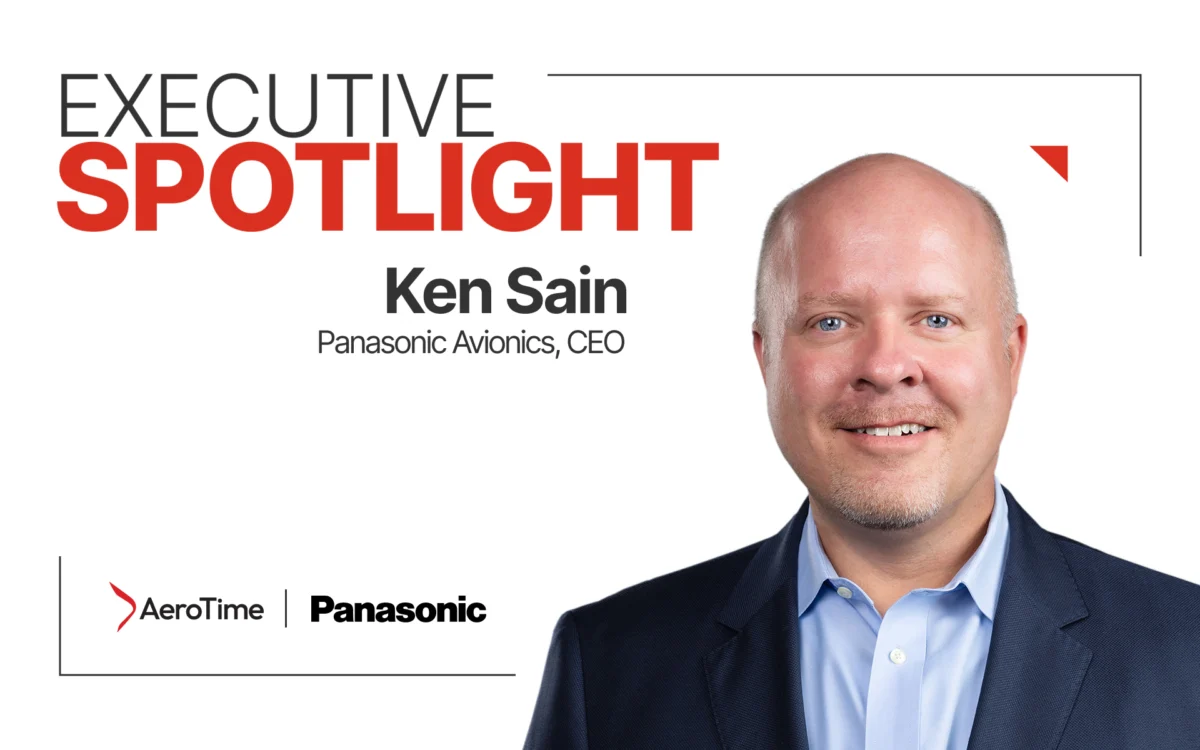
In late 2025, AeroTime sat down with Ken Sain, CEO of Panasonic Avionics, to better understand the forces currently shaping the inflight entertainment landscape and how the company is navigating this rapidly evolving landscape.
“A phone isn’t a great vehicle to enjoy content, and even a tablet isn’t ideally set up, aspect ratio-wise, to watch theatrical content,” Sain explained. “A seatback screen is much bigger than either of these and it’s also placed right at the spot where the passenger can easily enjoy it.”
Throughout the conversation, Sain repeatedly referred to “inflight engagement” rather than “inflight entertainment”, highlighting the fact that Panasonic Avionics focuses on more than simply keeping people watching movies during flights.
While providing IFE through seatback screens is the bread and butter of Panasonic Avionics’ business, the company is also active in three other related business areas. One of these is inflight digital solutions, which includes the distribution of content as well as ancillary services, such as the digital tools that make it possible for passengers to order food, drinks, and duty-free items onboard.
Then there’s inflight connectivity. Panasonic develops and integrates solutions that work with both Geosynchronous (GEO) and low-Earth orbit (LEO) satellite constellations, and the aftermarket services. The latter plays a particularly important role in Panasonic Avionics’ value proposition, since it provides the company with a global reach and standards of service that are difficult to replicate.
“This is really unique about Panasonic. We have a large, distributed field service team with over 1,000 mechanics maintaining equipment for our customers,” Sain said. “We are at the airports, and, if an aircraft lands with some fault, they’ll meet the plane at the gate, go onboard and fix it during the turnaround.”
Sain also noted that this multi-faceted approach is, in great part, what has enabled Panasonic to claim leadership in the inflight services space. “Most of our competitors do one thing; none of them have our footprint,” he added.
The impact of free inflight internet
Controlling the gateway to millions of ‘eyeballs’, which is how content consumers are often referred to in the industry, has given Panasonic Avionics access to a large captive market – after all, there’s not much to do on a long flight. However, with more airlines signing up with SpaceX to provide free, high-speed broadband through the company’s Starlink satellites, the situation could soon change.
But Sain does not consider this a threat to business in any meaningful way.
“It’s going to be great,” he said, referring to the generalization of inflight broadband. “Here’s why: it’s going to elevate the IFC [inflight connectivity] experience, but it’s going to greatly improve the seatback IFE experience as well. And the reason it’s going to do so is that only about 5% of seatback screens today are connected to the internet. The other 95% are not connected, even if the aircraft has inflight connectivity.”
“Part of the reason why is that the vast majority of the in-flight connectivity solutions today are using GEO satellites, which are really far away, 22,000 miles away from Earth,” he continued. “So, when you’re on an airplane and click on something, you’re sending a signal to the satellite, 22,000 miles up, then from the satellite down to an Earth station, another 22,000 miles then back up to the satellite, and another 22,000 miles back to the airplane.
“So, you’re doing an 88,000-mile trip. Even at the speed of light, that takes almost a second, 700 to 800 milliseconds, and cloud solutions are built for low latency on the ground. Anything over 100 or 200 milliseconds won’t perform with a cloud solution.”
Since they orbit much closer to Earth, LEO solutions deliver a lower latency, Sain explained. This is enough to be suitable for cloud solutions.
He added: “We’re going to be able to connect each one of those seatback screens into a cloud solution that delivers personalized content for each particular passenger.”
How does this raise the bar for inflight engagement?
“Think of a logged-in experience in which the screen knows who you are, and it automatically configures itself to what you like, so that you have a more pleasant flight,” Sain continued. “That doesn’t happen today. Almost all the screens treat everyone exactly the same. The only difference is at the front of the plane; business class passengers get bigger screens.
“So, imagine a future where the digital engagement experience is personalized on every single screen on that flight,” he added. “So, 200 passengers each get a slightly different experience based on what they like. That’s what’s about to change.”
Sain clarified that, when it comes to inflight connectivity, Panasonic Avionics is technology-agnostic.
“We don’t have any satellites or any assets in space, which I would argue is a prudent approach during a time of rapid technology change,” he said. “We are an honest broker of technologies, so that we can assemble a network for the airlines.”
Sain also delved into the differences between LEO and GEO satellites and the pros and cons of each of these technologies, confirming that Panasonic Avionics’ platform can work with both.
“We have assembled a multi-orbit network that has both systems, and it selects which satellites to connect to, based upon where the airplane is in the world,” he said. “We generally lead with LEO, but it isn’t available everywhere – for example, it’s not available over China or Russia. GEO, in turn, is not available over the poles, but LEO is. So, there are places where one’s better than the other, and by having a multi-orbit solution, you can provide global coverage.”
At the 2026 Singapore Airshow, for example, Panasonic Avionics signed a memorandum of understanding (MOU) with Shanghai Spacesail Technologies. This agreement, if finally implemented, would give Panasonic Avionics access to the latter’s LEO satellite constellation, which is able to provide service over China.
Likewise, Panasonic Avionics does not produce most of the content that is watched on its screens. Other companies are the media buyers, and they manage the purchase of content from the studios.
“These are large files. We’re talking [about] terabytes’ worth of data that go into each airplane every monthly content cycle,” Sain explained. “It is quite a bit of work! We deliver the content, we package it so it can be consumed, we do the fulfilment. We’re not involved in the Hollywood content. There are companies like Anuvu that specialize in that.”
What Panasonic Avionics does do is design, manufacture, and service the screens and related hardware that goes onboard an airplane. It also builds its own GEO antennas (it purchases the LEO antenna from another company, Gilat). In July 2025, Panasonic Avionics introduced a new multi-orbit electronically steered array (ESA) antenna which can connect to both LEO and GEO satellites.
From entertainment to engagement: Changing the ‘e’ in IFE
“We’re at an inflection point. In our industry, ‘IFE’ has always stood for ‘inflight entertainment’, and entertainment has value for passengers and for the airline, typically on longer flights,” said Sain. “If you have someone on a 10-hour flight, and there’s no IFE, there’s going to be disruption on the airplane! That’s why almost 100% of widebody passenger aircraft have IFE.”
“What’s more recent is that we elevate the value proposition, from entertaining to what we call ‘passenger engagement’. This is meant to improve the airline’s NPS [Net-Promoter Score], drive ancillary revenue, and improve operational efficiency,” he continued. “We call those engagement levers. The value proposition is expanding.”
The prevalence of seatback screens is much smaller on narrowbody fleets, at least outside of the United States, where it is more common. Only 25 to 30% of narrowbody aircraft have seatback screens, but that number is growing. Sain attributes this upward trend to airlines understanding what switching from passenger entertainment to passenger engagement means, in terms of value proposition.
Sain explained how some airlines flirted with Bring Your Own Device (BYOD) technology, which lets passengers stream content on their own phones and tablets. At the time, it was also seen as a way to drive passenger engagement without the weight penalty and technical complexity of wiring the aircraft for seatback screens. However, this perception is changing, Sain explained.
“You should talk to airlines about the passenger take rate for bringing your own device versus seat back screens,” he said. “Seatback’s adoption rate is 10 times higher. Here’s the reason: the experience is better. You can check that with, for example, United Airlines, since they have said it publicly.”
“Airlines want to build loyalty with passengers through their digital experience, and when someone uses their phone and connects to Wi-Fi, more often than not, they’re not doing so to use the airline’s own app or website,” he continued. “They’re more likely transporting themselves to their work environment, or Netflix or Prime Video, and airlines recognize that’s not in their best interest, overall.”
“They have to earn the eyeball time with something that’s more compelling,” he added. “If you talk to sophisticated airlines that provide both, seatback IFE, and inflight connectivity (IFC), they’ll tell you IFE has twice the NPS impact of IFC. And it’s in the airline’s environment, versus someone else’s environment.”
Sain also explained that BYOD became popular 10 years ago because of two factors that were stacked against seatback screens: they were heavy, and you had to wire them. What’s more, because seatback screens were embedded in the seat, they couldn’t easily be upgraded. Recertification was necessary every time a change was needed.
However, technology has mostly solved these problems, explained Sain. In 2022, Panasonic Avionics introduced a new seatback system called Astrova, complete with an architecture that had been totally redesigned to address the weight issue and the ability to upgrade. To date, approximately 30 airlines have adopted this system. Among the most recent announcements are Emirates and flydubai, both of which revealed their selection at the Dubai Airshow in November 2025.
Sain said: “It has become the most successful system [in] the industry by a factor of two since its launch, and the reason is because it’s 30% lighter than anything else. It’s also the first system that is upgradable.”
He explained that, in older systems, the processor and memory were in the actual screen.
“The problem was that, to get it certified, you have to do dynamic testing with a dummy that simulates a crash,” Sain said. “So, if you wanted to change the processor, you had to redo the certification all over again, which costs millions of dollars.”
Panasonic Avionics found a different approach. It took the processor and the memory out of the screen and put it in a box right under the seat. This way, when an airline wants to upgrade the system, it can just change the box without having to rip the entire system out and recertify it.
“That was the number one pain point of basically every single airline,” Sain said. “We reduced the weight, we addressed the obsolescence challenge, and now it’s upgradeable.”
But there’s more to it than that, Sain said.
“Inflight connectivity is sort of a ‘table stakes’ necessity. Once you have connectivity on an airplane, the next thing you must offer passengers is in-seat power. because if you’re going to tell them to use their devices but there’s no power, they’re going to be upset,” he explained. “They’re going to have low-battery anxiety, because when they get off the plane and try to get an Uber, they need to have battery. All of a sudden, you’ve wired the plane. So, the incremental cost of adding a screen is much less today, as you are offering IFC anyway, than it was 10 years ago.”
According to Sain, then, the value proposition of screens has increased through increased passenger engagement, while pain points, such as weight and installation costs, have gone down.
“This is why you’re seeing an uptake in full fleet IFE, because the way airlines are making money is changing,” he added.
IFE and loyalty
The capability to act as a sales conduit for different types of loyalty schemes and ancillary services is another interesting capability of inflight entertainment and engagement systems.
In this regard, Sain pointed out that several major US airlines are currently making more money out of their credit cards programs than from the actual business of flying. He explained how, for example, Delta Air Lines uses its IFE system to get passengers to sign up for the airline’s credit card.
“They do that by creating a loyalty environment,” he said. “Delta, for instance, does not advertise its credit card outside of its system. They do 100% of advertising onboard for the credit card and American Express buys miles from Delta.”
Credit card programs act as a way for airlines to protect against seasonal travel demand fluctuations.
“When a Delta SkyMiles member who has a credit card is not flying, whether it’s because it’s winter or the economy’s bad, they’re still going to use the Delta SkyMiles credit card to buy their groceries. Delta is going to make money off people buying groceries,” Sain explained. “They say that today, 1% of US GDP goes through them because of that. So, it’s a more secure revenue stream, and that’s complementary to the typical airline transportation revenue.”
He added: “Many airlines are trying to do the same thing, because Delta has been very public about how they’re driving value this way.”
But loyalty is not the only area in which IFE platforms can help airlines make money. A more tailored and personalized experience allows the airline to generate some ancillary revenue with, for example, targeted ads.
“Targeted ads actually increase NPS, if they give you relevant ads,” Sain explained. “It’s actually an NPS improver. If they’re not relevant, it’s an NPS diminisher. So, they’re actually able to make money, and make you feel better. Create this environment, this loyalty.”
He added: “We call it loyalty economics. They create this environment where they’re able to make money outside of flying passengers.”
Likewise, selling stuff to passengers becomes easier.
“In going digital, airlines are getting really good pickup rates for their inflight shops,” Sain said. “When we created a digital solution for food and beverage ordering onboard, for instance, in some cases we doubled consumption.”
So, why was that? The answer, according to Sain, is deep- rooted in human psychology.
“Some people don’t want to push a flight attendant button or call the flight attendant over and order something in person,” he said. “Having it available and advertised [at] every single seat creates extra uptake.”
And airlines are just beginning to scratch the surface of the commercial opportunities provided by the digitalization of the cabin.
“Once all of these seatbacks are connected to the internet through a low latency LEO solution, the value potential through personalization is massive, so it’s just going to be a step change improvement,” Sain said. “That’s more ancillary revenue for the airlines, which is what many airlines are focused on. It has a big impact.”