
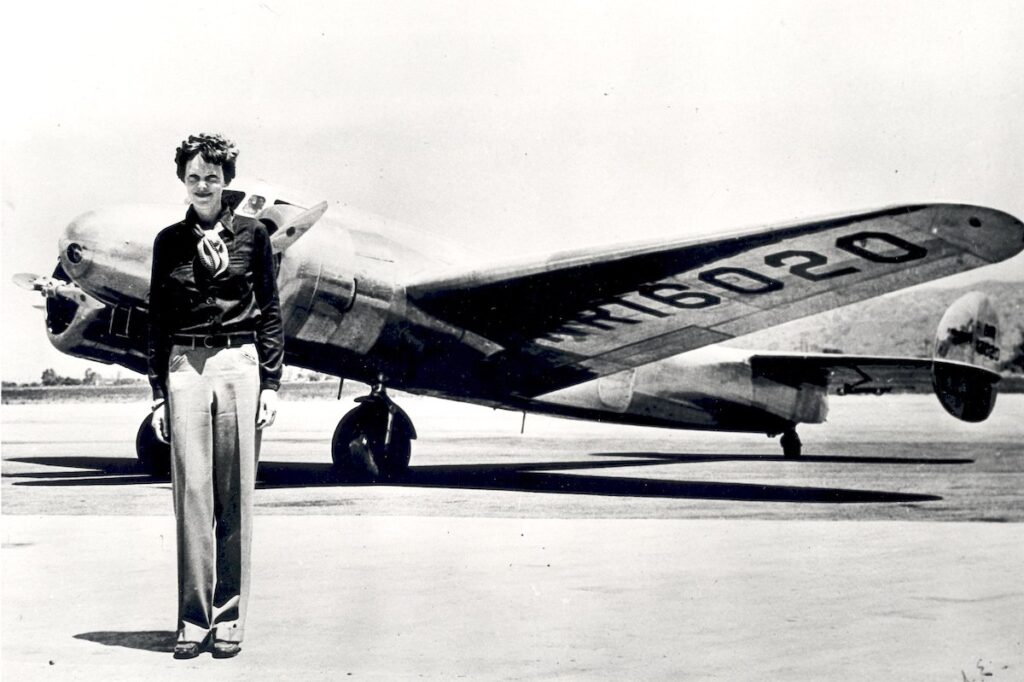
Nearly nine decades after Amelia Earhart and navigator Fred Noonan disappeared on July 2, 1937, in the South Pacific, a new expedition will test whether an unexplained object in a remote island’s lagoon is wreckage from their aircraft.
Backed by Purdue University, whose research foundation helped finance Earhart’s Lockheed Electra 10E in the 1930s, the team will travel to Nikumaroro Island in October 2026 to examine a shallow-water site that some researchers believe contains remnants of the aircraft’s fuselage and tail.
The uninhabited atoll lies roughly 400 miles southeast of Howland Island, the pair’s intended destination after departing Lae, New Guinea. It has long been the focus of a theory that Earhart and Noonan reached the island after failing to locate Howland Island, landed on its reef and survived for a time as castaways. No aircraft wreckage found there has been definitively linked to Earhart.
The expedition’s target, known as the Taraia Object, appears in satellite imagery of the lagoon near the tip of a sandy peninsula. Researcher Michael Ashmore noticed the feature in Apple Maps satellite imagery in 2020, prompting an examination of other satellite images, aerial photographs and footage.
The Archaeological Legacy Institute, which is leading the expedition with Purdue University and the Purdue Research Foundation as partners, argues that the object’s apparent dimensions, shape and reflective qualities are consistent with parts of the Electra. The group also believes older imagery shows the same feature at the site.
Another group that has spent years trying to solve the mystery of Earhart’s disappearance disagrees that the site will yield meaningful clues. The International Group for Historic Aircraft Recovery, better known as TIGHAR, has disputed the aircraft interpretation despite its own decades of work investigating the Nikumaroro theory. In a 2021 account, the group suggested the feature was a fallen palm tree and root mass washed into the lagoon during a storm.
The expedition team plans to travel to Tarawa, Kiribati, on October 6 and depart by ship the following day. The voyage to Nikumaroro is expected to take about six days, followed by several days of fieldwork.
Researchers will use underwater drones, sonar and magnetometers to investigate the target and surrounding area, with underwater excavation planned as needed to examine material obscured by sediment.
Shipping giant DHL announced on October 1 that it is supporting the expedition as its official logistics partner. The company is transporting about 1,650 pounds of equipment and supplies from Eugene, Oregon, and Pensacola, Florida, and then to Bonriki International Airport in Tarawa for the sea journey.
The shipment includes diving equipment, navigation systems, solar panels and communications equipment needed to work at the remote atoll.
Archaeological Legacy Institute president Richard Pettigrew will direct the expedition. The team includes terrestrial and maritime archaeologists, Kiribati representatives and three Purdue representatives: university Senior Vice President Steve Schultz and alumni Sirisha Bandla and Marc Hagle.
Purdue’s involvement renews a connection dating to 1935, when Earhart joined the university as a career counselor for women and an adviser in aeronautics. The Purdue Research Foundation subsequently helped finance the Electra she flew on her attempted round-the-world journey.