
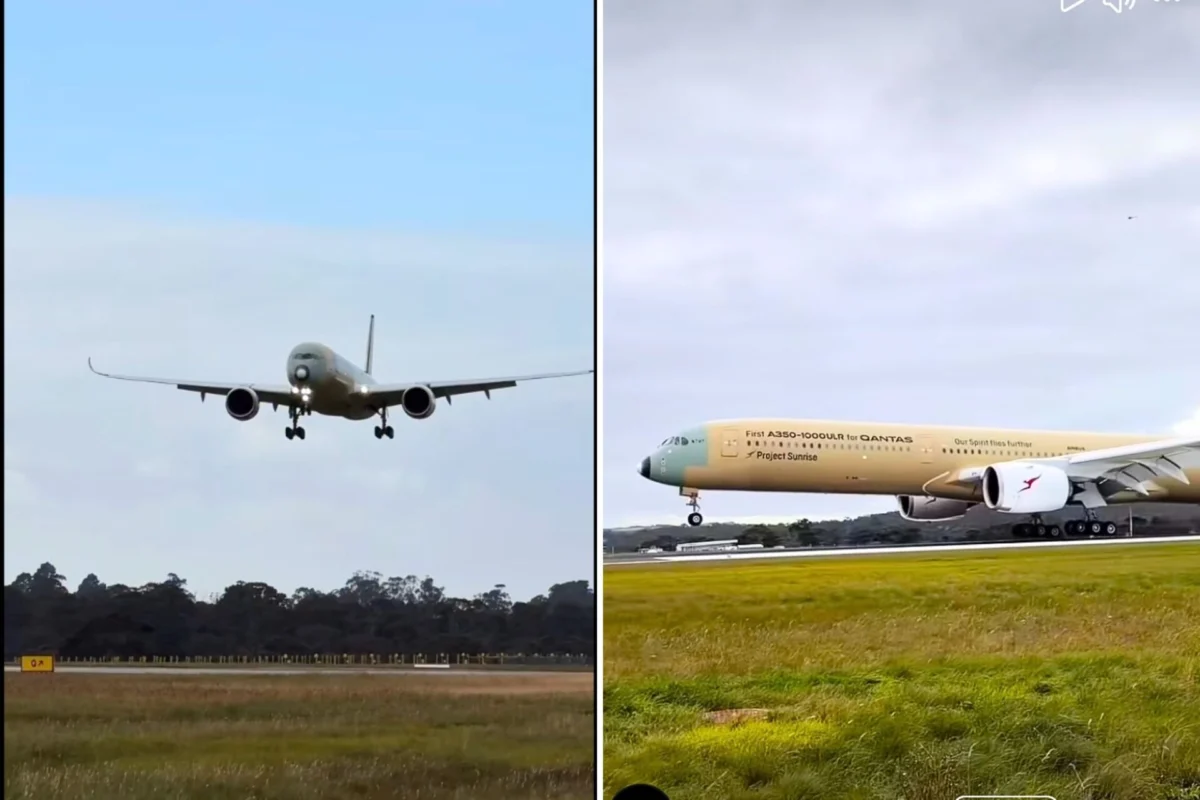
Qantas’ first ultra-long-range Airbus A350-1000ULR has landed in Melbourne, Australia, after flying nonstop from Toulouse, France. The journey took more than 19 hours and drew thousands of aviation enthusiasts to track its progress in real time.
The aircraft, registered F-WULR, departed Airbus’ assembly facility in Toulouse at 07:33 local time Thursday, July 23, 2026, and touched down at Melbourne Airport the following morning at 10:46 local time.

Covering roughly 17,000 kilometers, the flight climbed to the top of Flightradar24’s list of most-watched flights, with tens of thousands of people following the aircraft as it crossed from summer in the Northern Hemisphere into winter in the Southern Hemisphere.
Ahead of departure, Airbus posted on social media, “From summer to winter in a single hop! As part of our flight test campaign, our test crew is taking the #A350-1000ULR from Toulouse to Melbourne NON-STOP for the first time.” Qantas responded with a simple message welcoming the aircraft’s arrival, adding a waving hand emoji.
From summer to winter in a single hop!
— Airbus (@Airbus) July 23, 2026
As part of our flight test campaign, our test crew is taking the #A350-1000ULR from Toulouse to Melbourne NON STOP for the first time.
Follow this major milestone live on @FlightRadar24! https://t.co/J5nObjN1n3
Next stop: Australia!… pic.twitter.com/QrAvgBMos4
Two Qantas pilots and an Airbus flight test crew were on board for the journey. The aircraft is scheduled to depart Melbourne on Monday to return to Airbus headquarters in Toulouse as part of its ongoing test program, with analysts and engineers using the flight to gather data across a wide range of aircraft systems.
Built for Qantas’ Project Sunrise
The A350-1000ULR is the first of 12 specially built aircraft Qantas ordered in May 2022 to power Project Sunrise, the airline’s initiative to connect Australia directly with destinations on the other side of the world without a fuel stop.
The aircraft is fitted with an additional 20,000-liter rear center fuel tank, extending its range by around 1,000 nautical miles and allowing it to remain airborne for close to 20 hours.
Qantas plans to begin nonstop service between Sydney and London using the aircraft from October 2027, a route expected to shave around four hours off the current one-stop journey between the two cities. A Sydney-to-New York route is set to follow within months, with additional routes proposed from Melbourne and Brisbane to London, New York, Paris, and Chicago. Bookings for the new services are due to open in February 2027.
Fares for the ultra-long-haul flights are projected to run about 20% higher than comparable one-stop routes. The first aircraft, named Vega, was originally scheduled for delivery in late 2026, but has been pushed back to April 2027 due to supply chain issues, with the next four expected to follow in quick succession. At least three aircraft are needed to support a daily nonstop schedule on the routes.
A cabin designed around passenger comfort
The A350-1000ULR carries just 238 seats, which Qantas describes as the lowest seat density of any A350 flying anywhere in the world, a deliberate choice intended to give passengers more room on ultra-long-haul flights. The aircraft’s Economy cabin, configured in a 3-3-3 layout, is part of a design process that Qantas claims has been a decade in the making, developed with the University of Sydney’s Charles Perkins Centre and Caon Design Office along with other technology partners.
Qantas has suggested that the guiding goal behind the cabin’s design is to have passengers arrive at their destination feeling refreshed, a philosophy that the airline says has shaped every part of the aircraft’s layout and onboard systems.
The Melbourne test flight followed the aircraft’s maiden flight on June 3, 2026 when it flew for roughly three hours and 43 minutes over France and the French Atlantic coast, operated by two Airbus flight test pilots, three flight test engineers, and one ground test engineer. Since then, the aircraft has continued through Airbus’ test program ahead of its eventual delivery to Qantas.