
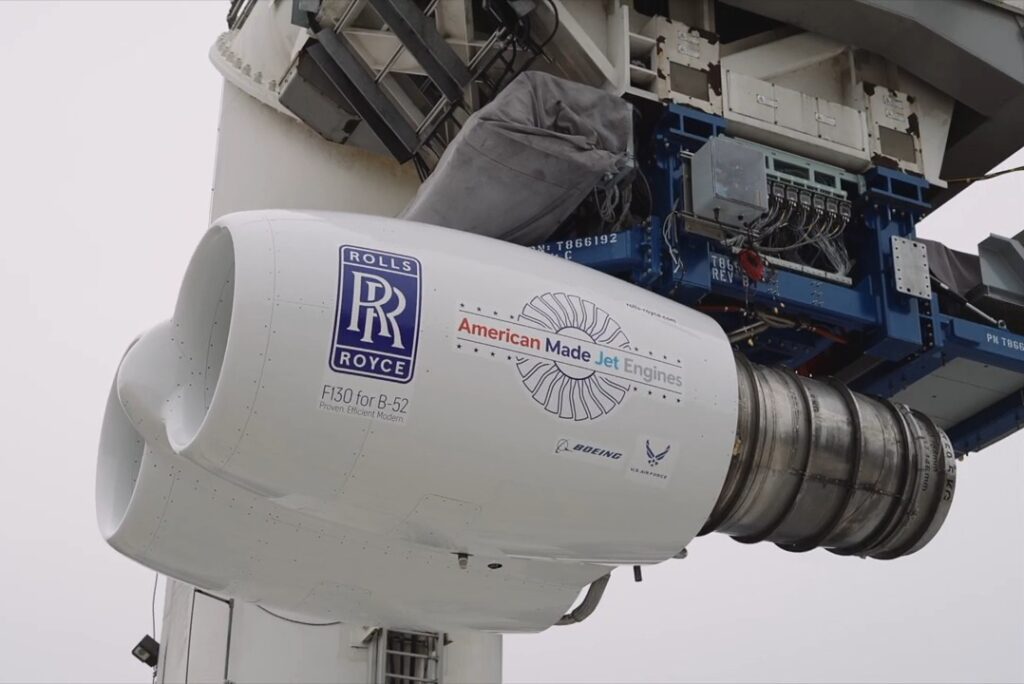
Rolls-Royce has completed altitude and operability testing of its F130 engine for the US Air Force’s B-52 Commercial Engine Replacement Program (CERP).
The company said the test campaign was conducted at the US Air Force’s Arnold Engineering Development Complex (AEDC) in Tullahoma, Tennessee, where Rolls-Royce and USAF teams evaluated engine performance under representative mission conditions.
The work included altitude testing for long-duration, high-altitude missions, operability testing using distortion screens to simulate turbulent airflow, and Integrated Drive Generator (IDG) testing with Boeing to verify electrical power performance across mission scenarios.
In a statement released by Rolls-Royce, Lieutenant Colonel Timothy Cleaver, USAF program manager for the B-52 engine replacement effort, said the campaign generated data across the engine’s “full spectrum of flight conditions” and would support the next phase of test aircraft modification and flight testing.
The latest campaign builds on earlier F130 development milestones, including twin-pod testing at NASA’s Stennis Space Center and sea-level testing in Indianapolis. Rolls-Royce also said the engine passed its Critical Design Review (CDR) in late 2024, clearing the way for the first flight-test engines.
Initial F130 flight-test engine builds are already underway, with deliveries expected in 2027 to support the start of test aircraft modifications. Two B-52 bombers are expected to be used in the engine flight-test campaign.
What the F130 upgrade changes for the B-52
Derived from Rolls-Royce’s BR725 commercial engine, the F130 is central to the B-52 re-engining program and is intended to replace the bomber’s legacy Pratt & Whitney TF33 engines. Rolls-Royce says the new engines will be fully interchangeable within the B-52’s dual-pod configuration, a change expected to simplify logistics and maintenance while improving readiness. Re-engined aircraft will be redesignated B-52J.
Part of a broader B-52J modernization effort
The propulsion upgrade is part of a broader B-52 modernization package that also includes radar, avionics, and other subsystem upgrades. The radar modernization effort has already entered flight-test activity, following a ferry flight to Edwards Air Force Base in December 2025.
Along with the engine change, Honeywell will provide a new auxiliary power unit (APU), forgoing the need for explosive gunpowder cartridges to quick-start the engines.
The USAF plans to upgrade its full fleet of 76 B-52s, with initial operating capability for the B-52J targeted for 2033, with the platform expected to play a long-term role alongside the B-21 Raider.