
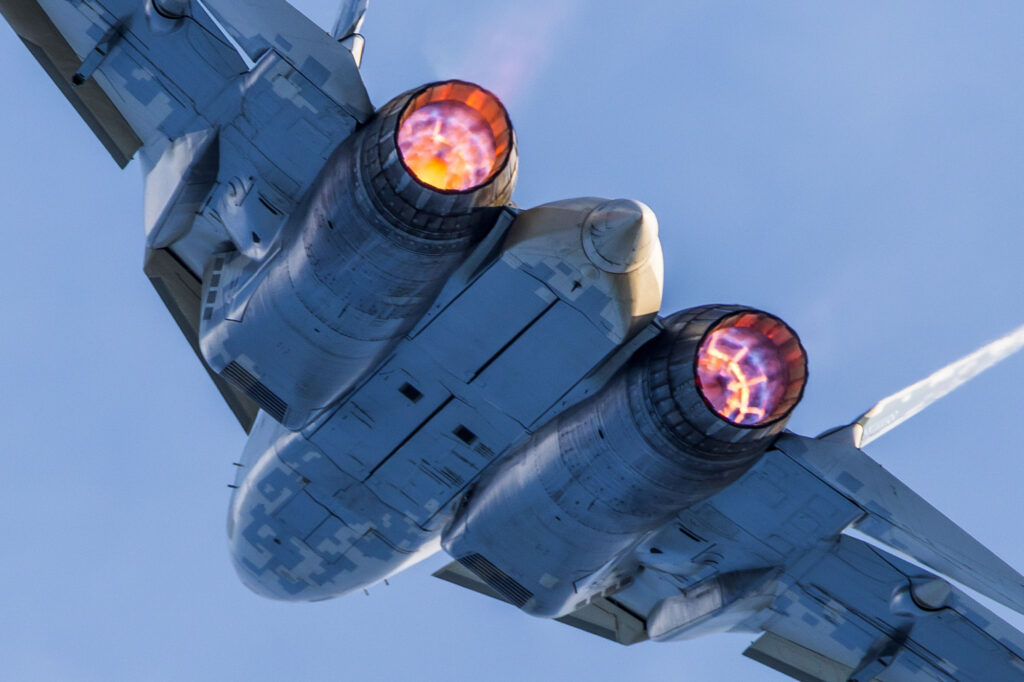
Russia has begun flight testing a new engine on its Sukhoi Su-57 fifth-generation fighter as part of an effort to introduce a more powerful and efficient powerplant on future versions of the aircraft.
Russia’s state-owned defense conglomerate Rostec said on December 22, 2025, that a Sukhoi Su-57 flew for the first time powered by the new “Product 177” engine, which it describes as a fifth-generation powerplant developed specifically for advanced combat aircraft. The flight was conducted by test pilot Roman Kondratyev and proceeded normally, according to the company.
The start of flight testing is significant because engine development has long been one of the biggest technical hurdles facing the Su-57 program. Early production aircraft entered service with interim engines while Russia continued work on more advanced designs intended to deliver higher thrust, improved fuel efficiency, and longer service life.
According to Rostec, the Product 177 engine produces up to 16,000 kilograms-force of thrust (roughly 35,000 pounds of thrust) in afterburner and offers reduced fuel consumption, along with improved durability. The engine was developed by the United Engine Corporation, a Rostec subsidiary, for use in fifth-generation aircraft systems.
Russian officials said the new engine is expected to further improve the Su-57’s flight performance and provide a foundation for future upgrades. The aircraft is designed as a multirole fighter capable of engaging air, ground, and maritime targets, with internal weapons bays, low-observable shaping, and a high degree of onboard automation intended to reduce pilot workload.
The Su-57 first flew in 2010 and was envisioned as Russia’s answer to US fifth-generation fighters such as the Lockheed Martin F-22 and F-35, as well as China’s Chengdu J-20. However, development delays, funding constraints, and production challenges have limited the pace of deliveries. Public estimates suggest only a few dozen aircraft have been built to date, a fraction of the fleets fielded by the United States or China.
Russia has said the Su-57 has seen limited operational use, including missions related to the war in Ukraine, though independent assessments of its combat performance remain scarce. Analysts have noted that Russia has often used the aircraft cautiously, likely reflecting its small fleet size and ongoing development work.
Alongside the engine test announcement, Rostec said United Aircraft Corporation is expanding production capacity to increase deliveries of the Su-57 to Russian forces and to support export efforts. Moscow has been actively marketing an export version, designated the Su-57E, and has previously announced its first foreign sales contract, although details about customers and delivery timelines remain limited.
Reports and leaks in recent years have pointed to interest from countries including Algeria, India, and others seeking an interim stealth fighter option, particularly as Russia looks to maintain defense exports under international sanctions.
In the broader fifth-generation fighter landscape, the Su-57 remains produced in far smaller numbers than Western and Chinese peers. The US-led F-35 program has delivered hundreds of aircraft across multiple air forces, while China has steadily expanded its J-20 fleet. Russia, by contrast, continues to develop the Su-57 as a long-term program, introducing upgrades to engines, avionics, and weapons as the aircraft evolves.