
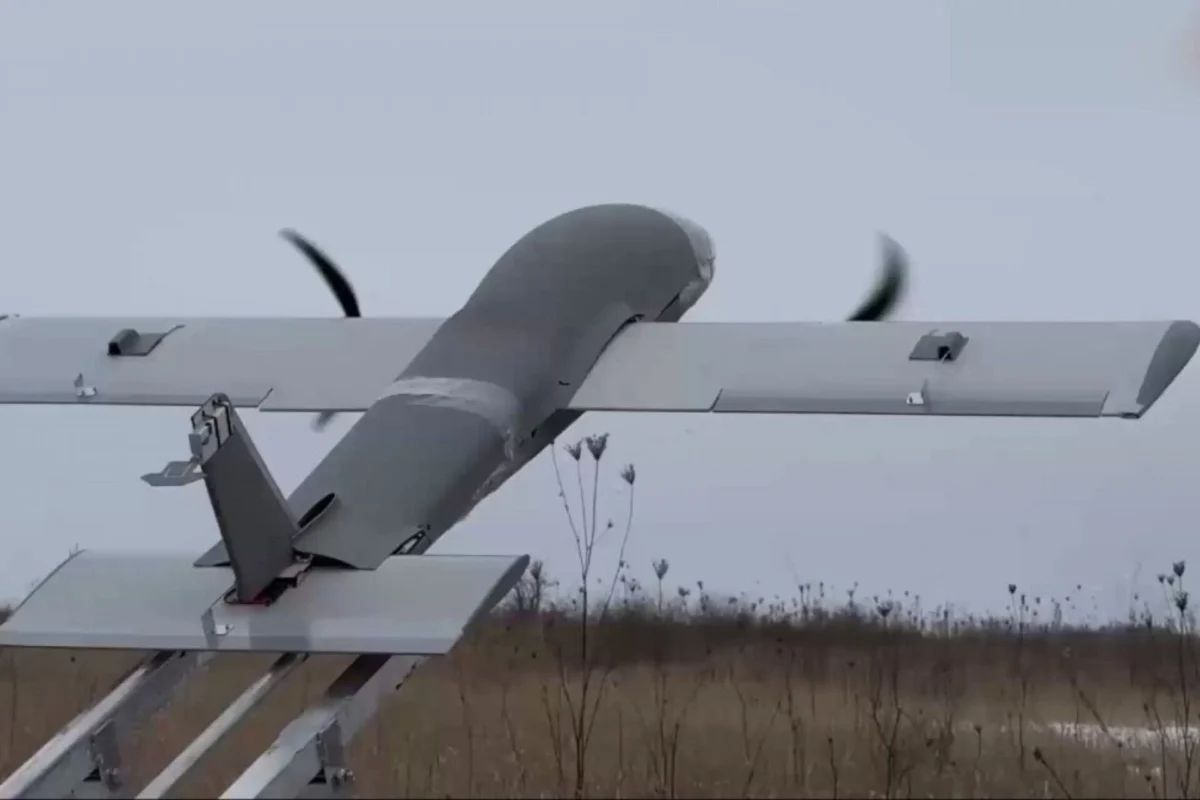
A Russian attack drone that navigated and selected its target without intervention from a human pilot killed three civilians in southeastern Ukraine, according to an investigation published by The New York Times on August 24, 2026.
The strike occurred at a gas station in Zaporizhzhia on July 6. It killed Tetiana Bubynets, a 19-year-old accounting student at Zaporizhzhia National University, Oleksiy Svirin, 41, and Roman Karpiy, 48.
The Times identified the weapon as a Russian Molniya fixed-wing attack drone equipped with an Nvidia Jetson Orin minicomputer. Ukrainian air-defense commanders, drone specialists and forensic investigators who examined the wreckage said the aircraft flew without radio control and used onboard artificial intelligence to navigate and select its target, likely propane tanks being stored at the gas station.
The attack could represent the first documented case in which an AI-controlled Russian drone caused civilian deaths, according to experts.
Russian operators reportedly programmed the drone to fly toward a specific gas station. Once it entered the target area, its onboard software searched for an object matching a target profile and selected the exact point it would attempt to strike, most likely the propane tanks that the system had been trained to recognize.
The drone failed to clear an apartment building near the gas station, struck a wall and exploded close to a group of people sheltering nearby. Bubynets was pronounced dead at a hospital. Svirin and Karpiy later died from their injuries.
Investigators find no radio-control equipment
Ukrainian officials said the drone was one of approximately six aircraft involved in the attack. The group emitted no detectable radio-control signals, limiting the effectiveness of electronic-warfare systems designed to disrupt the link between a drone and its pilot.
Investigators also found no radio-control antenna in the recovered aircraft. The absence of an antenna does not by itself prove that a drone can select its own target because an aircraft can follow preprogrammed coordinates without continuous communication.
The computer recovered from the wreckage provided stronger evidence. Ukrainian investigators said the Jetson Orin module was not encrypted, allowing them to examine stored terrain imagery and portions of the target-recognition software. The imagery was used to help the drone navigate by comparing visual landmarks with its programmed route, while the targeting system had been trained to recognize categories of objects, including propane tanks.
The combination allowed the aircraft to operate without a pilot transmitting commands during the flight or manually choosing the final aim point.
This goes beyond the “last-mile” autonomy already used by Russia and Ukraine. In those systems, a human operator finds and designates a target before onboard software takes control during the final seconds of an attack. The Molniya involved in the July 6 strike apparently navigated to the target area and searched for a matching object without that final human designation.
Commercial Nvidia hardware found in drone
Nvidia confirmed to the Times that photographs of the recovered hardware showed a Jetson Orin module. The compact, energy-efficient computers are designed to run artificial-intelligence and computer-vision applications directly on robots and other machines without requiring a connection to a remote data center.
Nvidia said the module was a consumer-grade product intended for students, developers and startup companies, not military hardware. The company does not sell the product in Russia, although Jetson modules remain widely available through international resellers. The component recovered in Ukraine was marked as having been made in China.
Commercially available hardware gives Russia a relatively inexpensive way to add visual navigation and object recognition to mass-produced attack drones. It also makes the supply chain harder to control because the same computers have extensive legitimate civilian uses.
Russia reportedly began testing AI-enabled Molniya drones in May 2026. On July 3, three days before the fatal gas-station strike, Ukrainian military communications specialist Serhii Beskrestnov said Russian forces had begun deploying autonomous versions of the aircraft in the Zaporizhzhia region.
Strike raises questions over AI weapons
The International Committee of the Red Cross defines an autonomous weapon as one that selects and applies force to a target without human intervention after activation. The organization has called for binding international restrictions, warning that removing human judgment from target selection creates legal, ethical and humanitarian risks.
Autonomous guidance also carries an immediate operational advantage. A drone that does not depend on a radio link is more difficult to stop through electronic jamming and does not expose a nearby pilot through control transmissions.
Russia has not publicly confirmed that the Molniya used autonomous guidance or commented on the Ukrainian forensic findings. The Times examined recovered drones and interviewed the officials and specialists involved, but the software’s complete decision chain has not been independently reproduced by a neutral investigating authority.