
Poland’s Defense Minister Władysław Kosiniak-Kamysz confirmed on November 20, 2026, that a Russian Kh-101 cruise missile had crashed near the village of Nowy Lipowiec in eastern Poland, one of three Russian objects reported to have entered Polish airspace during an overnight attack on Ukraine.
At a press conference, Kosiniak-Kamysz identified two other suspected impact sites: Rudnik nad Sanem and Mołodycz, both in Podkarpackie Voivodeship. He said the object at Rudnik nad Sanem was also likely a missile, while the one at Mołodycz was probably a jet-powered drone. No injuries or damage to critical infrastructure were reported.
🇺🇦🇷🇺🇵🇱 ❗️Kolejne nagranie z rejonu miejscowości Nowy Lipowiec w powiecie biłgorajskim. https://t.co/zCWbG8eqt2
— WarNewsPL (@WarNewsPL1) November 20, 2026
Lublin police said the object at Nowy Lipowiec struck a field beside a forest and caught fire. The Lublin District Prosecutor’s Office opened an investigation with the Military Gendarmerie, police and Military Counterintelligence Service. Investigators were also examining reports of objects falling elsewhere.
Takie coś spadło dziś w Nowym Lipowcu w powiecie biłgorajskim Najnowsze informacje: https://t.co/Gv2SRaHtOl https://t.co/dbTQbTlY1s
— Paweł Buczkowski (@buczkowskipawel) November 20, 2026
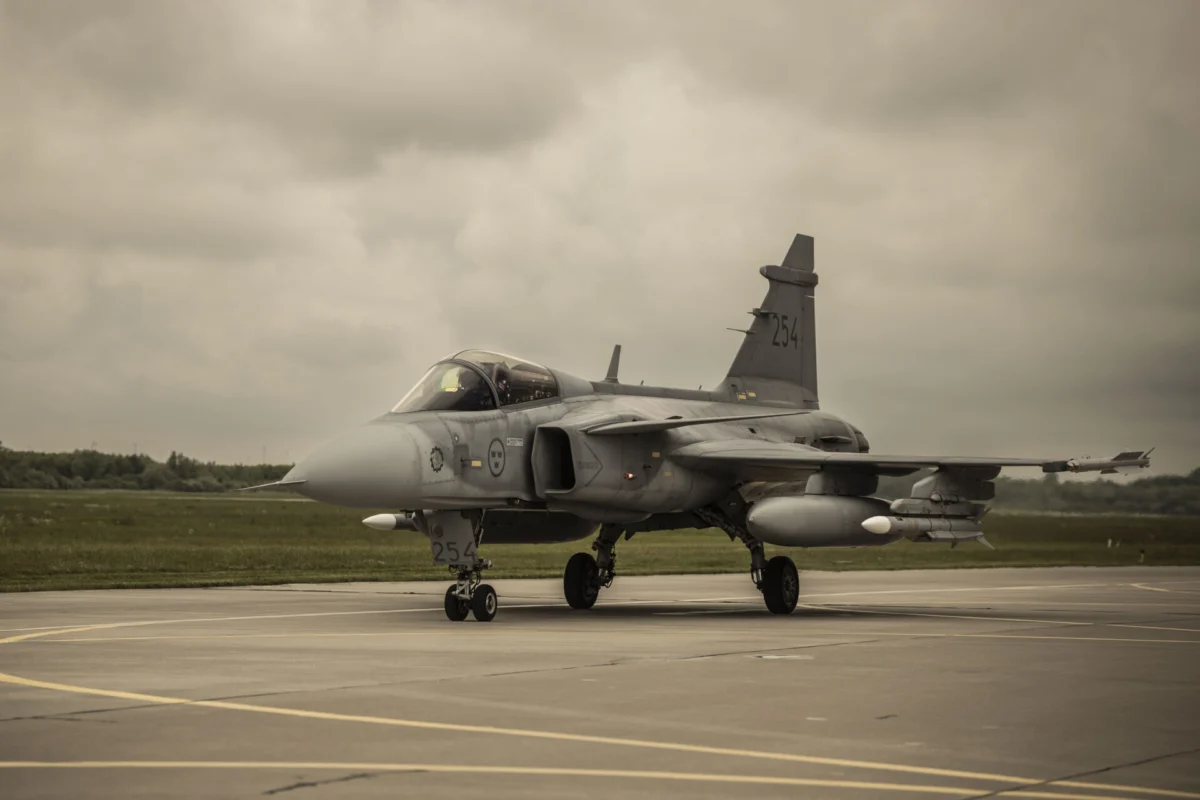
Swedish Gripens attempt to intercept Russian missile
Lieutenant General Ireneusz Nowak, commander of the Polish Armed Forces Operational Command, said 11 objects posed a potential threat to Polish airspace overnight, with three confirmed incursions.
Two Polish F-16 fighters and two Swedish Gripens took part in the air defense response, supported by a Dutch tanker and a Polish airborne early-warning aircraft. Ground-based air defense systems, including Patriot batteries around Rzeszów-Jasionka and Świdnik, were also activated.
Nowak said Swedish pilots attempted to intercept an object believed to be the Kh-101, but one pilot reported that poor weather prevented visual identification of the target.
“No weapons were used that night. Not all the conditions for using a weapon system were met,” Nowak said.
The incident comes less than two months after Poland revised its air defense procedures, allowing pilots to engage certain threats without visual identification if other conditions for positive identification are met. Polish military officials previously confirmed to AeroTime that the new rules also apply to allied aircraft defending Polish airspace.
Kosiniak-Kamysz said the Kh-101 had spent approximately three minutes over Polish territory. Operational Command spokesperson Lieutenant Colonel Jacek Goryszewski had earlier told broadcaster TVN24 that a possible airspace violation occurred shortly after 06:30 local time.
Rzeszów control tower evacuated as airports suspend flights
Rzeszów-Jasionka Airport (RZE) and Lublin Airport (LUZ) suspended operations to give military aircraft freedom of action, the Polish Air Navigation Services Agency (PANSA) said.
Infrastructure Minister Dariusz Klimczak said the air traffic control tower at Rzeszów-Jasionka was evacuated for the first time, with nine people, including six operational staff, moved to a temporary shelter.
Both airports briefly reopened before suspending operations again at 09:26 local time as military aircraft responded to another wave of Russian strikes. Operations subsequently resumed.
Poland and Ukraine report different figures for Russian attack
Nowak said Russia had launched 26 Kalibr and 72 Kh-101 cruise missiles, along with 503 drones, 202 of them jet-powered, according to Polish military assessments.
The Ukrainian Air Force reported lower figures: 84 Kh-101, Kalibr and Iskander-K cruise missiles, 404 drones, including 123 jet-powered variants, and an unspecified number of ballistic and other missiles.
Ukrainian air defenses had shot down or suppressed 462 targets, including 79 cruise missiles, three ballistic missiles and 380 drones.
Second Kh-101 incident in Biłgoraj County in four months
The incident marks the second time a Russian Kh-101 has landed in Biłgoraj County in less than four months. On July 30, 2026, a missile struck a field near Tarnawa-Kolonia after a Polish F-16 was scrambled to intercept an unidentified object crossing the border.
Kosiniak-Kamysz said he would ask NATO Secretary General Mark Rutte for additional forces and resources to reinforce Operation Eastern Sentry, launched after Russian drones entered Polish airspace in September 2025.
The minister described the latest incursions as “another provocation” by Russia and suggested their timing was deliberate, pointing to a Coalition of the Willing military exercise taking place that day at Nowa Dęba, southeastern Poland.