
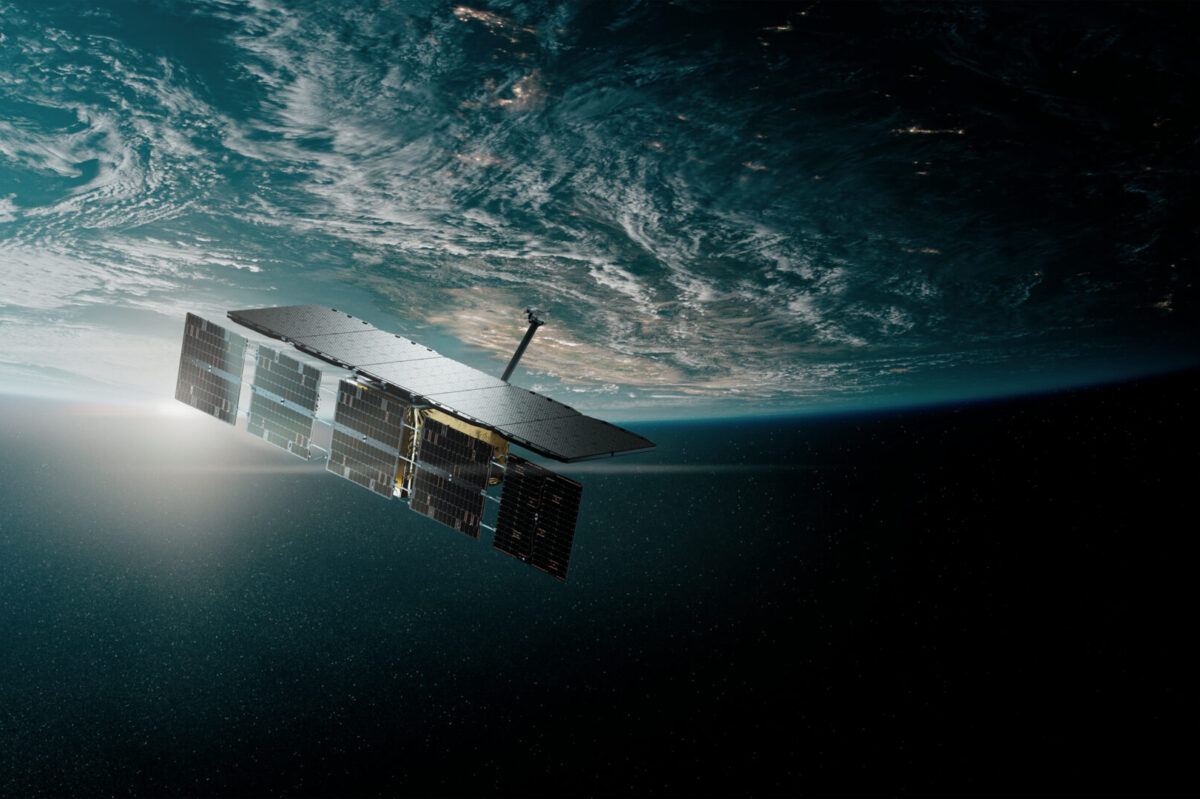
Russia’s Cosmos 2612 military satellite may have passed within a few hundred meters of ICEYE-X36, a US-registered commercial radar satellite operated by Finnish-founded ICEYE, during a close approach on October 18, 2026, according to independent orbital tracking analysis.
Dutch satellite tracker Marco Langbroek reported that the spacecraft may have approached within a few hundred meters (roughly 1,000 feet), or possibly closer, at approximately 01:35 UTC. Uncertainties in publicly available orbital data prevent a reliable calculation of their minimum separation.
Langbroek found no orbital evidence that ICEYE-X36 had been struck or disturbed. However, only its operators or users could establish whether it remained fully operational.
On October 17, 2026, independent satellite tracker Jonathan McDowell reported that Cosmos 2612 was “stationkeeping within 5 km or less of ICEYE X36”. He described it as the first rendezvous, to his knowledge, between two active satellites in low Earth orbit without one owner’s approval.
The encounter has raised concerns because ICEYE supplies radar imagery to Ukraine, although the company has not identified ICEYE-X36 as one of the satellites serving Ukrainian operations.
🛰️ Right now, a Russian satellite is flying in close formation with a Western commercial-ish radar satellite, and makes another close pass in the next ~10 minutes. COSMOS 2612 has matched orbits with ICEYE-X36, a Finnish-built commercial-ish radar (SAR) satellite. They’re circling the planet together under half a kilometer apart, making a close pass almost every orbit (~95 min), the next one around 01:38 UTC (18 Oct), every one at essentially zero relative velocity. Being upfront: at these separations (sub-km, down to tens of meters), the exact distance is below the precision of public tracking, so treat specific metre figures as indicative. What ISN’T ambiguous is the orbit match and the ~0 m/s closing. This is deliberate, controlled formation flying, the behaviour associated with close-up inspection, not a chance conjunction (collision). And it’s targeted. Cosmos 2612 is the ONLY one of a six-satellite cluster (Cosmos 2609–2614) to have maneuvered: it raised its orbit in the public data ~47 km, drifted into phase with X36, then dropped back to settle alongside it. The other five never moved.
— Radio & Nukes 🇺🇦 (@HamWa07) October 18, 2026
How Cosmos 2612 maneuvered into position near ICEYE-X36
According to analyses by Virginia-based Integrity ISR and the Center for Strategic and International Studies (CSIS), Cosmos 2612 began repositioning on September 30, 2026. A maneuver raised its orbit by about 46.5 kilometers (29 miles), allowing orbital drift to realign its plane with ICEYE-X36.
On October 12, 2026, a second maneuver returned the Russian spacecraft to roughly 555 kilometers (345 miles) altitude, matching ICEYE-X36’s orbital plane and placing it about 475 kilometers (295 miles) behind.
Integrity ISR calculated that the two-week sequence required approximately 57 meters (187 feet) per second of velocity change. The roughly 90-kilogram (198-pound) ICEYE-X36 last maneuvered detectably in late June, leaving its ability to evade a potential threat unclear.
Langbroek identified further Russian maneuvers on October 15 and 16, followed by possible small adjustments near the closest approach.
Not the first Russian approach
Cosmos 2612 is one of six military satellites, Cosmos 2609 through 2614, launched from Plesetsk Cosmodrome in April 2026. Several shifted into ICEYE-X36’s orbital plane in May 2026.
A US Space Force threat fact sheet identifies four Russian satellites positioned near a Western commercial radar satellite used by Ukraine for imagery intelligence; Integrity ISR and CSIS count five. CSIS, citing COMSPOC data, reported that Cosmos 2609 passed within 2.5 kilometers (1.6 miles) of ICEYE-X36 on May 26, 2026.
Those earlier encounters were followed by the Russian spacecraft drifting away. The latest sequence instead culminated in sustained close proximity.
Could Cosmos 2612 pose an anti-satellite threat?
Neither the payload nor the intentions of Cosmos 2612 have been publicly established. CSIS analysts note that sharing another satellite’s orbital plane enables close-proximity operations with relatively little additional fuel, whether for inspection or potentially hostile activity.
The US Space Force has also noted Moscow’s warnings that commercial satellites supporting military operations “may become a legitimate target for retaliation”. In 2020, Russia conducted a separate orbital test involving a projectile-like object, which the US and UK criticized as a potential anti-satellite weapons demonstration.
ICEYE’s intelligence support for Ukraine raises the stakes
Under an August 2022 agreement, ICEYE dedicated one satellite’s capabilities to Ukraine and provided access to its wider synthetic aperture radar (SAR) constellation. SAR satellites can collect imagery regardless of daylight or cloud cover, making them particularly useful for military reconnaissance.
The partnership expanded in January 2026, but ICEYE has not disclosed whether ICEYE-X36 serves Ukraine.
As of October 19, 2026, ICEYE had made no public statement about the close approach or the satellite’s operational status. AeroTime has contacted ICEYE for comment on the incident and the operational status of ICEYE-X36.
Russia’s orbital encounters put Western militaries on alert
There have been previous instances of Russian satellites approaching Western spacecraft under suspicious circumstances. In 2017, Russia’s Olymp-K satellite maneuvered close to the Franco-Italian military communications satellite Athena-Fidus, prompting France to accuse Moscow of attempted espionage.
The latest encounter comes as Western militaries expand their counterspace capabilities. On September 23, 2026, the Royal Air Force established No. III Space Effects Squadron to counter hostile activity in orbit. Days earlier, US Secretary of the Air Force Troy Meink acknowledged that the United States already possesses on-orbit space control weapons, without disclosing their capabilities.