
Current predictions suggest that Asia-Pacific will account for almost half of the world’s future passenger growth – but its airports won’t be able to double in size to keep up.
For SITA (Société Internationale de Télécommunications Aéronautiques), the solution lies in moving passengers, bags and borders through the same space more quickly, and in moving more of the airport journey away from the airport itself.
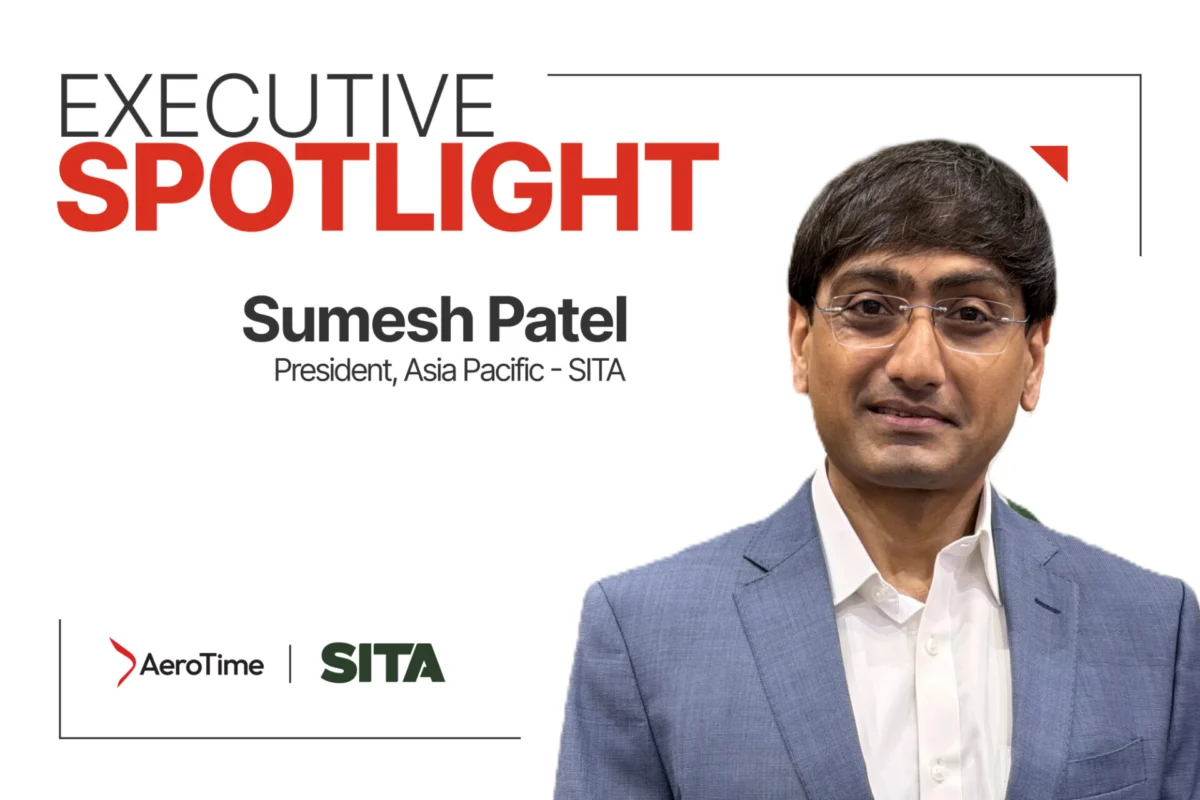
At Passenger Terminal Expo Asia 2026 in Singapore, AeroTime sat down with Sumesh Patel, President for Asia Pacific at SITA, the air transport IT provider, to discuss biometric borders, baggage tracking and how the region is preparing for a future of up to 10 billion passengers a year.
Patel said the timing of the expo’s first edition in Asia reflected where the industry is heading. “When we look at the airlines, the airports, the expansion – the future growth in terms of the passenger is in Asia,” he said, adding that the event had been busier than he expected.

Border Flow: from ‘stop and check’ to ‘walk through’
SITA launched its Border Flow lane as a commercial product on September 9, 2026, after trialing the concept for years at its customer experience center in Singapore.
The system pre-clears passengers before they reach the airport, enabling them to walk through border control without stopping. SITA claims to process travelers up to eight times faster than traditional e-gates, with 75% of travelers cleared before departure.
According to Patel, the benefits go both ways. Passengers no longer queue at gates or counters, while immigration officers can focus on “the people of interest rather than stopping everyone”.
That matters in a region where infrastructure and staffing can’t keep pace with demand. “We’re not going to have double the number of airports,” he said. “You’ll have a challenge in terms of the resources to manage such a large crowd.”
Collaboration, not technology, sets the pace
SITA is in talks with several airports and border agencies across Asia-Pacific about Border Flow, discussing pilots and trials. Patel noted that the fastest adopters are not necessarily the most technologically advanced, but rather the ones where agencies work closely together.
“It’s how do we change the processes, how do we work as one,” Patel mused.
Even so, he expects Asia-Pacific to move faster than other regions, pointing to its lead in biometrics and the pressure created by growing fleets and passenger numbers. “They have no choice but to rely more on technology,” he said.
Patel cited a biometric program that SITA has implemented at more than 22 airports, in which the time from entering the terminal to reaching the gate has fallen from around 40 minutes to under seven.
Kobe: going international without a new terminal
In Japan, SITA has helped Kobe Airport expand into international operations without building a new terminal. The company integrated its passenger processing technology, including self-service check-in, so that the same systems now run across both domestic and international operations.
“You’re trying to leverage the existing infrastructure to ensure that you don’t have to rebuild another terminal,” Patel said.
Baggage: from tracking to recovery
SITA’s latest Baggage IT Insights report found that technology helped cut the rate of mishandled bags by 23% in 2025. Still, mishandled baggage costs the industry about $6.3 billion a year, and Patel warned that the problem will persist as passenger numbers and fleets grow.
One step forward could be SITA’s work with Apple and Google, which allows passengers to share their tracker’s location with the airline or ground handler. Many travelers began using item trackers during the pandemic, but until now, they had no easy way to pass that information on. “What do you do with that information?” Patel asked.
SITA has also introduced automatic rebooking of delayed bags onto the next available flight. In one recent implementation, the process went from about three minutes of manual work to one second, with no human intervention.
One airport, one source of truth
Looking ahead, Patel sees two main areas of opportunity, the first being the passenger experience and the second, airport operations.
On the subject of operations, he noted that many airport systems, from ground handling and gate allocation to vehicle and aircraft movements, still work in isolation. SITA’s airport management system aims to bring that data together, into “a single source of truth” shared with every stakeholder.
He gave the example of a flight arriving 30 minutes late. With integrated data, cleaning, catering and baggage teams can reassign their time instead of waiting at the gate, and airports can manage disruption more effectively.
On the passenger side, the focus is on doing more before travelers even arrive, from check-in to baggage drop.
“Much of what you need to do at the terminal can now be done before you arrive at the terminal,” Patel said. That, he added, allows airports to “process much more passengers in the same infrastructure”.
As Asia-Pacific braces itself for the bulk of the world’s future passenger growth, Patel believes that the region’s airports will succeed less by expanding their footprint than by rethinking how people, bags and data move through the space that they already have.
For SITA, that means bringing more of the journey online, before travelers even reach the terminal, and getting every part of the airport working from the same information.
“It’s not a question of technology,” he stressed. “The technology is there.”