
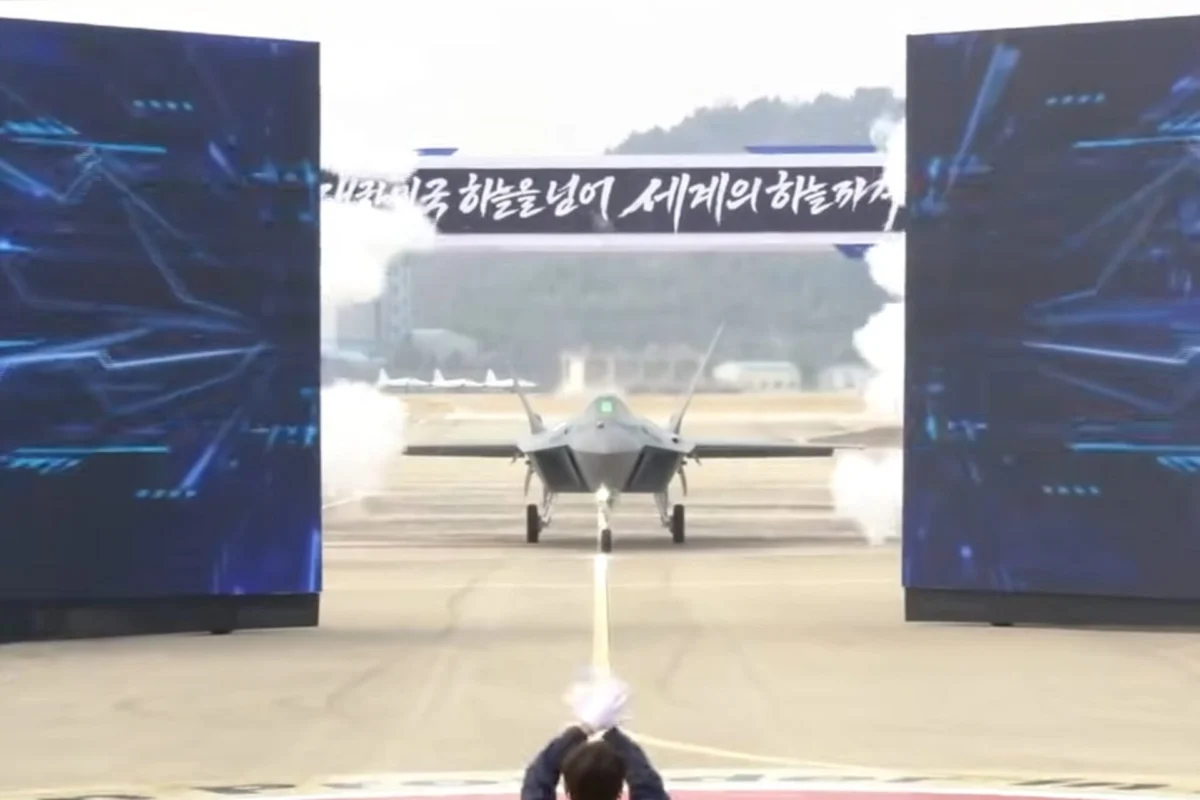
South Korea has rolled out the first mass-produced KF-21 Boramae fighter jet, completing a major production milestone for the country’s flagship domestic combat aircraft program.
The rollout took place on March 25 at Korea Aerospace Industries (KAI) facilities at Sacheon Airport. The aircraft will now enter acceptance testing, including ground and flight trials, before being handed over to the Republic of Korea Air Force (ROKAF). Delivery is expected in the second half of 2026.
The event marks the culmination of a production sequence that began with the formal launch of mass manufacturing in July 2024. Final assembly of the aircraft started in May 2025, when KAI brought together the complete airframe, wings, empennage, engines, avionics, and mission systems.
The first production aircraft is a Block I variant, configured primarily for air-to-air missions. More capable Block II versions, with expanded air-to-ground strike capabilities, are planned for later in the decade.

What is the KF-21 Boramae?
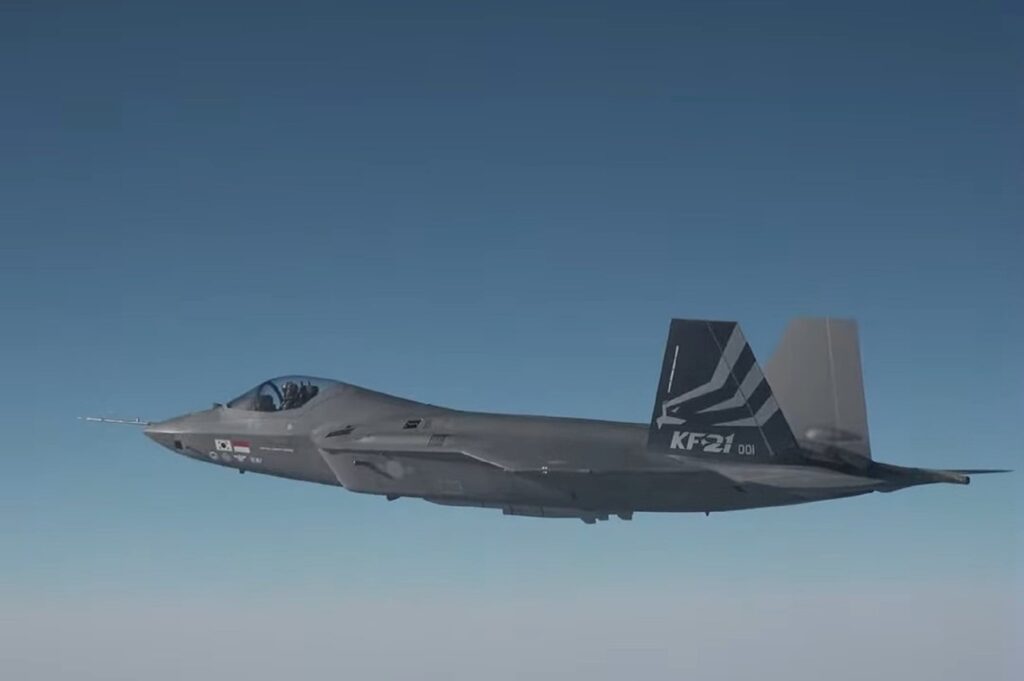
The KF-21 is a twin-engine, 4.5-generation multirole fighter powered by two GE F414 engines, the same powerplant used in the Boeing F/A-18E/F Super Hornet and Saab JAS 39 Gripen E/F.
It has a top speed of Mach 1.8, a range of approximately 2,900 kilometers, and a maximum weapons payload of 7,700 kilograms. While the aircraft incorporates a reduced radar signature and advanced sensor integration, it lacks an internal weapons bay.
A core objective of the program has been the development and integration of domestic systems. The aircraft uses a locally developed active electronically scanned array (AESA) radar, mission computer, electronic warfare suite, and flight control software.
The ROKAF has a stated requirement for 120 KF-21s by 2032, where the type is set to replace aging F-4E and F-5E aircraft.

Indonesia dispute casts a shadow
The road to this milestone was not without setbacks. The KF-21 program, originally launched as the KF-X joint project with Indonesia, faced significant financial and trust issues with its partner in recent years. Indonesia contributed $437 million against an originally pledged $1.16 billion, placing a greater share of the financial burden on South Korea. Relations were further strained by allegations that Indonesian engineers at KAI attempted to copy classified program data, triggering a joint investigation by South Korean intelligence and defense agencies.
South Korea has also positioned the KF-21 as a potential export platform for air forces seeking a modern multirole fighter outside the constraints typically associated with US- or European-origin aircraft. Deliveries to the ROKAF in 2026 will mark the first induction of an indigenously developed fighter in the country’s history.