
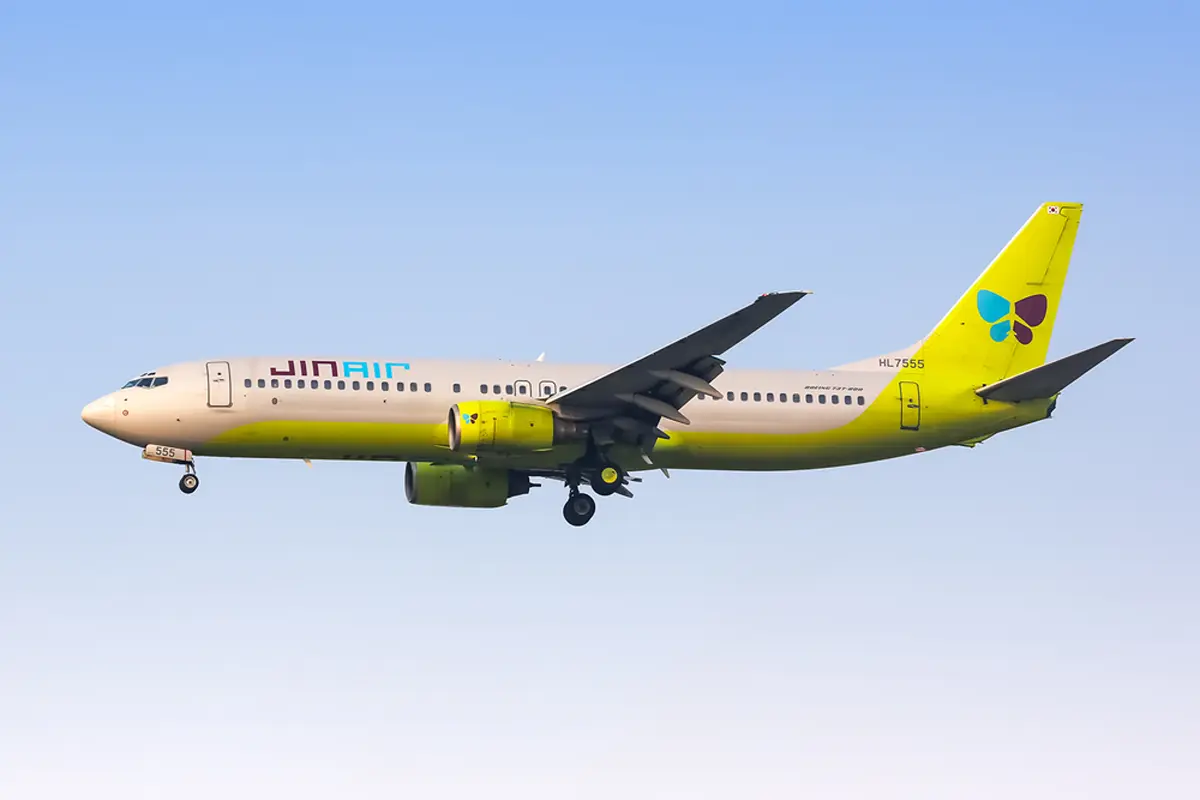
The Ministry of Land, Infrastructure and Transport of South Korea has approved a three-way merger between low-cost carriers Air Seoul, Air Busan, and Jin Air to form a single operator.
This consolidation is a consequence of Korean Air’s acquisition of Asiana Airlines to form a single national airline. The merger between South Korea’s two largest airlines is expected to be formally completed on December 17, 2026.
Replicating the move made by their respective parent companies, Jin Air, which is a subsidiary of Korean Air, will merge with Air Seoul and Air Busan, which belong to Asiana Airlines.
The resulting carrier, which will use the Jin Air brand, will start operating as an integrated entity from March 17, 2027.
The merger has already been cleared by the Fair Trade Commission (FTC), Korea’s competition authority, so the only remaining formal step before completion is shareholder approval, which is slated for December 2026.
According to ch-aviation data, the three airlines have a combined fleet of 58 active aircraft. Jin Air has 31 active aircraft (plus another three listed as inactive), including three Boeing 777s, one Airbus A321, seven B737 MAX 8s, 18 B737-800s and two B737-900s. In turn, Air Busan operates 21 aircraft, all from the A320 family, while Air Seoul operates six A321s.
According to reports in Korean media, the integration of Air Busan is a particularly sensitive part of the project. Officials in Busan, Korea’s second-largest city, fear the city will lose out because of the merger and have asked for the new airline to be headquartered there.
That request appears to have been set aside, although Jin Air has committed to expanding its operations at Busan’s Gimhae International Airport (PUS), increasing its routes from 28 to 33 and its weekly flights from 281 to 339.
Consolidation also in Japan
Coincidentally, a similar consolidation is taking place in neighboring Japan. In October 2026, All Nippon Airways (ANA) announced its intention to acquire Regional Plus Wings (RPW), the parent company of two domestic airlines, Air Do and Solaseed Air. These two operators, which are based at opposite ends of the island country, on the islands of Hokkaido and Kyushu respectively, already hold close cooperation agreements with ANA, which distributes a significant percentage of their capacity.
According to ch-aviation, Air Do operates a fleet of eight B737-700s and three B767-300ERs, while Solaseed Air has 14 B737-800s in its fleet.
While the Air Do and Solaseed Air brands will remain in place for now, ANA has not ruled out their full integration into its mainline operation in the future.