
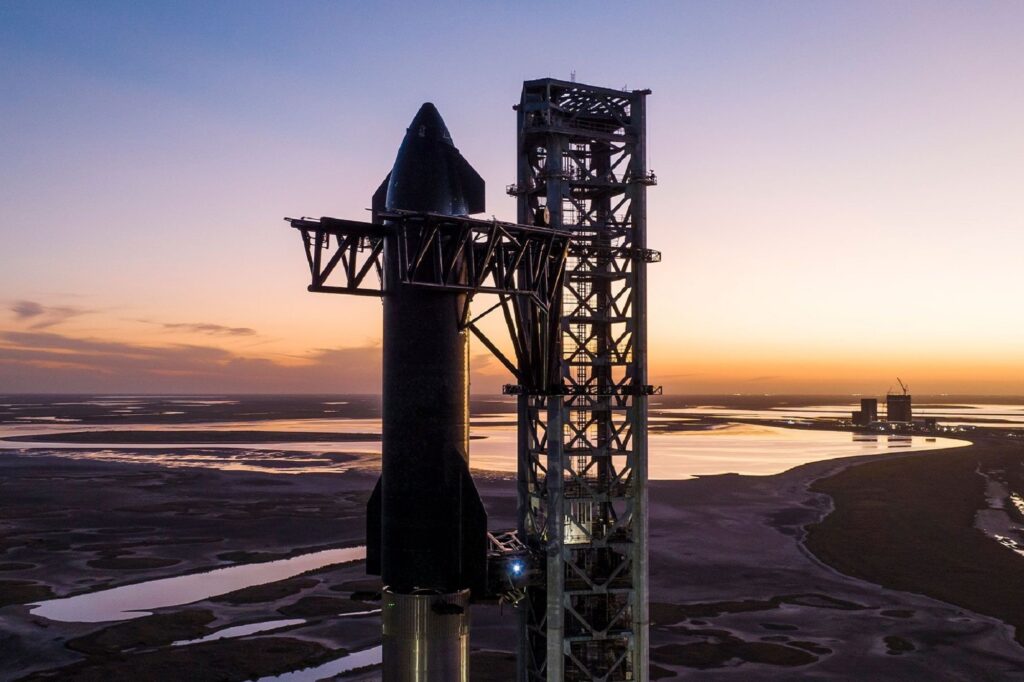
SpaceX plans to invest $100 billion in a sprawling new Starship launch site in Louisiana with 10 launch pads and the capacity to support thousands of flights a year.
The company and Louisiana officials announced the project on August 25, 2026. The facility, called Starbase Louisiana, will be built on former Exxon property near Pecan Island in Vermilion Parish along the Gulf Coast.
SpaceX plans to begin construction by the end of 2027 and is targeting the first Starship launches from Louisiana as early as 2029.
Louisiana Economic Development described the proposed facility as SpaceX’s fourth and largest launch site. It will include five separate launch complexes with two pads and a propellant farm at each one.
Plans also call for a propellant-production facility, power generation, vehicle-processing buildings and housing for SpaceX employees and their families.
The company says the site eventually will be able to handle thousands of launches annually, supporting both commerical customer’s and SpaceX’s own satellite launch needs.
SpaceX has not disclosed how quickly it expects to reach that rate or how the $100 billion investment would be divided or spent over time.
“Starbase, Louisiana will unlock that future,” SpaceX CEO Elon Musk said, referring to the company’s goal of making trips to space as routine as airline flights.
SpaceX prepares to increase Starship launch rate
The Louisiana site will give SpaceX another Gulf Coast location for Starship launches as the company works to expand beyond its original Starbase complex in South Texas and its launch facilities in Florida and California.
Louisiana officials said the location offers access to natural gas for power and propellant production, enough land for future expansion and a coastal location that could accommodate a range of launch trajectories.
SpaceX intends to use the site for missions to Earth orbit, including the deployment of communications satellites and orbital data centers, as well as future flights to the Moon and Mars.
Starship combines the Super Heavy first-stage booster with an upper-stage spacecraft. SpaceX designed both stages to be recovered and flown repeatedly, although the company has not yet demonstrated the sustained turnaround rate required to support thousands of launches a year.
The Louisiana complex would therefore represent both a major expansion and a long-term bet that SpaceX can turn Starship into a routinely reusable transportation system.
Louisiana ties incentives to jobs and investment
SpaceX said it expects the project to create 3,000 direct jobs over the next 10 years with an average annual salary of $92,600. Louisiana Economic Development estimates that it could support another 8,100 indirect jobs through contractors, suppliers and other businesses.
The state offered SpaceX an incentive package tied to capital investment and job creation. The company is expected to participate in Louisiana’s Aerospace Facilities and Activities Rebate and High Impact Jobs programs and receive recruitment assistance through the state’s FastStart workforce program.
SpaceX also agreed to donate $25 million to the Community Foundation of Acadiana.
Under a payment-in-lieu-of-taxes agreement with local authorities, SpaceX will make a $20 million upfront payment and pay at least $25 million annually for 25 years. The annual payment will increase under an agreed-upon escalator.
Louisiana said its incentives are performance-based, meaning SpaceX must meet the applicable investment and employment requirements before receiving them.
Louisiana said some of the costs for needed public infrastructure are expected to be shared by SpaceX and the state, although the details have not been settled.
New electrical generation and transmission infrastructure will be required. State officials said SpaceX will cover the cost of the new power facilities and related upgrades so existing utility customers are not charged for them.
Launch site still requires regulatory approval
The project must still undergo federal, state and local reviews covering launch operations, wetlands, wildlife, natural resources and other environmental effects. The Federal Aviation Administration (FAA) must approve commercial Starship launches from the site, while other agencies retain authority over construction and environmental permits.
Louisiana said SpaceX has begun working with the state Department of Wildlife and Fisheries and Coastal Protection and Restoration Authority to evaluate effects on coastal habitats, fisheries and wetlands.