
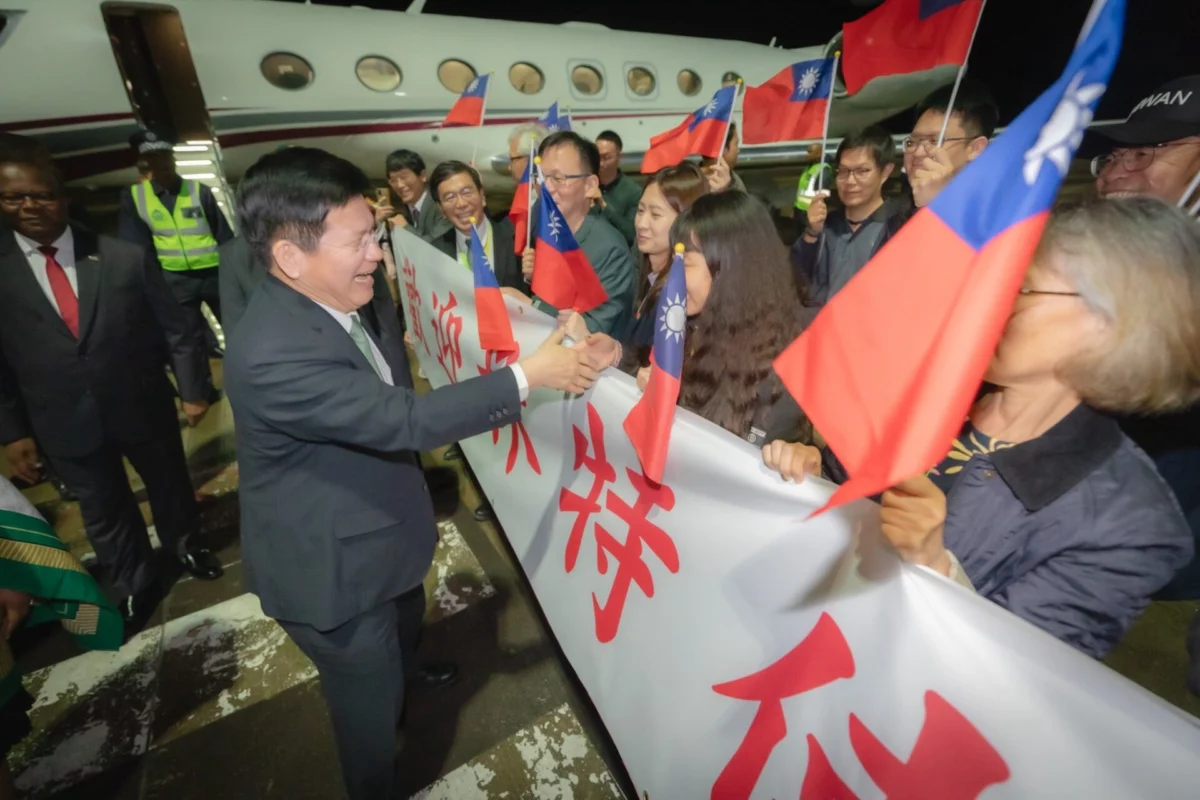
Taiwan Foreign Minister Lin Chia-lung arrived in Eswatini on April 25, 2026, days after President Lai Ching-te’s planned visit to the southern African kingdom was abandoned when the Seychelles, Mauritius, and Madagascar withdrew permission for his chartered aircraft to transit their airspace.
Lin, traveling as Lai’s special envoy to attend celebrations marking the 40th anniversary of King Mswati III’s accession, posted a photograph of himself disembarking from a private jet on his Facebook page late on April 25, 2026, saying his delegation had “overcome all obstacles” to reach the country. He did not disclose the aircraft’s routing or the aircraft’s operator.

His arrival followed the cancellation of Lai’s own trip on April 22, 2026, after the three Indian Ocean states unilaterally revoked overflight permits for the president’s chartered aircraft less than 24 hours before departure. Taipei said the timing left no operational window to file an alternative flight plan or secure new diplomatic clearances along the route from Taiwan to Eswatini, one of its 12 remaining diplomatic allies and its only ally in Africa.
Taiwanese officials accused Beijing of pressuring the three governments to withdraw the permits in a coordinated action. China denied applying any pressure but publicly praised the Seychelles, Mauritius and Madagascar for their decisions. Bloomberg reported on April 23, 2026, that Taiwan officials assessed the simultaneous 11th-hour revocations as deliberately timed to make rerouting impossible.
A new pressure point in civil aviation
Overflight permissions are granted by states for transit through the flight information regions (FIR) they administer, and are governed by the principles of the 1944 Chicago Convention on International Civil Aviation, to which all three African states are signatories. While states retain sovereignty over their airspace and the right to grant or refuse access, last-minute revocations of previously issued permits for a head-of-state flight are unusual and complicate the operational planning required for long-range diplomatic missions.
The German Institute Taipei and the Bureau Français de Taipei, the de facto embassies of Germany and France in Taiwan, said in separate statements that overflight rights constitute a fundamental aspect of international civil aviation and that both countries attach importance to maintaining safe, orderly, and predictable operations in line with the Chicago Convention. The European Union, the United Kingdom, and the United States have also expressed concern over the revocations.
Taiwan does not operate a dedicated long-range head-of-state aircraft for intercontinental travel. The presidential office’s primary aircraft, a Boeing 737-800 designated Air Force 3701 and delivered in 2000, is used for shorter regional missions.
For longer trips, the office charters wide-body or business-jet capacity, including from the flag carrier, China Airlines, on past visits to Pacific allies and the United States. Chartered routings to Eswatini from Taipei involve transits across multiple FIRs in South and Southeast Asia, the Indian Ocean, and southern Africa, leaving the mission exposed to permit decisions taken by any state along the way.
Lin described the incident as China’s “new form of pressure, politicizing and weaponizing the flight information region.”