
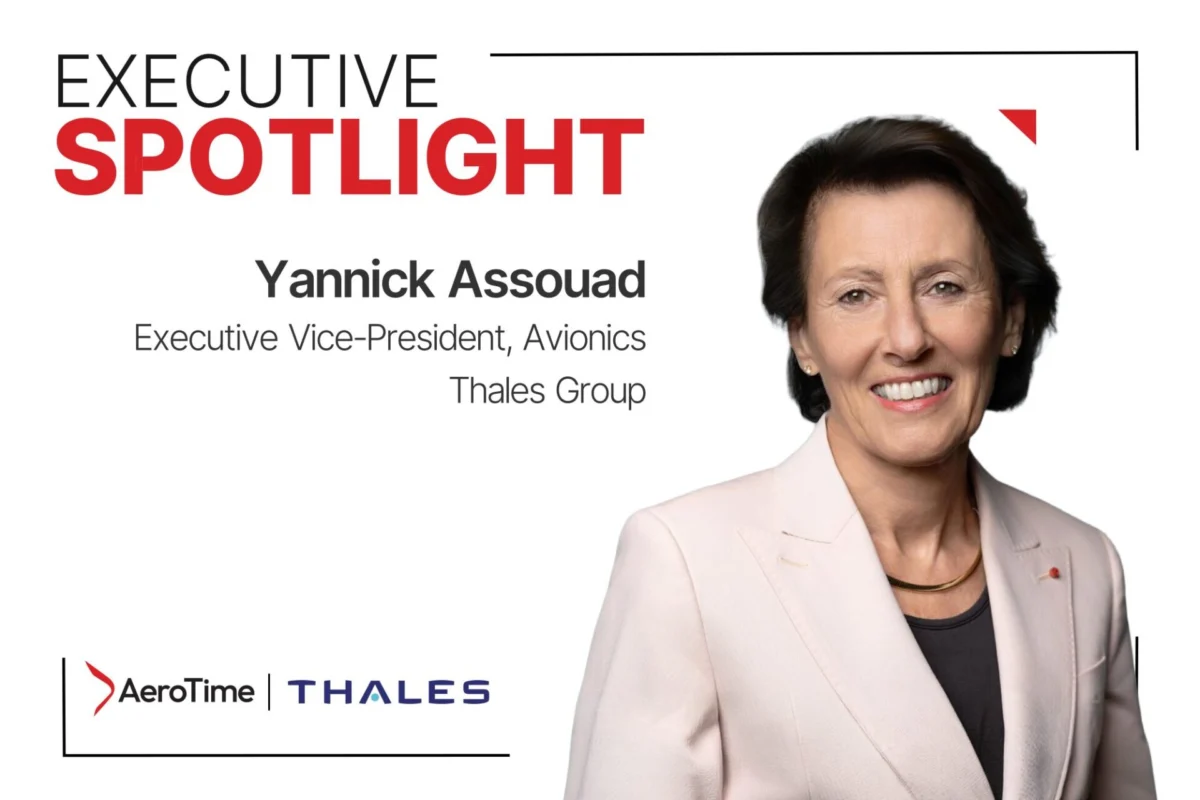
From optimizing crowded airspace to rethinking how aircraft are designed from the ground up, Yannick Assouad sees the aviation industry standing at the edge of its most consequential transformation since the jet age.
As Executive Vice-President of Avionics at Thales, Assouad oversees the systems that keep pilots informed, aircraft positioned and flights safe, and she believes the coming decade will reshape all of it.
In an Executive Spotlight interview with AeroTime conducted during the Singapore Airshow 2026, Assouad discussed her vision for AI-assisted cockpits and the urgent path toward decarbonization. She also addressed the growing threat of GPS interference and what it will take to bring more women into aerospace leadership.

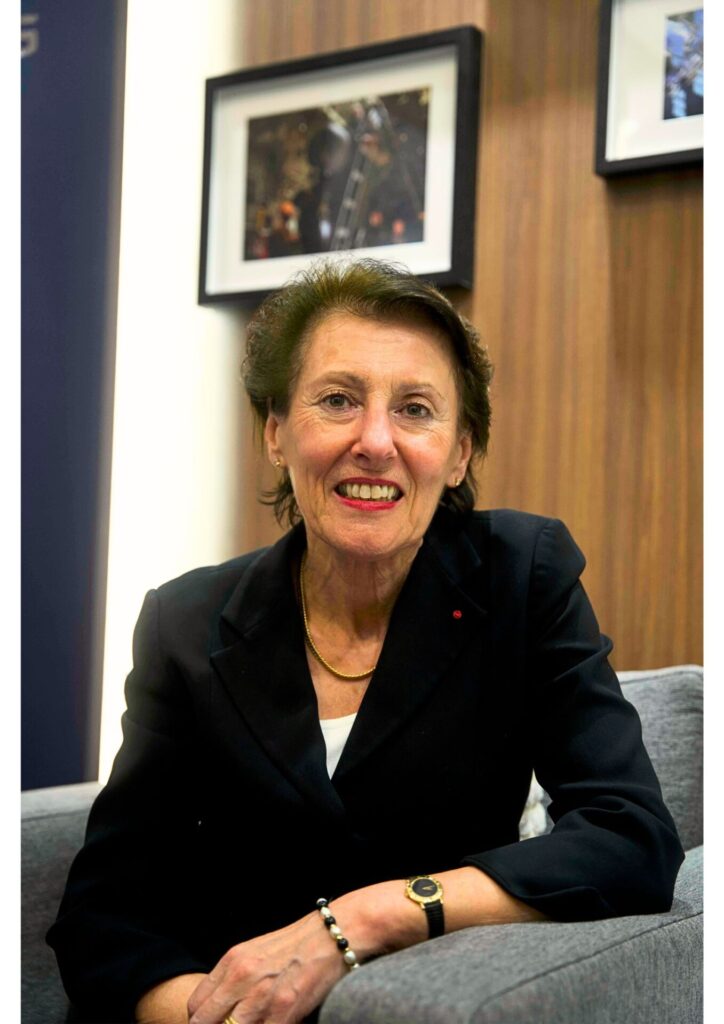
Singapore as a strategic avionics lab location for Thales
In May 2025, CAAS and Thales announced they will jointly establish an International Avionics Lab in Singapore, the first of its kind outside France. The lab is set to test and develop new avionics solutions for air traffic management and airport operations across the Asia-Pacific region and beyond.
Assouad was direct about why Thales chose Singapore for its new avionics lab. The city-state’s airspace is extraordinarily dense, with a massive volume of traffic funneled through a compact area, much of it concentrated around a single major airline. That makes it, in her words, “an ideal sandbox” for testing the technologies Thales believes will define the future of air traffic.
The core ambition is to replace the voice-based communication that still links pilots and air traffic controllers with a direct digital connection between aircraft systems and ground-based air traffic management.
“Today, the connection between those two bodies– the onboard system and the on-ground system, is the voice of the pilot on board and the voice of the controller on ground,” Assouad explained. “We need to change that to really make it seamless, much more efficient, and optimize more globally.”

AI in the cockpit: Helping pilots, not replacing them
While Assouad is clear about AI’s potential in aviation, she is equally frank about its limits. Embedding artificial intelligence into safety-critical onboard systems remains a distant prospect, she acknowledged. But that does not mean AI can’t already make flying safer.
She pointed to one immediate application: helping pilots manage system failures. When something goes wrong mid-flight, the pilot has to diagnose the issue, troubleshoot it, and figure out which redundant systems can compensate. An AI agent receiving the same data as the pilot could analyze the situation faster and, crucially, without the emotional pressure that comes with an in-flight emergency.
“Emotion-less, of course, which is very important to have a good troubleshooting of anything happening,” she said.
The second major application is trajectory optimization. An AI trained on millions of flight cases and fed real-time weather and airport congestion data can calculate the most efficient route far better than any human pairing of pilot and controller.
Assouad envisions AI agents working alongside both flight crews and air traffic controllers, always with the human making the final call.
“Agent, rather than integrated AI in the system,” she said, “to always have the pilot ultimately decide and the controller ultimately decide what they want to do.”
Flying better, not just flying less
When the conversation turned to sustainability, Assouad reframed the challenge. The question isn’t whether the industry should stop growing; it’s whether it can grow while sharply cutting its environmental impact.
She identified three levers for decarbonization. The first, sustainable aviation fuel, is largely outside Thales’s control — she can only encourage governments to incentivize SAF production. The second, new aircraft technology, demands enormous investment from both manufacturers and airlines and takes years to materialize. But the third lever is available right now: optimizing how the existing system operates.
“Singapore is a good example,” Assouad said. “You have so many holding patterns around Changi Airport. If you could eliminate that already, you would save a lot of fuel.”
She described a suite of improvements that could be implemented today: continuous descent approaches, flying at optimal altitudes, and routing aircraft to avoid the atmospheric conditions that produce contrails, those white lines that trail behind jets and contribute to warming beyond CO₂ alone.
“We can fly much better than we do today,” she said. “And I truly believe that we can do it as of now, while doing the two other major undertakings that we have to do nonetheless.”
The growing urgency around navigation security
Thales is investing €55 million to strengthen navigation systems and Assouad went on to explain the factors for this decision. GPS jamming and spoofing, where satellite signals are either blocked or imitated to mislead aircraft positioning systems, have become an escalating problem for civil aviation.
On the civil side, Thales is upgrading onboard inertial navigation systems that allow aircraft to determine their position independently of GPS. The company is also deploying anti-jamming technology that can identify interference and help systems work through it. Demand from airlines for these upgrades is growing steadily.
On the defense side, the picture is even more urgent. Positioning systems are embedded in everything from missiles to military vehicles, and European production is scaling up fast as the continent shifts toward greater regional defense self-sufficiency. Thales plans to quadruple its production capacity for these systems in the coming years.
Shattering glass ceilings in aerospace
Assouad’s career has taken her through multiple turnarounds of struggling aerospace businesses, and she has done it in an industry where women in senior leadership remain rare. Her advice to young women considering aviation careers was powerful and positive. “The sky is the limit,” she said.
She pushed back on the notion that glass ceilings in major aerospace companies are still what they once were. Large organizations, she argued, have come to understand that they cannot build their talent pipeline from only half the population.
“Resource is finite,” she said. “And you cannot rely only on the male population to recruit. But to recruit women, you have to offer them a career as well.”
The result, she believes, is an environment where the barriers are less structural than psychological.
“Ceilings are made to be broken. And I truly believe that if you wish, if you dare do it, if you do it with skill and patience, you will succeed.”
Her own path into aviation’s technical core was shaped by a deeply personal choice: she became a pilot. That experience, she said, gave her something no management course could.
“When you pilot, you are more acutely aware of what safety means,” she said.
It sharpened her understanding that every action on the factory floor, every gesture by every worker, feeds directly into the safety of an aircraft in flight. “Quality in anything we do is driving safety,” she added. “That’s really the way I manage my teams.”
She also reflected on how being a woman has influenced her leadership style, not by making her less demanding, she noted with a laugh, but by adding a layer of care for the people around her.
“It doesn’t mean that you are less demanding than a male in the same position. My team would tell you that I’m a very demanding leader. But nonetheless, you do that with respect, and that changes the way people feel about your leadership.”
A new era in aircraft design
Assouad saved her boldest prediction for last. She compared the current moment in aviation to the dawn of the jet era not just in terms of the scale of change, but in how fundamentally the industry will need to rethink what an aircraft is.
The path to achieving net zero emissions by 2050, the industry target, will not happen through incremental improvements alone. Aircraft will need to be lighter, more aerodynamic, compatible with sustainable fuels, and connected into optimized system-wide networks. But perhaps most importantly, Assouad argued, they will need to be designed differently from the start.
She drew a parallel with the automotive world’s shift toward software-defined vehicles. Aviation, she said, needs to make the same leap. The current model of spending billions to design an aircraft and then spending further billions to evolve it is simply unsustainable. Future aircraft must be built so they can be updated and improved through software, adapting far more efficiently over their lifetimes.
“I truly believe software will enable that,” Assouad said.
For an executive who has spent her career working on aircraft from nose to tail, that conviction carries the weight of experience, alongside the urgency of someone who knows the clock is ticking.